




Farmed salmon: what the Scottish postcard doesn’t show you


In October 2026 the campaign group Project Slingshot released Gaslit, an 11-minute film arguing that Scottish farmed salmon is sold on an illusion: a wild, wholesome fish from glittering lochs, when the reality underwater is crowded cages, sea lice, disease and pollution. Like the group's Tube ads about pigs and chickens, it is made to get people to look again.
We checked its claims against government data, regulators and the research. Most of what it says about the fish, the lochs and the money stands up. Where the detail is more complicated, we explain why.



Watch: Gaslit: The hidden truth about salmon farming in the UK, by Project Slingshot. The film features the broadcaster Chris Packham, the writer George Monbiot and the Scottish Green MSP Ariane Burgess, alongside campaigners and a former salmon farm worker.
What is Gaslit, and who made it?
Gaslit is the centrepiece of Project Slingshot's eight-week campaign against salmon farming, launched in October 2026 with more than 5,000 adverts on the London Underground and a call for Marks & Spencer to stop selling farmed salmon altogether, not just its Lochmuir range, reports The Grocer. Project Slingshot was set up in April 2026 by Matthew Glover, a co-founder of Veganuary, to make factory farming "socially and politically indefensible". The industry body Salmon Scotland calls it a "vegan-led activist group" with overseas funding. In response, Project Slingshot told foodfacts.org: "Our leadership team includes both vegans and non-vegans, and we're open about our funding. Most of it comes from philanthropic foundations in the U.S. that work to reduce harm to farmed animals, alongside around £150,000 in public donations."
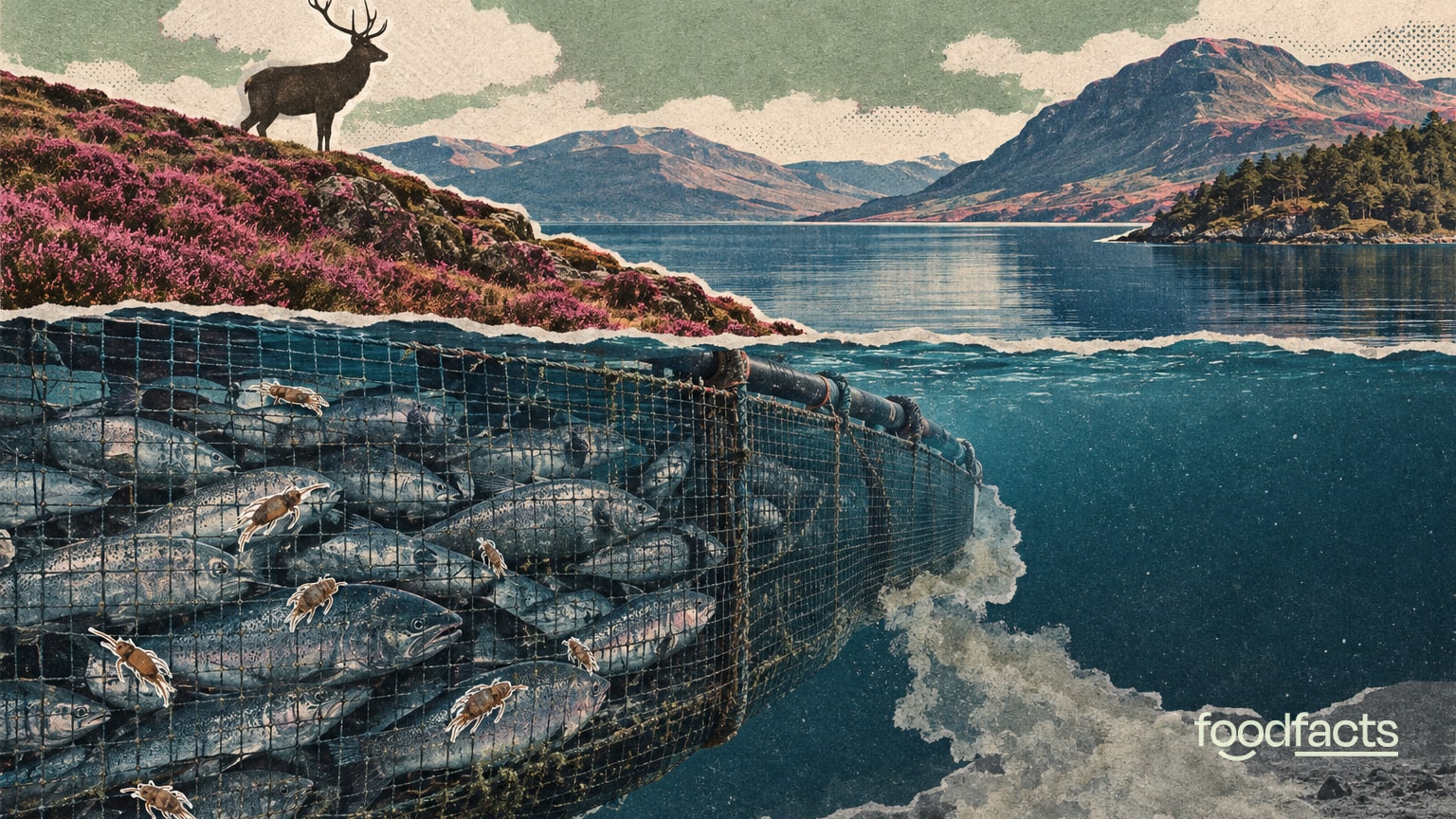
The film's argument is about image as much as welfare. Words like "aquaculture" and adverts full of heather and glittering lochs, it says, airbrush what is really factory farming, kept out of sight beneath the water. We checked what it shows against government statistics, regulators' records and the research.
How big is salmon farming in Scotland?
Bigger than most people realise. Scotland produced 197,836 tonnes of farmed salmon in 2025 and put 53.6 million young salmon into its sea farms, according to the Scottish Fish Farm Production Survey. Salmon is the UK's biggest food export, worth £828 million in 2025, with most of it sold to France and the United States.
One contributor in the film says up to 77 million fish are farmed and killed in the UK each year, 52 million of them Scottish salmon. Those figures come from Fishcount, a research project that estimates fish numbers from production tonnages and typical body weights. For 2017 it put the UK at between 28 and 77 million farmed fish, including 22 to 52 million Atlantic salmon, so the film quotes the top of each range. Dividing the 2025 tonnage in the government's production survey by a typical harvest weight of about 5 kg suggests roughly 40 million salmon are killed for food each year, on our own estimate, well within that range. Either way, it is tens of millions of animals.

Why do so many farmed salmon die?
This is where the film is on its firmest ground. Of the salmon put into Scottish sea farms in 2022, only 61.8% survived to harvest, according to the government's production survey. More than a third died first. Survival recovered to 68.8% for fish put to sea in 2023, and Salmon Scotland reports further improvement since. Even so, Animal Equality's analysis of official mortality reports counts almost 36 million deaths on Scottish salmon farms between 2023 and 2025.
The main killers are gill disease, blooms of jellyfish and plankton, warmer seas, and the stress and injuries caused by treating fish for sea lice, which often means pumping them through warm water or high-pressure washers. The official figures also leave out the wrasse and lumpfish put into cages to eat lice. The Ferret found that at least 7 million of the 22 million cleaner fish used between 2020 and 2024 died.
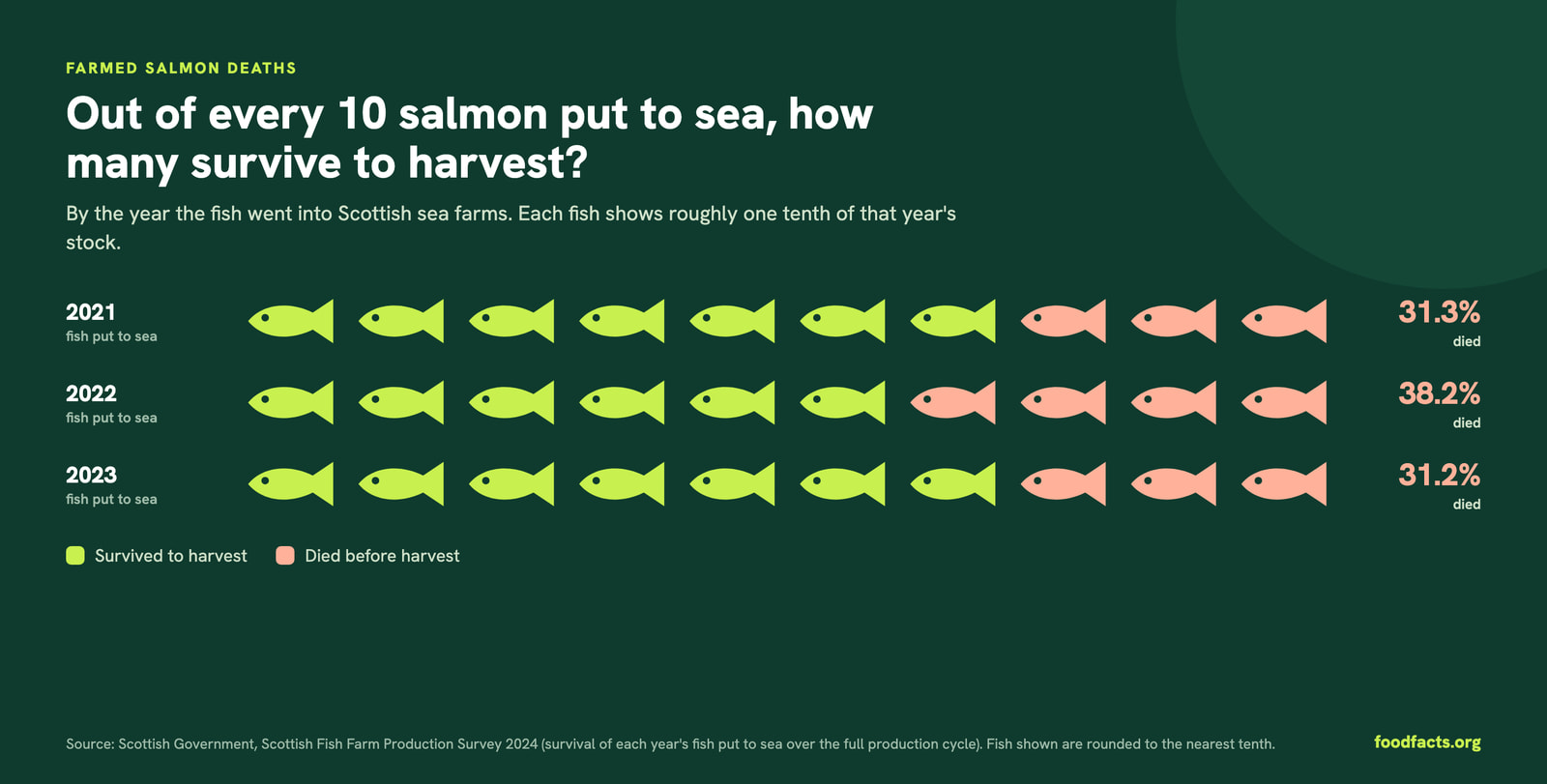
A contributor describes death rates as "sky high" and "soaring". That fits the 2022 and 2023 figures most closely, and even in the industry's better years around three in ten salmon put to sea in Scotland die before harvest.
What are sea lice, and do they harm wild salmon?
Sea lice are small native parasites that latch on to salmon and feed on their skin, mucus and blood. A wild salmon at sea might carry a few. In a crowded farm cage that is open to the loch, they can multiply fast, and heavy infestations cause open sores, stress and trouble controlling the fish's salt and water balance. Young wild salmon swimming out to sea past the farms are especially vulnerable, because a small number of lice can kill a fish that size.
The Scottish Government's own summary of the science concludes that there is a risk that sea lice from fish farms harm populations of wild salmon and sea trout on Scotland's west coast. The industry argues that climate change and conditions at sea are the bigger drivers of wild salmon decline. Both can be true at once.

Lice levels on farms are not falling. An analysis of industry data by Animal Equality and WildFish found 1,274 weekly lice counts above the industry's own limits in 2025, up from 934 in 2024.
Meanwhile wild salmon are in serious trouble. Anglers caught 28,020 salmon in 2025, the lowest since records began in 1952 and a quarter of the 2010 peak. Only about 300,000 adult salmon now return to Scotland's coasts each year, down from around a million in the early 1970s, according to the government's Status of Salmon report.
That backs up one of the most striking lines in the film: a large farm licensed for around 2,500 tonnes can hold roughly half a million salmon at its peak (our estimate, at about 5 kg a fish), more than all the wild adults returning to Scotland in a year. One line needs a caveat. When a contributor says "there is no wild-caught salmon here anymore", the point is how scarce wild salmon have become: they do still return to Scottish rivers, just in record low numbers, according to the government's 2025 fishery statistics.
Why haven't the sea lice rules fixed this?
In February 2024 the Scottish Environment Protection Agency (SEPA) brought in a sea lice risk framework to protect wild salmon. It applied first to new and expanding farms, and SEPA then moved to add lice limits to existing farms' licences. The industry appealed. By March 2025, 210 appeals had been lodged, mostly by Mowi, Bakkafrost and Scottish Sea Farms, and the new conditions are on hold until the appeals are decided. In February 2026, WildFish told the Scottish Parliament they were still unresolved.
One contributor says the industry has "clogged up" the framework so that it is not functioning. The appeals have indeed stalled the new controls on existing farms, while new and expanding farms have been covered by the framework since February 2024.
What chemicals are used on salmon farms?
Salmon farms use a range of medicines to treat lice and disease, and several are toxic to other sea life. A study commissioned by SEPA found that emamectin benzoate, a lice treatment given in feed, was linked to "substantial, wide-scale reductions" in the crustaceans living on the seabed around farms, The Ferret reported. Bath treatments such as azamethiphos and deltamethrin are highly toxic to shrimp and lobster larvae at or below the concentrations used on farms.
Formaldehyde, which the film singles out, is classed as a known human carcinogen by the International Agency for Research on Cancer, mainly because of cancers in people who breathe it in at work. On salmon farms it is used mostly against fungal infections in freshwater, in hatcheries, rather than in sea cages, so the concern is for rivers, lochs and workers rather than for people eating salmon. That concern is real: Scottish Sea Farms' Barcaldine hatchery breached its formaldehyde discharge limits on 177 days in 2024.
Under the cages, uneaten feed and faeces pile up. Poor seabed surveys are the main reason farms fail SEPA's environmental checks, and in 2019 about 40 farms were rated "poor", "very poor" or "at risk". The damage is serious but mostly concentrated within a few hundred metres of the cages, so a contributor's description of a "wasteland" where "no one can survive" applies most to the seabed directly beneath a farm.
Who owns Scotland's salmon farms?
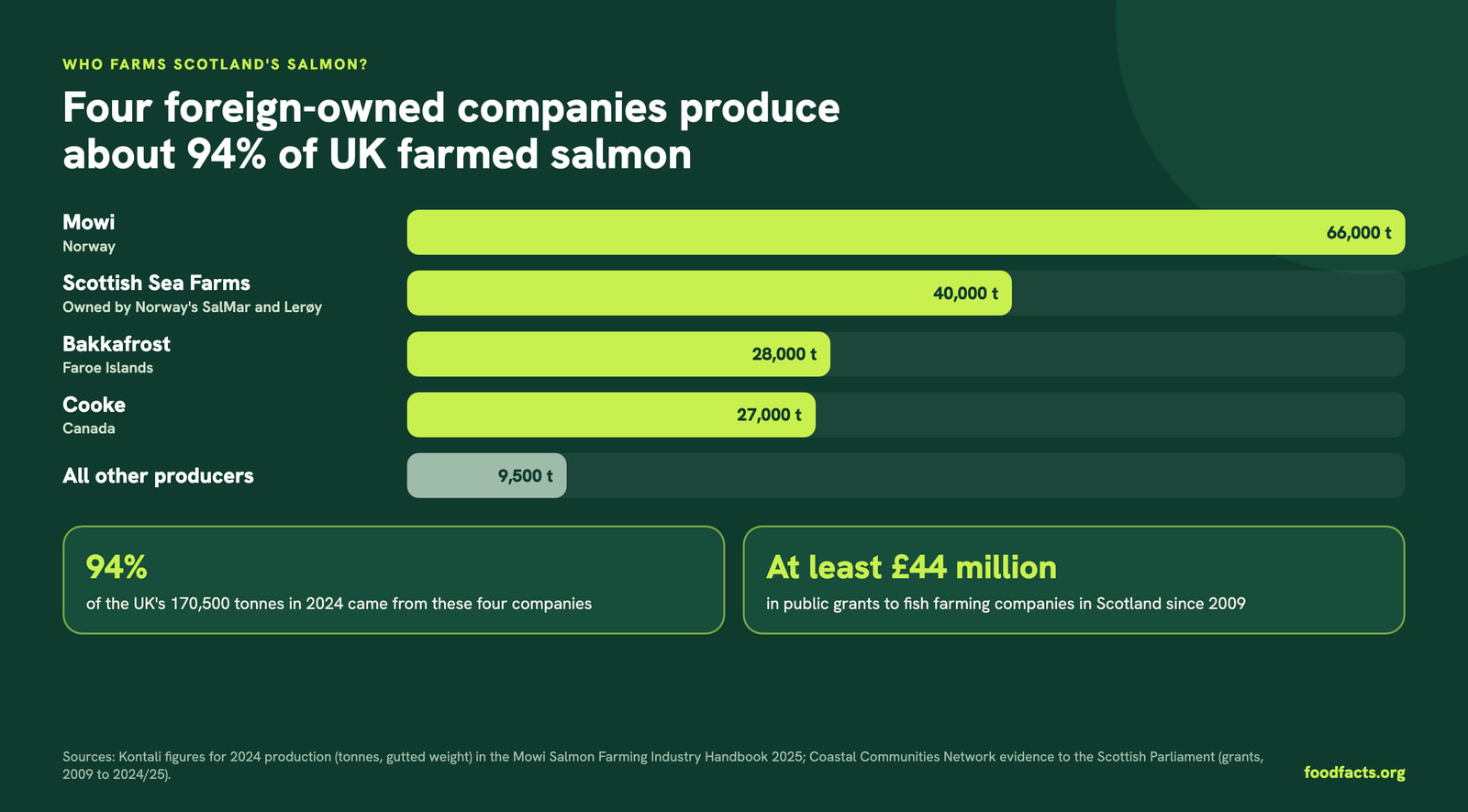
One contributor points out that none of the big salmon companies is Scottish-owned, and that is right. Four companies produced about 161,000 of the UK's 170,500 tonnes of farmed salmon in 2024, according to figures in Mowi's industry handbook: Norway's Mowi, Scottish Sea Farms (owned by the Norwegian firms SalMar and Lerøy), the Faroese company Bakkafrost and Canada's Cooke. The last independent Scottish salmon farmer, Wester Ross, was bought by Mowi in 2022, and Loch Duart has been owned by a US investment fund since 2020.
One detail is slightly different: when a contributor says "we have no Scottish salmon farms", the point is ownership. The farms themselves are in Scotland and employ people there, as the government's production survey records. It is the ownership, and most of the profit, that sits overseas.
The film also asks why such a profitable industry receives public money. It does. Mowi received £7 million and Scottish Sea Farms £5 million from the UK Seafood Fund, and the Coastal Communities Network puts public grants to fish farming companies in Scotland at at least £44 million since 2009. Project Slingshot's petition asks the UK and Scottish governments to stop using public money to fund the industrial salmon farming industry.
Is farmed salmon bad for you?
One contributor calls farmed salmon's healthy image "an illusion". The evidence on health is more mixed. Farmed salmon is still a good source of the omega-3 fats EPA and DHA, and one portion still provides the weekly amount recommended for adults, according to the researchers who track it. But the levels have fallen a long way as salmon feed has switched from fish oil to plant oils. A University of Stirling study found that EPA and DHA in Scottish farmed salmon roughly halved between 2006 and 2015.
Contaminants such as dioxins and PCBs, once a big worry, are now lower in farmed than in wild Atlantic salmon, according to Norwegian monitoring data. Farmed salmon does have a less favourable balance of omega-6 to omega-3 fats than wild fish. So farmed salmon is not "bad for you" in the way some headlines suggest, but it is not the nutritional powerhouse it was 20 years ago either. Our guide to omega-3 from fish and plant sources covers the alternatives, and we have also looked at how fish farming can breed disease and antibiotic resistance.
Why is farmed salmon pink?
Because it is fed a pigment. Wild salmon turn pink by eating krill and shrimp that contain astaxanthin. Farmed salmon get astaxanthin, usually synthetic, added to their feed, and without it their flesh would be pale, from beige to greyish white. Farmers choose the shade they want from a colour fan, dsm-firmenich's SalmoFan, much as you would choose paint. A contributor's comparison with Farrow & Ball is tongue in cheek, but accurate. The European Food Safety Authority judges synthetic astaxanthin safe for consumers at permitted levels.
Does "Scottish salmon" on the label mean wild salmon?
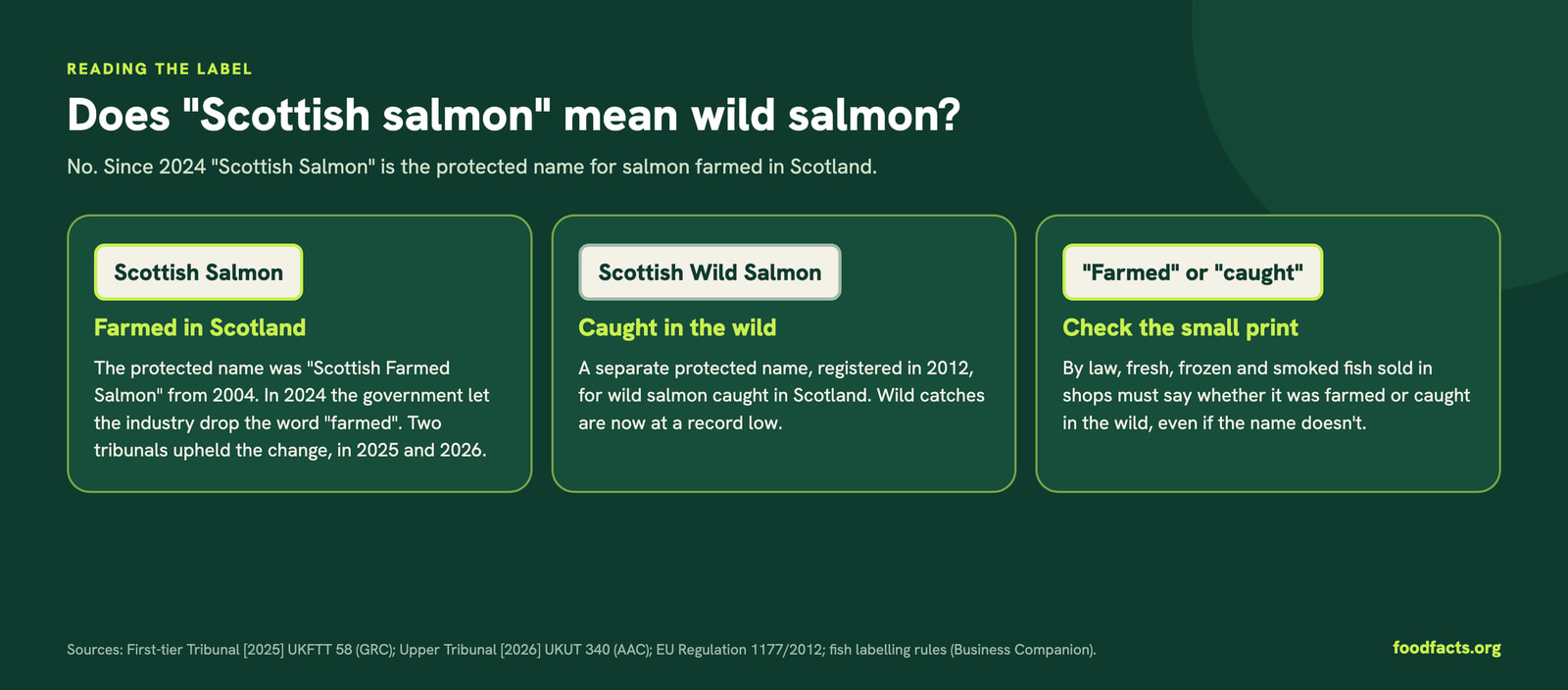
No. The history is a little different from how it's told in the film, where a contributor says the protected name used to be reserved for wild-caught fish, but the outcome is the same. The protected name, known as a PGI, was "Scottish Farmed Salmon" from 2004, and wild fish have their own, "Scottish Wild Salmon", registered in 2012. In 2023 Salmon Scotland applied to drop the word "farmed", and the government agreed in April 2024 despite 22 objections. WildFish and Animal Equality challenged the decision, but the First-tier Tribunal dismissed their appeal in January 2025 and the Upper Tribunal upheld that ruling on 31 August 2026.
So "Scottish Salmon" is now the protected name for farmed salmon, and a shopper could easily assume otherwise. The safeguard is in the small print: fish labelling rules require fish sold in shops to say whether it was farmed or caught.
The industry's marketing has been challenged before. Loch Duart dropped the word "sustainable" from an advert in 2019 after a complaint, and in 2023 WildFish and the Coastal Communities Network asked the Competition and Markets Authority to investigate "greenwashing" claims. Project Slingshot points out that M&S's Lochmuir salmon is named after a loch that does not exist. For more on what seafood labels do and don't promise, see our explainer on sustainable seafood labels.
Do fish feel pain?
One contributor says there is a scientific consensus that fish feel pain. The evidence for that is strong. Fish have pain receptors, and in experiments their pain-related behaviour is reduced by painkillers, as Lynne Sneddon's research has shown. In 2024 more than 500 scientists signed the New York Declaration on Animal Consciousness, which says there is at least a "realistic possibility" of conscious experience in fish, and UK law treats all vertebrates, fish included, as sentient under the Animal Welfare (Sentience) Act 2022. A minority of researchers, such as the neuroscientist Brian Key, still dispute that fish experience pain consciously, so "strong evidence" is the more precise way to put it. We have looked at the same questions for mussels and clams.
The bottom line
The evidence backs the core of the film: a fast-growing, foreign-owned industry with high death rates, a lice problem its own regulator is struggling to control, and wild salmon at a record low.
What can you do?
Watch and share the film, and make up your own mind. If you buy salmon, check the label for "farmed" or "caught", rather than relying on the name. If you want to go further, Project Slingshot's petition calls on the UK and Scottish governments to stop funding the industry with public money. And for the bigger picture, read why farmed fish aren't a climate solution and how fish farming can increase the pressure on wild fish.
Frequently asked questions
Is Scottish salmon farmed or wild?
Almost all salmon sold as "Scottish salmon" is farmed. Since 2024 "Scottish Salmon" is the protected name for salmon farmed in Scotland, and wild salmon has a separate protected name, "Scottish Wild Salmon". Fish labels must still say whether the fish was farmed or caught.
Is farmed salmon bad for you?
No, it is still a good source of omega-3 fats and protein, and contaminants such as dioxins are now low. But its omega-3 content has roughly halved since the mid-2000s as fish oil in feed was replaced with plant oils.
Why is farmed salmon pink?
Farmed salmon are fed astaxanthin, a pigment that wild salmon get from krill and shrimp. Without it their flesh would be pale, and farmers choose the shade they want from a colour fan.
Do salmon farms harm wild salmon?
The Scottish Government's own scientists say sea lice from fish farms pose a risk to wild salmon and sea trout on the west coast. Wild salmon catches hit a record low in 2025, although climate change and conditions at sea also play a big part.
Who owns Scotland's salmon farms?
Four foreign-owned companies, Mowi, Scottish Sea Farms, Bakkafrost and Cooke, produced about 94% of UK farmed salmon in 2024. Their owners are based in Norway, the Faroe Islands and Canada.

Independent fact-checking, funded by readers like you.
Misinformation is a growing threat to our health and planet. At foodfacts.org, we're dedicated to exposing the truth behind misleading food narratives. But we can't do it without your support.
1. Project Slingshot (2026). Gaslit: The hidden truth about salmon farming in the UK (YouTube).
2. Scottish Government (2026). Scottish Fish Farm Production Survey 2025.
3. Scottish Government (2025). Scottish Fish Farm Production Survey 2024.
4. Scottish Government (2026). Scottish salmon and sea trout fishery statistics: 2025 season.
5. Scottish Government (2025). Status of Salmon in Scotland: decline in adult salmon numbers.
6. Scottish Government Marine Directorate. Summary of information relating to impacts of salmon lice from fish farms on wild Scottish sea trout and salmon.
7. The Ferret (2025). Salmon farms lodge 210 appeals against lice controls.
8. WildFish (2026). Evidence to the Scottish Parliament Rural Affairs and Islands Committee.
9. Animal Equality UK (2026). Scottish salmon farms saw 35 million deaths over a three-year period.
10. Animal Equality UK (2025). Analysis reveals hundreds of lice breaches on Scottish salmon farms.
11. Mowi (2025). Salmon Farming Industry Handbook 2025.
12. IARC (2012). Formaldehyde, Monograph 100F.
13. Sprague M, Dick JR, Tocher DR (2016). Impact of sustainable feeds on omega-3 long-chain fatty acid levels in farmed Atlantic salmon, 2006 to 2015. Scientific Reports.
14. Upper Tribunal (2026). Animal Equality v Secretary of State for the Environment, Food and Rural Affairs [2026] UKUT 340 (AAC).
15. First-tier Tribunal (2025). [2025] UKFTT 58 (GRC).
16. The Grocer (2026). M&S urged to stop sourcing farmed salmon by Project Slingshot.
17. Fishcount (A Mood and P Brooke, 2019). Estimated numbers of individuals in aquaculture production of fish species: United Kingdom (2017).
18. Project Slingshot (2026). Petition: stop public funding of salmon farming.



foodfacts.org is an independent non-profit fact-checking platform dedicated to exposing misinformation in the food industry. We provide transparent, science-based insights on nutrition, health, and environmental impacts, empowering consumers to make informed choices for a healthier society and planet.






.svg)


.svg)

