

Can saffron tea treat depression? Here’s what the evidence shows


In a recent Instagram video, Eric Berg tells his followers that depression can be lifted with a simple drink of saffron tea. He advises his viewers to steep saffron threads in hot water, and to drink two cups daily. Along with other lifestyle advice like getting morning sunlight and avoiding sugar, he claims that mood will completely change within a few weeks. In this article, we fact-check this claim against the scientific evidence on saffron and depression.
Full Claim:
“Drink 1 cup of this to help get rid of depression. Multiple clinical trials show that this drink works as well as a standard antidepressant for mild to moderate depression without side effects. This drink contains two compounds. They're called crocin and safranal. Both of these increase serotonin, dopamine, and norepinephrine. These are essential neurotransmitters to make you feel better and to elevate your mood. And also they lower cortisol, which will then help you sleep. It's called saffron tea. Just take a small pinch of these saffron threads, steep them in hot water for 10 minutes, and drink one cup in the morning, one cup in the afternoon. Stack that with morning sunlight outside. Let the sun hit your face. Don't look into the sun. That's going to help you with the circadian waves at night. Then go on a daily walk. Make sure you don't have any sugar in your diet, and watch how your mood will completely change within a few weeks.”



Small, short trials mostly conducted in Iran (the world’s largest saffron producer) have compared measured saffron capsules with antidepressants such as fluoxetine and found no significant difference in symptom scores. However, they were too small to prove the treatments work equally well and more independent research across different populations is needed. Saffron is not free of side effects, Berg’s tea preparation has not been tested for depression, and the promise that “your mood will completely change within a few weeks” is not supported.
Depression is a common condition, and UK guidance recommends a range of evidence-based treatment options, from talking therapies, guided self-help, lifestyle changes, and when needed, medication. When a video reaching millions of followers suggests that saffron tea can replace antidepressants “without side effects” and produce a change “within a few weeks”, people most vulnerable to that message may delay or abandon other evidenced-based treatments that could help them. Saffron is however an interesting and potentially useful research area, which makes overstated claims about it all the more important to check.


When you hear “multiple clinical trials show”, ask one question: did those trials actually use what’s being recommended? Here, the studies used carefully measured saffron capsules, not a pinch of saffron threads in tea. Also, be weary of advice presented as a ‘quick fix’ - there is usually more to the story.
Claim 1: “Drink 1 cup [of saffron tea] to help get rid of depression. Multiple clinical trials show that this drink works as well as a standard antidepressant for mild to moderate depression without side effects.”
Verdict: Misleading. A real body of research exists, and some of it is encouraging, but it does not show that saffron tea works as well as an antidepressant, and it does not show that saffron works without side effects.
What the trials actually tested and found
Berg is right that clinical trials on saffron exist. Since 2004, researchers based mostly in Iran (the world’s largest saffron producer) have run small randomised trials of saffron for mild to moderate depression. A 2013 meta-analysis pooled five of these trials, all using 30 mg per day of dried saffron stigma or petal taken in capsules: saffron outperformed placebo, and there was no statistically significant difference between saffron and the antidepressants fluoxetine and imipramine. A larger, more recent study came to similar conclusions; a 2025 meta-analysis of nine small Iranian trials comparing saffron with SSRIs (fluoxetine, sertraline or citalopram) found the same pattern across the 416 participants in the depression comparisons, with fewer reported side effects in the saffron groups.
Why Berg's claims overstate the findings
Finding no significant difference between two treatments in a series of small trials is not the same as proving they work equally well. The trials behind this claim typically enrolled only 30 - 40 people per trial, lasted four to eight weeks, and many were conducted in Iran, with several by the same research group. The 2025 meta-analysis authors themselves rate the evidence as only moderate certainty and called for larger, longer and more diverse trials before concluding that saffron is as effective as antidepressants.
Saffron tea vs saffron extract
More fundamentally, these trials did not use tea. They used precisely measured doses, most commonly 30 mg per day, of dried stigmas or petals in capsules, or standardised extracts. Berg’s suggestion is a “small pinch” of threads steeped in hot water, twice a day: an unmeasured dose whose active-compound content depends on the size of the pinch, how the saffron was stored, and how much of the active compounds crocin and safranal dissolve into the water.
A randomised trial of saffron tea that found a beneficial effect on mood gave postmenopausal women one cup a day made from exactly 30 mg of dried stigmas for six weeks. However, it measured happiness rather than depression, so it cannot tell us whether tea treats depression. It also lacked blinding, meaning the control group knew if they were receiving saffron tea or the control, which increases the risk of bias. No trial has tested Berg’s suggested quantity or regimen, and his specific claim is not “shown by clinical trials”; it is untested.
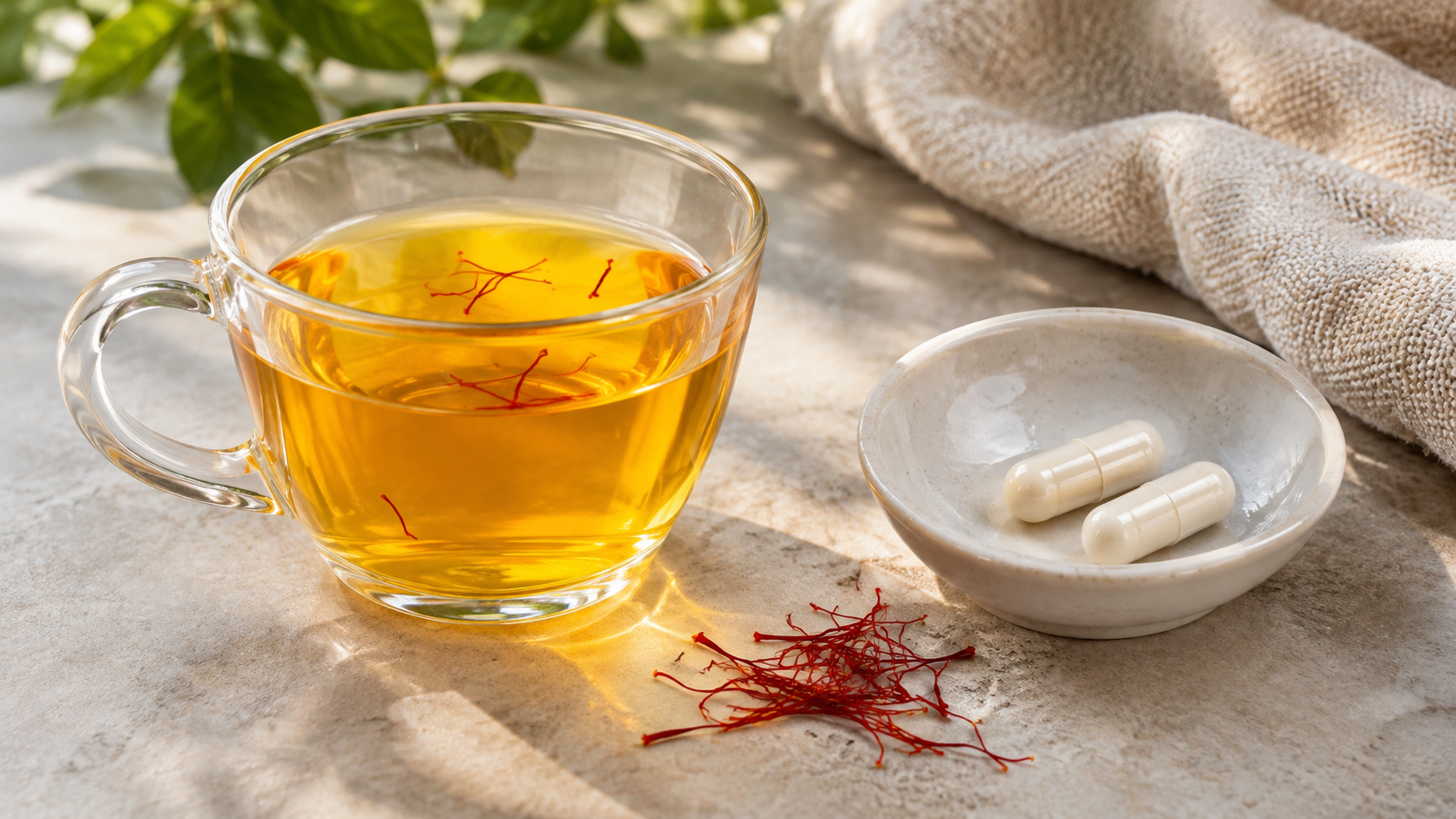
“Without side effects” is not what the evidence shows
A 2026 systematic review of human trials found that 44 of 102 trials reported adverse events; 35 reported none, while 23 did not provide safety information. The most commonly reported events were generally mild, including nausea, abdominal pain, headache and insomnia. A smaller number of reports described nervousness, restlessness and hypomania (an elevated, agitated state that may be particularly relevant for people with mood disorders).
It is important to note that an adverse event being reported does not prove that saffron caused it, particularly because events were also recorded in control groups. Nevertheless, the evidence does not support the blanket claim that saffron has “no side effects.”
The review also found that safety evidence is limited for pregnancy, older or people with multiple medical conditions, and people taking medicines, particularly anticoagulants. Therefore absence of demonstrated harm should not be interpreted as established safety in these groups.
Bottom line: There is promising research on saffron for mild to moderate depression, but it comes from small, short trials of measured preparations, not tea, and it does not establish that saffron is as effective as antidepressants or is free from side effects.
Claim 2: “Stack that [saffron tea] with morning sunlight outside. Let the sun hit your face.[...] Then go on a daily walk. [...] Don't have any sugar in your diet, and watch how your mood will completely change within a few weeks.”
Verdict: A mix of truth and overstatement. Several of the referenced lifestyle habits genuinely help mood, but combining them with saffron tea has never been tested, and the absolute promise of a complete mood change within weeks is not supported.
Morning sunlight
There is some truth here about the benefits of light for our wellbeing. Morning light helps regulate circadian rhythms which can improve energy levels and sleep quality (source). Bright light therapy is a clinical treatment using light boxes at around 10,000 lux (source) which has modest evidence for treating depression, especially in combination with other treatments (source). A Cochrane review found morning bright light in addition to another treatment such as medication or therapy outperformed control conditions, although many included studies were of short duration (source). Despite these promising results for bright light therapy, Berg’s claim refers to ordinary outdoor daylight which is not clinically dosed light therapy. Stating “let the sun hit your face” is general wellness advice, not a depression treatment.
Daily walking
Incorporating a daily walk is a well-researched way to reduce depressive symptoms. A 2024 BMJ network meta-analysis of 218 randomised trials found that walking and jogging reduced depressive symptoms compared with active controls, with effects in a similar range to other treatments examined in that review, although the authors caution that evidence quality varied and the trials have limitations. A separate meta-analysis of 75 walking trials found similar benefits compared to non-exercise controls. Regular walking is an evidence-based strategy which may help lift mood, but it is not a guaranteed cure for depression and should not be presented as a replacement for individualised clinical care.

No sugar
Cutting out all sugar to treat depression is not supported by high-quality evidence. The main research is observational: a 2024 meta-analysis of 38 studies involving more than 1.1 million people found those with the highest sugar intakes had 21% higher odds of depression. But most of these studies are cross-sectional snapshots that cannot establish that high sugar intake causes depression, and reverse causation or confounding are possible.
The advice goes beyond official UK guidance, which recommends reducing free sugars (such as those added to food and drink, including those in fruit juice and honey), rather than eliminating all sugar in the diet, including those naturally present in whole fruit and milk. Avoiding excessive intake of free sugars is sensible for general health, but expecting it to fix your mood is not evidence-based.
“Your mood will completely change within a few weeks.”
This absolute framing is a particularly problematic element of the video. Depression varies enormously in severity and many people need a combination of approaches. NICE guidance for adults with depression recommends a stepped-care approach, including options such as guided self-help, group exercise, talking therapies and where appropriate, medication. Promising a complete transformation within weeks sets expectations that the evidence cannot support, and not adequately directing viewers towards professional help is a serious omission for a video about a medical condition.
Bottom line: Walking is well supported and generally safe, and sensible morning light is reasonable wellbeing advice. But the sugar claim rests on observational associations rather than trials, and the evidence does not support the promise that this routine will “completely change” someone’s mood within weeks.

Final take-away
Taken as a whole, Berg’s video takes findings from real research on saffron and depression and re-packages them to make misleading claims about saffron's ability to improve mood or resolve depression.
The claim is misleading in many ways. He advises consumption of a different amount and preparation of saffron to what the research actually supports; he doesn’t mention that those trials were short-term, or make clear that many people with depression may need professional treatment, and that quick fixies are not a substitute for evidence-based care.
Claiming viewers’ mood would “completely change within a few weeks” is misleading in framing, and not supported by trials. It also carries potential for harm, since viewers who treat depression with saffron tea and sunshine instead of evidence-based care may delay treatment that is more beneficial for them. If you are struggling with your mood, speak to a GP or a qualified mental-health professional.
We have contacted Eric Berg and are awaiting a response.
Disclaimer
This fact-check is intended to provide information based on available scientific evidence. It should not be considered as medical advice. For personalised health guidance, consult with a qualified healthcare professional.
Independent fact-checking, funded by readers like you.
Misinformation is a growing threat to our health and planet. At foodfacts.org, we're dedicated to exposing the truth behind misleading food narratives. But we can't do it without your support.
Sources
Shafiee, A., et al. (2025). “Effect of Saffron Versus Selective Serotonin Reuptake Inhibitors (SSRIs) in Treatment of Depression and Anxiety: A Meta-analysis of Randomized Controlled Trials.”
NICE (2022). “Depression in adults: treatment and management”
Hausenblas, H. A., et al. (2013). “Saffron (Crocus sativus L.) and major depressive disorder: a meta-analysis of randomized clinical trials.”
Delam, H., et al. (2023). “The effect of Crocus sativus L. (saffron) herbal tea on happiness in postmenopausal women: a randomized controlled trial.”
Hasheminasab, F. S. et al. (2026). “Adverse Events of Saffron (Crocus sativus L.): Systematic Review of Current Evidence.”
Blume, C. et al. (2019). “Effects of light on human circadian rhythms, sleep and mood.”
Kurlansik, S. L., & Ibay, A. D. (2012). “Seasonal Affective Disorder.”
Menegaz de Almeida, A., et al. (2025). “Bright Light Therapy for Nonseasonal Depressive Disorders: A Systematic Review and Meta-Analysis.”
Tuunainen, A., Kripke, D. F., & Endo, T. (2004). “Light Therapy for Non-Seasonal Depression.”
Noetel, M., et al. (2024). “Effect of exercise for depression: systematic review and network meta-analysis of randomised controlled trials.”
Xu, Z., et al. (2024). “The Effect of Walking on Depressive and Anxiety Symptoms: Systematic Review and Meta-Analysis.”
Xiong, J., et al. (2024). “Association of sugar consumption with risk of depression and anxiety: a systematic review and meta-analysis.”
NHS (2026). “Sugar - the facts.”



foodfacts.org is an independent non-profit fact-checking platform dedicated to exposing misinformation in the food industry. We provide transparent, science-based insights on nutrition, health, and environmental impacts, empowering consumers to make informed choices for a healthier society and planet.