




Sustainable seafood labels: certification or greenwashing?




This article is the fifth and final in a series examining the myths that uphold the image of "sustainable" aquaculture, drawing on the Aquaculture Accountability Project's December 2025 report with Farm Forward, The Myth of "Sustainable" Aquaculture. Previous articles in this series have shown how aquaculture intensifies overfishing of wild species, how the industry engineered global seafood demand rather than meeting it, how fish farming breeds disease, parasites, and antibiotic resistance, and how aquaculture exacerbates, rather than reduces, climate change. Here, the focus is on the final layer of the industry's greenwashing architecture: the certification schemes, eco-labels, and consumer guides that supply the social license for industrial fish farming to continue unchecked.
What are sustainable seafood labels?
Sustainable seafood labels are voluntary certifications that claim to identify seafood produced with less environmental harm. The three biggest — MSC (wild-caught fisheries), ASC (farmed seafood) and BAP (farmed seafood and processing) — are industry-funded, set their own standards with industry input, and rely on sampling-based audits. Independent investigations consistently find weak enforcement, overstated environmental claims, and certified products that fail the schemes' own requirements.
Quick facts
- The Marine Stewardship Council (MSC) certifies wild-caught fisheries — but allows bottom-trawling, and over 90% of certifications start as "conditional" before standards are met.
- The Aquaculture Stewardship Council (ASC) and Best Aquaculture Practices (BAP) certify farmed seafood — both are funded by the industries they certify.
- A 2020 SeaChoice study found 60% of self-declared seafood sustainability claims in Canadian retailers could not be verified.
- A 2022 WildFish investigation found ASC-certified Scottish salmon farms with sea lice counts up to 30× the ASC limit — none lost certification.
- Seafood Watch's "Best Choice" rating reflects species and region — never individual farms.
How consumer concerns became a commercial opportunity
Concern over the health of the world's oceans has never been higher. A 2024 survey commissioned by the Marine Stewardship Council found that 91 percent of seafood buyers expressed concern for ocean health, with nearly half citing overfishing among their top concerns. A separate 2020 Kantar survey conducted across six countries found that between 75 and 93 percent of people considered ocean health important to their families. The seafood industry's response to this anxiety has been commercially effective: products marketed with sustainability attributes grow faster than conventional goods, and certification logos now guide procurement for hospitals, universities, and major retailers. But there is a fundamental problem with this system. Because there are no enforceable global standards defining what "sustainable seafood" means, the industry has largely been free to define its own terms and shape the certifiers that are supposed to regulate it.
MSC, ASC and BAP: what these seafood labels actually mean
Five major schemes dominate the sustainable seafood landscape, each with its own scope, governance and structural weaknesses. The table below summarises the most important differences.
LabelWhat it coversFunded byKey criticismsMSC (Marine Stewardship Council)Wild-caught fisheriesLicensing fees from certified fisheriesAllows bottom-trawling; 90%+ of certifications start as "conditional" before standards are met; 80%+ of MSC products come from destructive gear typesASC (Aquaculture Stewardship Council)Farmed seafoodLicensing fees from producers and retailersUp to 2.52kg of wild fish allowed per 1kg of farmed salmon; raised BC sea lice limit by 1,550%; permits up to 6 antibiotic treatments per cycleBAP (Best Aquaculture Practices)Farmed seafood and processingGlobal Seafood Alliance — industry trade group (founded by Cargill, Monsanto)No quantitative sea lice limit; vague antibiotic oversight; audit results not public; documented farms with 51 sea lice per fishMarinTrustFishmeal and fish oil processingMarine Ingredients Organization (IFFO — industry trade body)Certifies processing plants only, not source fisheries; accepts MSC as proxy; sourcing linked to overfished West African fisheriesSeafood WatchConsumer guide (no farm audits)Monterey Bay AquariumRates species and region only — never individual farms; aligned with ASC ratings since 2017
When "responsibly farmed" means nothing at all
The most basic layer of sustainability labeling on fish and shrimp is the self-declared claim; phrases like "responsibly farmed" or "sustainably sourced" are printed directly on packaging or menus. These terms operate in a regulatory vacuum: neither the United States nor Canada has standardized definitions or federal oversight for voluntary sustainability claims on sea animal products. A peer-reviewed investigation of Canadian seafood retailers, published in a 2020 SeaChoice report, found that self-declared environmental claims were the most common label type, yet 60 percent of those claims could not be verified, and nearly 10 percent were actively misleading, including wild salmon products labeled "no antibiotics," a claim that is meaningless for fish who have never been farmed.
.jpeg)
Mandatory disclosures fare little better. U.S. law requires sea animal products to be labeled by country of origin and by production method—wild-caught versus farmed—yet enforcement has proven so weak that misrepresentation is widespread. An Oceana DNA study found that 43 percent of salmon sold in U.S. grocery stores and restaurants was mislabelled, most commonly farmed Atlantic salmon sold as wild-caught. At the most basic levels of fish and shrimp labelling—voluntary claims and mandatory disclosures—the information reaching consumers has been shown to be systematically unreliable.
How weak standards normalize sea lice, antibiotics, and overfishing
Third-party certification schemes are marketed as the solution to unreliable self-declarations, providing rigorous, independent audits that verify environmental performance and revoke approval when violations occur. The two most widely used aquaculture certifications globally are Best Aquaculture Practices (BAP) and the Aquaculture Stewardship Council (ASC). Both have serious structural problems.
Conflicts of interest are baked in: BAP is administered by the Global Seafood Alliance, an industry group founded by seafood and agribusiness corporations, including Cargill and Monsanto. As of 2025, 42 percent of its Board of Directors represent companies that produce, process, distribute, or sell sea animal products or aquafeed, and another 27 percent are major buyers or distributors. The program is sustained primarily through membership dues and licensing fees from the companies it certifies, creating a direct financial conflict of interest. ASC presents itself as an independent body, but is similarly dependent on licensing fees from producers and retailers. This financial structure results in a ceiling on standards: if a company is removed from a certification program for failing to meet requirements, the certification body loses revenue, creating a perverse incentive to maintain membership rather than enforce rigor.
.jpeg)
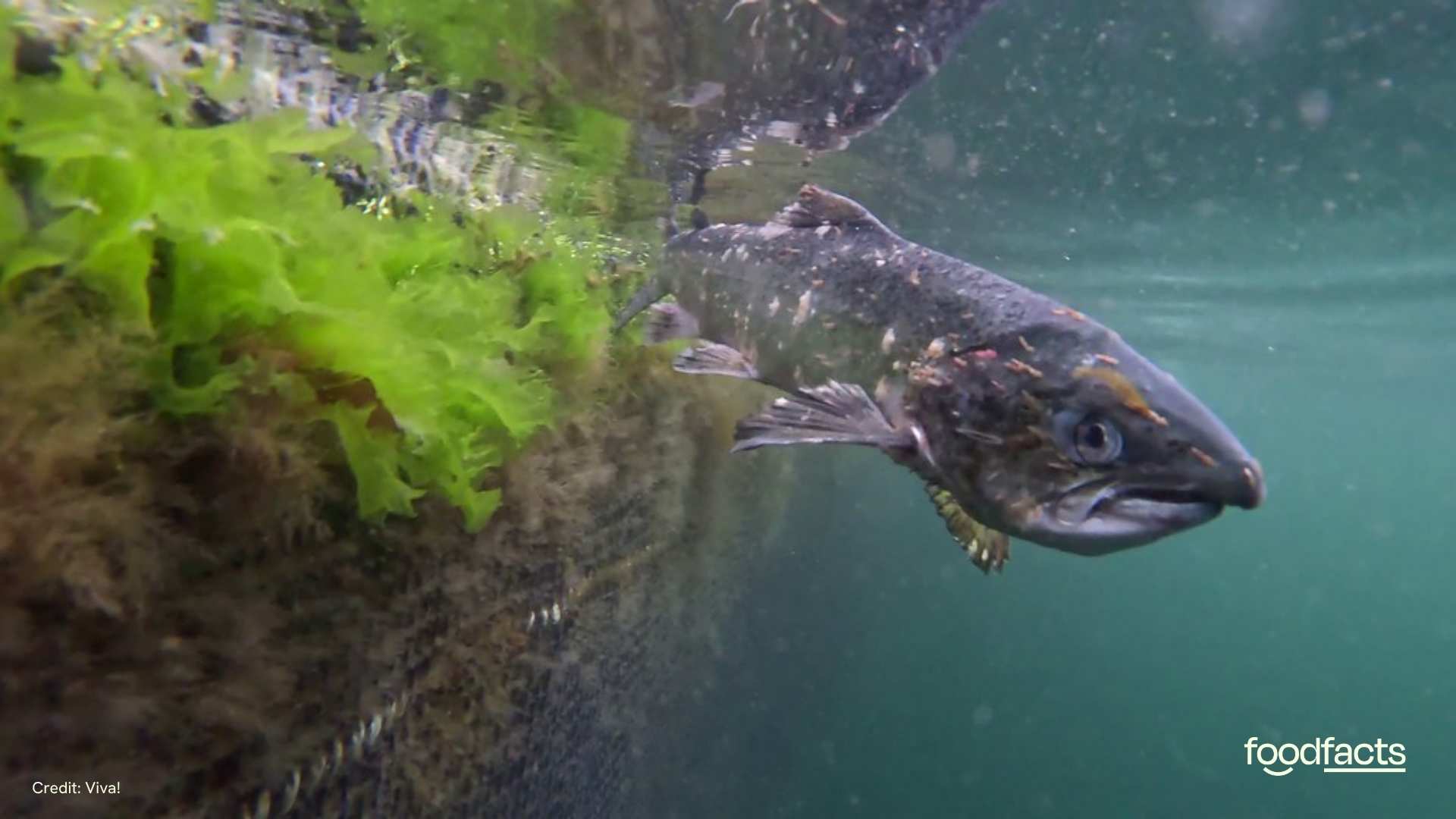
Weak standards normalize harm: As explained in a previous article, raising salmon is inherently inefficient because these fish require more wild fish in feed than what they ultimately produce. ASC's current Farm Standard (Version 1.0.1, August 2025) reinforces this inefficiency, allowing farms to use enough fish oil that producing one kilogram of ASC-certified salmon can still require catching up to 2.52 kilograms of wild fish—even as ASC proclaims on its website that it is "easing pressure on natural resources." On disease and parasites, ASC in 2022 increased its sea lice limit for salmon in British Columbia by 1,550 percent from 0.1 to 3 adult sea lice per fish, a threshold that independent researchers and environmental groups warn can be dangerous for juvenile wild salmon migrating through the same waters. BAP sets no quantitative sea lice limits at all, and environmental organizations have documented BAP-certified farms with sea lice counts as high as 51 per fish. On antibiotic use, ASC allows up to six antibiotic treatments per production cycle—a cap set in 2012 and unmodified in recent revisions, despite mounting evidence on antimicrobial resistance—while BAP requires only vague veterinary oversight without clear limits on frequency or volume.
Enforcement rarely materializes: Both BAP and ASC rely on sampling-based audits, meaning only a fraction of farms within a company group need to be physically inspected in each annual cycle. BAP does not make audit results public, making it impossible for buyers or consumers to determine whether farms that have violated its standards have been allowed to remain in the program. ASC's enforcement record is no better. In 2022, a WildFish investigation found that five out of six ASC-certified Scottish salmon farms supplying a major UK retailer averaged sea lice counts eight times higher than ASC's own limit, with some exceeding the threshold by thirty-fold, and all retained their certification. A 2018 peer-reviewed SeaChoice review of 456 ASC audit reports identified widespread inconsistencies and lenient enforcement, with many farms certified despite failing to meet several core requirements. Meanwhile, a 2024 Outlaw Ocean Project investigation of one of India's largest shrimp exporters found that the BAP-certified facility never actually purchased BAP shrimp for processing, subjected workers to dirty and crowded conditions, and falsified records to pass audits. Even after BAP withdrew the facility's certification, products bearing the label remained on store shelves.
How aquaculture outsources sustainability to flawed fishing labels
Aquaculture certifications outsource the question of responsible feed sourcing to secondary certification schemes covering the fisheries that supply fishmeal and fish oil (FMFO), primarily the Marine Stewardship Council (MSC) and MarinTrust. When certified farms purchase feed containing wild fish, aquaculture certifications like BAP and ASC do not directly certify or audit this feed supply chain. Instead, they accept assurance from certifiers like MSC and MarinTrust that these wild fish were caught sustainably—without verifying anything themselves. This outsourcing does not resolve the accountability problem; it transfers it to schemes with the same structural flaws. Essentially, one certification is just taking the word of another—both suffering from industry ties, limited accountability, and weak standards—removing yet another layer of transparency.
.jpeg)
MSC's stated mission was to reduce the environmental impact of wild-catch fisheries, but today it depends on licensing fees from the use of its logo on certified products—creating a structural incentive to maintain a healthy pipeline of certified fisheries rather than enforce stringent standards. A 2024 assessment found that more than 90 percent of MSC-certified fisheries carry conditions—ongoing improvement requirements that can remain open for years after certification is granted. Fisheries with conditions have met MSC's baseline threshold and are considered certified, but the sheer prevalence of conditional certifications raises serious questions about whether that baseline is meaningfully stringent. MSC's standards also permit bottom-trawling, among the most destructive fishing methods, and a 2023 systematic review identified 83 MSC-approved trawl fisheries. Researchers using content analysis methodology estimated that over 80 percent of MSC-labeled products come from destructive gear types.
MarinTrust is more compromised still. It was created by, and remains tightly bound to, the Marine Ingredients Organization (IFFO), the trade association representing more than half of the world's FMFO producers and 80 percent of global FMFO trade—an organization whose explicit mission is to expand the industry's growth and profitability. A Changing Markets Foundation investigation found that IFFO- and MarinTrust-linked processing plants were sourcing from overfished and poorly managed fisheries in West Africa, where weak oversight and limited traceability make illegal and unreported catches commonplace. Because MarinTrust's Responsible Supply standard applies only to processing plants, not to the fisheries actually supplying them, facilities can receive certification even when relying on depleted fish populations. The scheme also accepts MSC certification as a proxy for fishery sustainability, further obscuring the environmental cost of using wild fish for feed.
Why a "best choice" rating doesn't mean what shoppers think
Seafood Watch, operated by the Monterey Bay Aquarium, is among the most trusted consumer guides to "sustainable" sea animal product purchasing in the United States. However, due to a lack of oversight and enforcement, Seafood Watch has no way to ensure that all farms are adhering to the required standards.
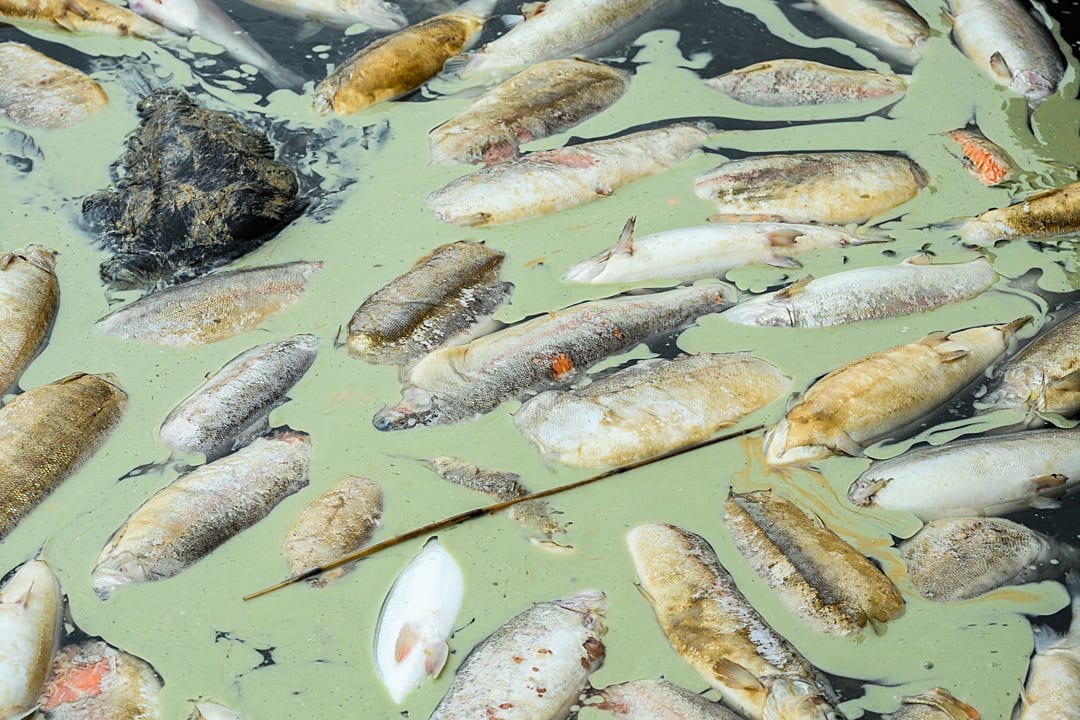
Seafood Watch rates seafood at the species and regional level, not the farm level. In conversation with the authors of the Aquaculture Accountability Project report, Seafood Watch staff confirmed that their scope is limited to region, species, and farm type, and that individual farms are never assessed or audited. As a result, farms experiencing chronic disease outbreaks, high mortality, or serious pollution violations can be hidden within a regional "Good Alternative" or "Best Choice" rating so long as the overall management system scores adequately. Seafood Watch's own Aquaculture Standard (Version A4.0) sets no mortality thresholds at all, despite routine pre-harvest mortality losses of 15 to 20 percent on salmon farms, and allows poor performance in one area, such as feed sourcing, to be offset by stronger scores elsewhere, producing favourable ratings that obscure serious ecological harms.
In 2017, Seafood Watch benchmarked ASC's salmon standard, directly applying ASC thresholds to its own aquaculture criteria. This means ASC-certified farms are automatically awarded a higher Seafood Watch rating, typically "Good Alternative," even in regions where Seafood Watch's own assessments acknowledge major ecological concerns, such as British Columbia. This alignment entangles Seafood Watch's independent standing with an industry-funded certification scheme whose conflicts of interest are well-documented. Once secured, these ratings function as much as business-to-business marketing tools as they do consumer guidance: Seafood Watch staff confirmed to the report's authors that the program operates a dedicated business team that works directly with major foodservice companies to shape sourcing policies. In this way, Seafood Watch ratings transform industry certification into institutional legitimacy, amplifying the sustainability narrative of industrial aquaculture rather than independently scrutinizing it.
What the industry hides from you
Across the spectrum, from self-declared eco-labels to third-party certifications to consumer guides, the system that is supposed to hold industrial aquaculture accountable is financed by the industry, structured to accommodate rather than constrain harmful practices, and rarely enforced in any meaningful sense. The individual people working within these systems are often acting in good faith. The frameworks they operate within were not built for that purpose.
A label saying "responsibly farmed" or a blue ASC logo on a salmon fillet encourages consumers to buy factory-farmed products under the guise of sustainability and high-welfare. It tells them very little, as the evidence reviewed in this article consistently shows, about sea lice levels, antibiotic use, pre-harvest mortality, the ecological state of the fisheries supplying the feed, or the farm's carbon footprint. For buyers at hospitals, universities, and retailers who have embedded certified aquaculture into their sustainability commitments, that is a gap worth taking seriously.
How to choose sustainable seafood without relying on labels
If no certification can fully verify environmental responsibility, what's a concerned consumer actually meant to do? The most reliable options sit upstream of the label entirely:
- Eat fewer sea animal products overall. No certification is more impactful than reducing demand for industrially-farmed fish.
- Shift toward plant-based proteins and seaweed, which deliver high-quality nutrition without the ecological burden.
- If you do buy seafood, prefer small species low on the food chain — sardines, anchovies, mackerel — which have lower bioaccumulation and don't require feeding from other fish.
- Ask retailers for traceability documentation rather than trusting a logo on the packaging. Real sustainability means farm-level data, not regional averages.
- Support policy reform. Independent verification, public audit records, and enforceable standards would do more for ocean health than any consumer label.
For the full evidence base behind this conclusion, see the rest of our aquaculture series: how aquaculture intensifies overfishing of wild species, how the industry engineered global seafood demand, how fish farming breeds disease, parasites, and antibiotic resistance, and how aquaculture exacerbates climate change.

Independent fact-checking, funded by readers like you.
Misinformation is a growing threat to our health and planet. At foodfacts.org, we're dedicated to exposing the truth behind misleading food narratives. But we can't do it without your support.
Sources & Further Reading
- MSC (n.d.). Rising Recognition in the US: The MSC Label and Sustainable Seafood in 2024
- Aquaculture Accountability Project & Farm Forward (December 2025). The Myth of Sustainable Aquaculture
- Kantar (March 2020). Public opinion survey conducted in Chile, China, Indonesia, Mexico, Japan and the US
- Roebuck, K., Foster, S., Veitch, L., & Wallace, S. (2020). Certification, Verification or Fabrication? An Investigation of Seafood Environmental Claims in Canadian Retailers. SeaChoice.
- Warner, K., & Lowell, B. (October 2015). Oceana Reveals Mislabeling of America's Favorite Fish: Salmon. Oceana. https://usa.oceana.org/reports/oceana-reveals-mislabeling-americas-favorite-fish-salmon/
- WildFish (27 April 2022). Aquaculture Stewardship Council's Accreditation Standards Worthless for Salmon Farms. WildFish, April 27, 2022. https://wildfish.org/latest-news/without-enforcement-the-aquaculture-stewardship-councils-accreditation-standards-for-salmon-farms-are-worthless/
- Roebuck, K. & Wristen, K. Global Review of the Aquaculture Stewardship Council’s Salmon Standard. Technical Report. SeaChoice, September 2018.
- On The Hook (2024). Research Brief: Conditional Certification and Associated Sustainability Claims Are a High Risk for Businesses. November 2024. https://onthehook.org.uk/wp-content/uploads/2025/02/2-On-the-Hook-briefings-high-risk.pdf
- Manach, F. L., et al (2020). Small is beautiful, but large is certified: A comparison between fisheries the Marine Stewardship Council (MSC) features in its promotional materials and MSC-certified fisheries.The Outlaw Ocean Project (20 March 2023). The Whistleblower
- R Hilborn, R Amoroso, J Collie, J G Hiddink, M J Kaiser, T Mazor, R A McConnaughey, A M Parma, C R Pitcher, M Sciberras, P Suuronen, Evaluating the sustainability and environmental impacts of trawling compared to other food production systems, ICES Journal of Marine Science, Volume 80, Issue 6, August 2023, Pages 1567–1579, https://doi.org/10.1093/icesjms/fsad115
- Changing Markets Foundation (2019). Fishing for Catastrophe.
- Desmog (4 July 2024). Revealed: Industry-Led West Africa Fishery Protection Measures Marred by Massive Conflicts of Interest. https://www.desmog.com/2024/07/04/revealed-industry-led-west-africa-fishery-protection-measures-marred-by-massive-conflicts-of-interest/
- Monterey Bay Aquarium (2020). Seafood Watch Standard for Aquaculture, Version A4.0. https://www.seafoodwatch.org/globalassets/sfw/pdf/standards/aquaculture/seafood-watch-aquaculture-standard-version-a4.pdf
- Marine Stewardship Council (2024). MSC Fisheries Standard and Guidance, Version 3.1. London: MSC. https://www.msc.org/docs/default-source/default-document-library/for-business/program-documents/fisheries-program-documents/msc-fisheries-standard-and-guidance-version3.1.pdf?sfvrsn=65e6141e_13
- SeaChoice (7 September 2022). ASC's New Sea Lice Limits Protects Industry, Not Wild Salmon.
- Global Seafood Alliance (2025). Best Aquaculture Practices Salmon Farm Standard, Issue 3.0. https://www.bapcertification.org/Downloadables/pdf/BAP%20-%20Salmon%20Farm%20Standard%20-%20Issue%203.0%20-%20FINAL.pdf
- Global Seafood Alliance (n.d.). Our Team
- Aquaculture Stewardship Council (2025). ASC Farm Standard, Version 1.0.1. https://programme-centre.asc-aqua.org/app/uploads/2025/08/ASC-STD-001-ASC-Farm-Standard-V1.0.1-Aug-2025.pdf
- SeaChoice (2024). Open letter to the Global Seafood Alliance https://www.seachoice.org/wp-content/uploads/2024/05/BAP-Open-letter.pdf



foodfacts.org is an independent non-profit fact-checking platform dedicated to exposing misinformation in the food industry. We provide transparent, science-based insights on nutrition, health, and environmental impacts, empowering consumers to make informed choices for a healthier society and planet.






.svg)


.svg)

