




Omega-3 fatty acids: evaluating the claims about fish and plant sources — and what gets left out


In a recent social media post, Barbara O’Neill makes several claims about the best sources of omega-3s in the diet. She states that “you can do superior to fish oil” and that “flaxseed is the highest source of omega-3”.
Full claim: “What are we told is the highest source of Omega-3? Fish? And yet no creature can put Omega-3 into their fatty acid chain, only plants can. So why are fish so high? Because fish are eating a one-celled algae that is high, so you can do superior to fish oil, you can get your omega-3 by foods, by plant foods. Flaxseed is the highest source of Omega-3, flaxseed and linseed are basically the same thing; Chia seeds is the second highest source of Omega-3.”



While flaxseed is high in one type of omega-3 (known as ALA), fish is a good source of two other types of omega-3 fatty acids (EPA and DHA). Only plants create omegas from scratch, and this is where fish get their omega 3s.
Understanding the sources and types of omega-3 fatty acids is important for making informed dietary choices, regardless of dietary preferences. Additionally, clarifying the role of fish and plant sources in providing omega-3s helps address misconceptions about their nutritional benefits, impacting personal health decisions.


There are Different Types of Omega-3 Fatty Acids
Before diving into the claims, it's important to understand what omega-3 fatty acids are, and that not all omega-3s are the same.
A fatty acid is a building block of fats, kind of like how bricks make up a wall. Fatty acids are found in fats and oils and are essential for many body functions.
Omega-3 fatty acids are a specific type of fatty acid that our bodies can’t make on their own, which is why they’re called essential fatty acids. We have to get them from our diet. There are three main types that are important for human health:
- Alpha-linolenic acid (ALA): Primarily found in plant sources like flaxseed, chia seeds, and walnuts (source).
- Eicosapentaenoic acid (EPA) and Docosahexaenoic acid (DHA): Primarily found in marine sources like fatty fish (salmon, mackerel, sardines) and algae (source; source).
EPA and DHA are considered the most bioactive forms of omega-3 and provide the most direct health benefits. For example, they play essential roles in cardiovascular health, brain health, and eye health. In particular, DHA is critical to a fetus' development (source).
Claim 1: “And yet no creature can put Omega-3 into their fatty acid chain, only plants can. So why are fish so high [in Omega-3]? Because fish are eating a one-celled algae that [contains it].”
Fact-check: The claim that only plants can create omega-3 fatty acids is mostly accurate. However, this does not automatically mean that fish is a ‘less efficient source’ of Omega 3s, as implied.
Microalgae (not all plants) are the primary organisms in nature that can make omega-3 fatty acids from scratch. These single-celled organisms are the foundation of the marine food chain and the original source of omega-3s.
Land plants can produce one type of omega 3, ALA, but generally cannot produce EPA and DHA directly. Animals, including fish, cannot synthesise omega-3s from scratch and must obtain them from their diet. Fish obtain EPA and DHA by consuming algae, or smaller fish that have consumed microalgae.
Claim 2: “Flaxseed is the highest source of Omega-3” and “Chia seeds is the second highest source of Omega-3.”
Fact-check: Research suggests that flaxseeds tend to have a slightly higher omega-3 content than chia seeds. However, depending on what you read, some sources may write that chia seeds have a higher omega-3 and/or ALA content, such as this recent review of chia seeds, contradicting the ranking in the claim.
But the main reason why the claim is misleading, is that it does not take into account that there are different forms of omega 3:
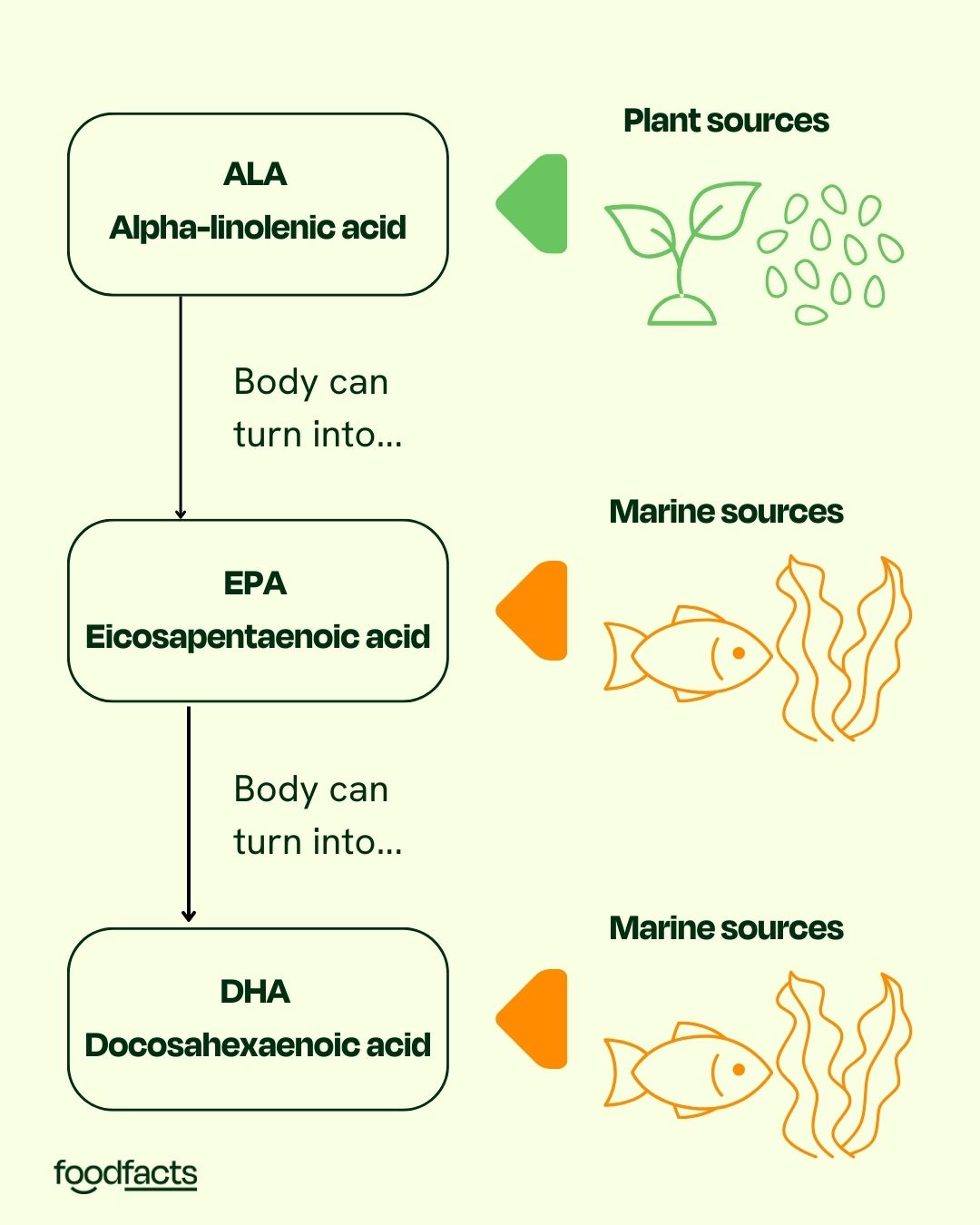
While flaxseed and chia seeds are great sources of ALA omega-3s, some fish, such as mackerel, are higher in the other omega-s DHA and EPA. Therefore, the implication that fish’s reputation for being high in omega-3 is overstated is misleading, because it overlooks the role played by EPA and DHA.
The human body can convert ALA into EPA and DHA, but only in small amounts: approximately 5-10% of ALA gets converted to EPA and less to DHA (source). This means that while flaxseed is a good source of ALA, it doesn't necessarily translate to higher levels of EPA and DHA in the body.
The body's conversion of ALA into EPA and DHA may also be lowered by high consumption of omega 6 fatty acids, as they compete for the same pathways when they are broken down.
While dietary recommendations provide clear guidance on meeting DHA and EPA requirements through oily fish consumption, there is less clarity when it comes to achieving similar levels from plant-based sources due to the body’s limited ability to convert alpha-linolenic acid (ALA) into these long-chain omega-3 fatty acids.
For individuals on plant-based diets, algae-based supplements can be a valuable option to maintain adequate omega-3 levels.
.avif)
Which Source of Omega-3s is “Superior”?
O’Neill suggests that there are better omega-3 sources than fish oil, and that “you can get your omega-3 by foods, by plant foods.” But this depends on many factors, which we discuss below. The answer will depend on several factors and also on the question being asked g. Are we thinking about health outcomes, environmental sustainability concerns, ethical issues, or something else? In this fact-check, we will focus on health considerations.
What if I Don’t Eat Fish?
Because EPA and DHA are associated with many health benefits, particularly heart health, people might worry about the low or non-consumption of fish. There are various reasons why some individuals cannot or choose not to consume fish or seafood products. These can range from financial constraints, personal taste preferences, food allergies, ethical or environmental concerns.
According to the Academy of Nutrition and Dietetics, a diet that doesn’t contain fish can be “nutritionally adequate and offer long-term health outcomes associated with cardiometabolic diseases” (source).
For individuals who don't consume fish, obtaining sufficient EPA and DHA can be managed by making sure you get plenty of ALA-rich foods in the diet, like flaxseed, chia seeds, walnuts, and oils, such as rapeseed and linseed.
Some fortified foods can also provide us with omega 3s. These include eggs, milk, yogurts, and plant-based milks. You can also get EPA/DHA from algae oils. However, recent research suggests that “the rate of ALA conversion may be sufficient to maintain adequate DHA levels through plant-sourced ALA consumption alone, although more research is warranted" (source).
The best thing to do is to consult a doctor, dietitian or registered nutritionist to advise as to whether supplementation is necessary.
The emphasis remains placed on a well-planned, varied, and nutrient-dense diet, rather than sole reliance on supplements.
Foods offer more than just their individual nutrients—they bring unique benefits to the table. Both oily fish and plant-based sources like chia and flax seeds provide valuable omega-3 fatty acids, but there’s no need to pit them against each other.
Fatty fish not only deliver a quick, affordable source of protein but also offer a rich supply of vitamin D—especially when consumed with the bones. Meanwhile, chia and flax seeds are excellent for boosting fibre intake and can easily be added to smoothies and baked goods.
Whether or not you follow a plant-based diet, incorporating seeds into your diet can have nutritional benefits.
A closer look at supplements
In some cases, supplements might be recommended to help manage or prevent certain health conditions. They can also be used during pregnancy to support foetal brain and eye development. The dosage and necessity of supplementation should be tailored to individual health needs and discussed with a healthcare provider to ensure safety and efficacy.
When choosing supplements, it’s helpful to understand the differences between fish oil, cod liver oil, and omega-3 supplements. Fish oil is derived from the tissues of fatty fish such as salmon or mackerel and is rich in omega-3 fatty acids, primarily EPA and DHA, which support heart, brain, and joint health. While fish oil has become a popular supplement, it is worth noting that studies have found that many common omega-3 fish oil supplements are rancid, which can lead to reduced efficacy and potential health risks (source).
Cod liver oil, on the other hand, is extracted specifically from the liver of codfish and contains not only EPA and DHA but also vitamins A and D, making it a nutrient-dense option for those needing additional vitamin support. However, due to its high Vitamin A content, it is not recommended during pregnancy (source).
Meanwhile, omega-3 supplements may be plant-based or derived from marine sources and typically focus on delivering ALA, EPA, or DHA individually or in combination. This means that the type and source of omega-3 should be selected according to an individual's dietary pattern, health needs, and medical advice, rather than by an assumption that one type is inherently superior.
Final Take-Away
When evaluating claims that one food is superior to another, we need to consider individual needs and preferences to make an informed decision. However, social media trends that undermine the benefits of various foods are detrimental because they do not take into account the role played by these foods on a global scale.
Fish can provide an essential source of nutrients including vitamins, minerals, essential fatty acids and protein. As a result, it can play an important role in supporting food security by providing essential nutrients that help combat malnutrition and support healthy development, particularly in vulnerable populations (source).
Meanwhile, flaxseeds and chia seeds provide fibre, omega-3 (ALA) fatty acids, and antioxidants. The notion that there is a single "right" way to eat, as is often portrayed on social media, is misleading, as dietary needs vary greatly among individuals. Social media often oversimplifies these complexities, but it's essential to recognise the diverse benefits of different food sources. By acknowledging these nuances, we can foster a more inclusive and informed approach to nutrition, one that respects both personal choices and global health imperatives.
This article was updated on April 29th to add some nuance about the conversion of ALA into EPA or DHA, taking into account the omega 3/omega 6 balance. We are working on a guide to dive deeper into this complex topic.
We have contacted Barbara O’Neill and are awaiting a response.
Disclaimer
This fact-check is intended to provide information based on available scientific evidence. It should not be considered as medical advice. For personalised health guidance, consult with a qualified healthcare professional.
Independent fact-checking, funded by readers like you.
Misinformation is a growing threat to our health and planet. At foodfacts.org, we're dedicated to exposing the truth behind misleading food narratives. But we can't do it without your support.
Sources
USDA. FoodData Central.
USDA National Nutrient Database for Standard Reference.
Basak, S. et al. (2020). “Maternal Docosahexaenoic Acid Status during Pregnancy and Its Impact on Infant Neurodevelopment.”
Kulczynski, B. et al. (2019). “The Chemical Composition and Nutritional Value of Chia Seeds—Current State of Knowledge.”
Wijendran, V. & Hayes, K.C. (2004). “Dietary n-6 and n-3 fatty acid balance and cardiovascular health.”
Cameron-Smith, D. et al. (2015). “Fishing for answers: is oxidation of fish oil supplements a problem?”
NHS (2023). “Vitamins, supplements and nutrition in pregnancy.”
Raj, S. et al. (2025). “Vegetarian Dietary Patterns for Adults: A Position Paper of the Academy of Nutrition and Dietetics.”
Lambert, R. (2024). The Science of Plant-Based Nutrition
Thilsted, S.H. et al. (2016). “Sustaining healthy diets: The role of capture fisheries and aquaculture for improving nutrition in the post-2015 era.”



foodfacts.org is an independent non-profit fact-checking platform dedicated to exposing misinformation in the food industry. We provide transparent, science-based insights on nutrition, health, and environmental impacts, empowering consumers to make informed choices for a healthier society and planet.








.svg)


.svg)

