




Gassed pigs and Frankenchickens: are the Tube ads true, and do they work?


In April, a campaign called Project Slingshot covered the London Underground with images of pigs in gas chambers and chickens bred to grow so fast they struggle to walk. Five months on, it has published an unusually candid evaluation of whether any of it is working. We read it in full, checked its key claims against independent sources and set out what the evidence does and doesn't show about its bid to make factory farming indefensible.



What is Project Slingshot?
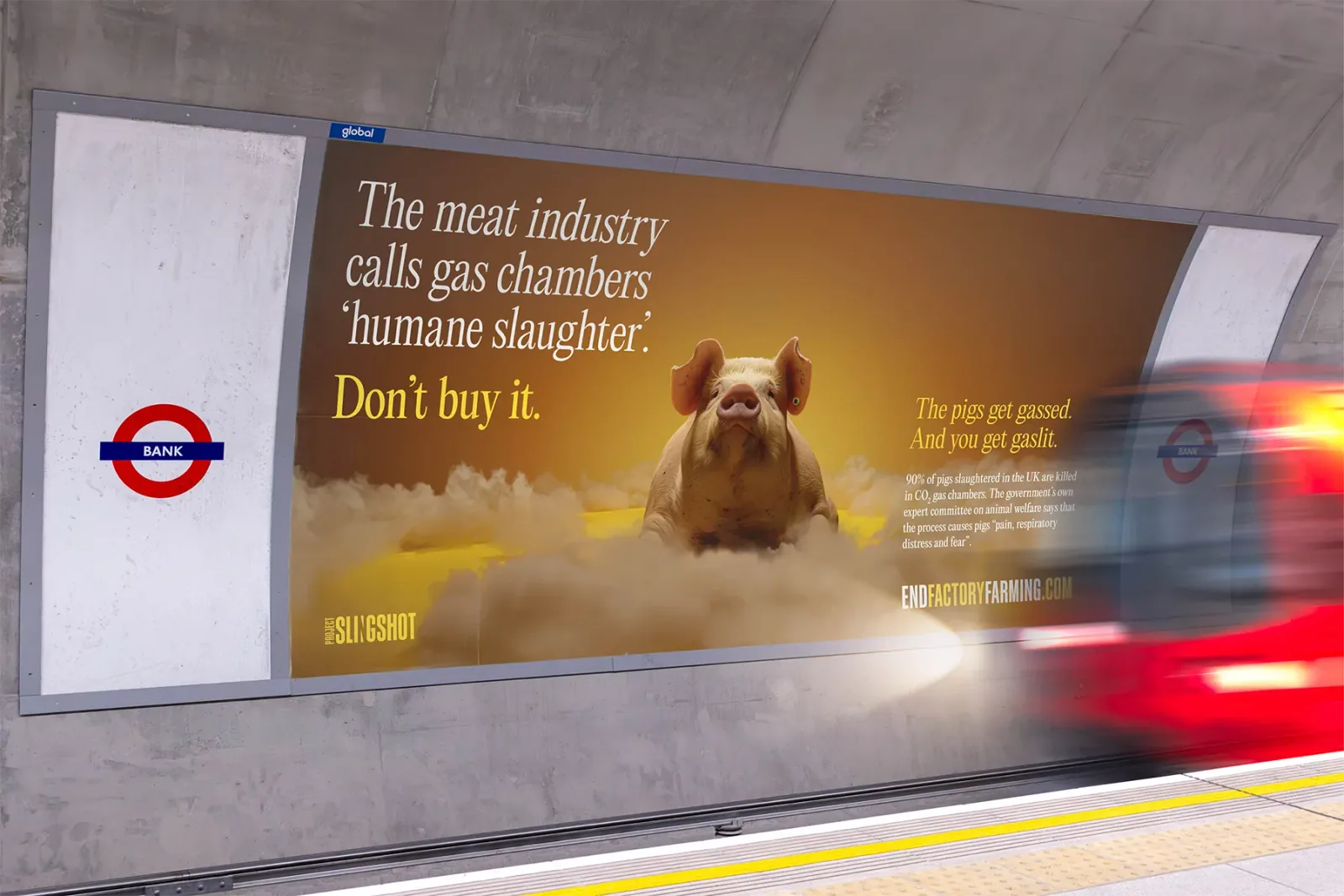
Project Slingshot is a UK campaign launched in April 2026 by Matthew Glover, the co-founder of Veganuary. According to The Grocer, it rolled out across more than 200 London Underground stations and 2,200 Tube carriages, fronted by comedians Diane Morgan and Jen Brister, TV doctor Amir Khan and others.
Its aim is not to win a single law or to persuade people to change their diets. It wants to strip factory farming of its "social licence": the quiet public acceptance that lets an industry carry on without ever having to defend itself. Its tagline, "Don't buy it", is aimed at the industry's story rather than its products, meaning the labels, the adverts and the reassurance that intensive farming is normal. What people then choose to eat is left to them.
The campaign runs in what it calls drumbeats: concentrated bursts that take one practice, put it in front of millions of people, name the companies that profit from it and give supporters a simple thing to do. The first drumbeat, from April to mid-June, targeted the carbon dioxide (CO₂) used to stun pigs at slaughter. The second, over the summer, targeted fast-growing "Frankenchickens". The third, on farmed salmon, launches on 5 October.
Slingshot says it doesn't lobby, negotiate with companies or take anyone to court. It describes itself as a pressure engine: its job is to make sure that when other organisations walk into a meeting with a retailer or an MP, the public is already paying attention.
Do its core claims stand up?
Before asking whether the campaign is working, it is worth checking what it has been putting on the walls. On both issues it has tackled so far, its headline claims are broadly accurate.
Pigs and CO₂ "gas chambers"
The claim: around nine in ten British pigs are killed in gas chambers.
What the evidence says: a Food Standards Agency survey of slaughterhouses in England and Wales found that 90% of pigs were stunned with high concentrations of CO₂, up from 52% in 2013. The pigs are lowered in groups into pits of the gas, which is aversive to breathe, before losing consciousness and being bled. The government's own advisers have objected for more than two decades. In 2003 the Farm Animal Welfare Council said the method was "not acceptable" and should be phased out within five years, and its successor, the Animal Welfare Committee, has since recommended ending it. Ministers have said they will consult on a ban as part of the Animal Welfare Strategy for England.
Our verdict: the nine-in-ten figure is accurate for England and Wales. "Gas chamber" is campaign language, but it describes a real practice that the government's advisers have criticised since 2003. Gas is used on poultry too, as we explain in our piece on chicken gassing in the UK.
Frankenchickens
The claim: fast-growing breeds make up the overwhelming majority of the 1.1 billion chickens raised for meat in the UK each year.
What the evidence says: Defra's slaughterhouse statistics put UK broiler slaughter at roughly 90 to 100 million birds a month, which adds up to more than a billion a year. The RSPCA says a handful of fast-growing breeds dominate the global chicken market, reaching slaughter weight at around 35 to 40 days old, and that their rapid growth makes leg and heart problems much more likely. "Frankenchicken" is a campaigning nickname for these birds rather than a scientific term (see our glossary entry): they are selectively bred, not genetically engineered.
The issue is very much live. In February, eight businesses running 18 restaurant chains, including KFC, Nando's and Burger King, withdrew from the Better Chicken Commitment, the welfare pledge that required slower-growing breeds, and moved to an industry-led framework that does not. Slingshot also took cameras to a KFC supplier farm for Netflix's Big Chicken documentary.
Our verdict: broadly accurate. The scale figure checks out and fast-growing breeds dominate chicken production. The nickname is emotive, but the welfare concerns behind it are mainstream.
Slingshot's film on the chicken in KFC's supply chain, which the campaign says reached 5.3 million views on Instagram:
What Slingshot's evaluation found
On 30 September Slingshot published Is Slingshot working?, a 39-minute read that draws on independent polling by the research group Social Change Lab, with a baseline taken in September 2025 before the campaign went public, alongside social media monitoring and the campaign's own figures. The headline results:
| What was measured | Result | Source |
|---|---|---|
| Awareness | Around 1 in 9 UK adults (about 6 million people) had heard of the campaign after one drumbeat, rising to about 1 in 4 Londoners | Social Change Lab poll, July 2026 |
| Where Londoners saw it | 58% of Londoners who knew of it named the Underground | Social Change Lab |
| Knowledge | Average guess of the share of pigs gassed: 54% among people who hadn't seen it, 70% among those who had (true figure: about 90%) | Social Change Lab |
| Views on gassing | 67% of those who saw it called gas chambers cruel, and 92% backed mandatory labelling | Social Change Lab |
| Online action | More than 140,000 digital actions, including 43,000 petition signatures in the first drumbeat | Slingshot's own data |
| Political reach | Over 13,000 emails to MPs in 646 of 650 constituencies; over 200 MPs replied, 85% of them supportively | Slingshot's own data |
| Audience | Social media views up from about 29 million to 54 million between drumbeats; over 100 press articles | Slingshot's own data and media monitoring |
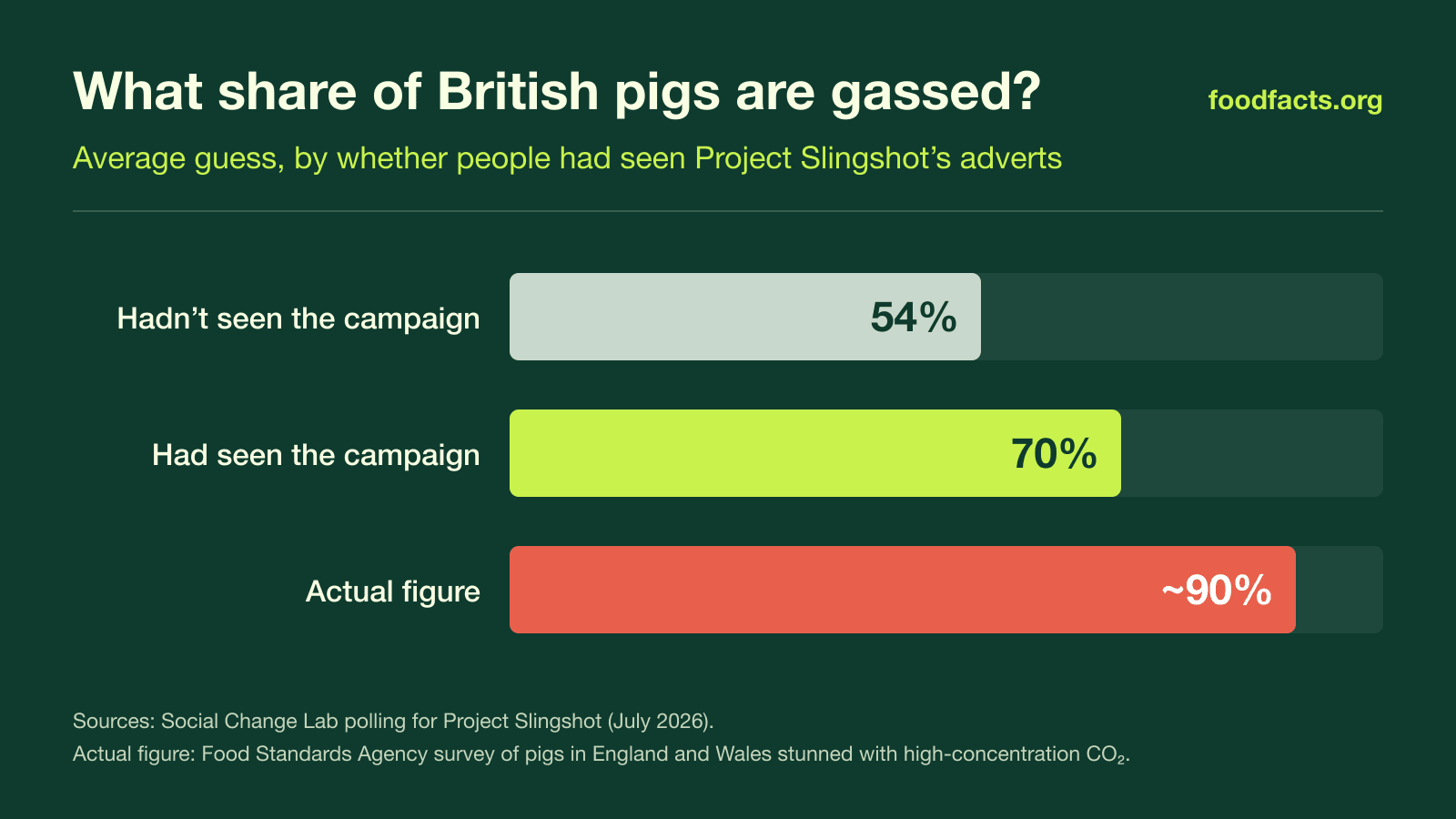
The knowledge result is the clearest evidence that the adverts did what they were designed to do. The more of the campaign people remembered, the closer their guesses got to the true figure, and the improvement was specific to the campaign's message rather than to general knowledge about farming. People who already cared about animal welfare were no more likely to remember the campaign than anyone else, which suggests it reached beyond the already converted.
The report also points to early signs of an industry on the back foot. It says Cranswick, Tesco's main pork supplier, switched off comments across its social media accounts after supporters flooded them, McDonald's UK added "gas chambers" to its comment filter and Red Tractor did the same with "Frankenchicken". The grocery trade magazine The Grocer asked in June whether meat was approaching its "tobacco moment". And two Liberal Democrat MPs who had received constituent emails through Slingshot's site raised CO₂ stunning in a Commons debate on support for pig farmers on 14 July. Slingshot is careful not to claim those emails caused it.
What hasn't worked
The most unusual thing about the report is how much space it gives to its own failures.
Opinion hasn't shifted. Around three quarters of the public opposed factory farming before the campaign and the same share did afterwards, and people who remember the adverts are no more opposed than those who don't. Support for a ban on factory farming rose from 55% to 64%, but Social Change Lab found no link between that rise and awareness of the campaign, so Slingshot doesn't claim it.
Frankenchickens fell flat compared with pigs. The chicken drumbeat ran for 12 weeks and produced just under 40,000 digital actions, against 83,000 in eight weeks for gas chambers, with less press and far fewer supportive replies from MPs. Slingshot's explanation is that the story is harder to tell, and nearly a quarter of Britons don't believe chickens are sentient, according to the RSPCA's Animal Kindness Index. It also admits that its pig adverts may simply have been better. Petition ads relaunched in September with a health angle produced its best week for signatures so far.
Engagement is broad but shallow. 95% of people who took an action took only one.
National news coverage hasn't followed. Projections onto Parliament and Buckingham Palace, joined by Green Party leader Zack Polanski, drove supporter action but little national coverage. Slingshot has since brought investigative reporters on board. Their first story, based on Freedom of Information requests, found that bird flu outbreaks have cost taxpayers more than £200 million since 2020 (for background, see our explainer on the bird flu crisis).
The movement wasn't ready to use the attention. Stickers and merchandise for grassroots activists were slow to arrive, and Slingshot admits it hadn't agreed in advance which partner organisations would follow up the opportunities its campaigns created.
The report also sets out what would prove the whole approach wrong: high awareness that never turns into support or action after two to three years, the targeted practices becoming more acceptable as people learn about them, or partner organisations being unable to use the pressure it creates.
Our analysis: what the evidence does and doesn't show
Campaign reports are usually highlight reels. This one publishes results that don't flatter it, names an independent evaluator and states in advance what failure would look like, which makes it easier to assess than most. A few limits are still worth keeping in mind.
Much of the evidence is self-reported. The polling comes from an independent organisation, but the figures on digital actions, MPs' replies and company behaviour come from the campaign itself.
Five months is early. The awareness and knowledge results show that the adverts were seen and understood, which is only the first link in Slingshot's chain. The links that matter most, such as policy change, company behaviour and what people buy, are still largely untested. An analysis of supermarket sales data, comparing London with the rest of the country, is due later this autumn.
The tobacco comparison is a hypothesis, not a result. Slingshot models itself on the US "truth" anti-smoking campaign, which a peer-reviewed evaluation credited with about 22% of the fall in youth smoking between 1999 and 2002, or roughly 300,000 fewer young smokers. As Slingshot points out, the effect only became measurable in the campaign's second and third years. That is a genuine precedent for a mass-media campaign against an entrenched industry. But food is not tobacco, and what we eat is far more bound up with culture, cost and identity than smoking ever was.
It has critics on several sides. According to the report, some vegan activists dismiss it as a welfare campaign that doesn't go far enough, some farmers feel personally attacked, and a policy director at the Association of Independent Meat Suppliers called it "ethnocentric". Questions about its funding also come up regularly: the report says more than 3,000 people have donated since launch, nearly half of them monthly, but it does not name its largest funders.
What comes next
The farmed salmon drumbeat starts on 5 October, focusing on sea lice, chemical treatments and the pigments added to feed to turn the flesh pink. Slingshot then plans to take the model to the United States, starting in San Francisco before moving to New York, Los Angeles and Washington DC.
In the UK, it is joining Foodrise, Communities Against Factory Farming and River Action for a lobby day in Parliament on 19 October, calling for a moratorium on new factory farms, and UK Voters for Animals is holding a mass lobby day on Frankenchickens on 10 November. Meanwhile, the Adfree Cities coalition Gag Big Ag is calling for an end to adverts for factory-farmed food, an idea Amsterdam has already acted on with its ban on meat advertising.
Whether Slingshot can turn quiet public disapproval into lasting pressure on companies and politicians is the question its next two years will answer. For now, it has shown that adverts can teach people something the industry would rather they didn't know.
Frequently asked questions
What is Project Slingshot?
Project Slingshot is a UK campaign, launched in April 2026, that aims to make factory farming socially and politically indefensible. It runs concentrated advertising campaigns, starting on the London Underground, that each expose one practice, such as the CO₂ stunning of pigs or fast-growing chickens.
Who is behind Project Slingshot?
It was founded by Matthew Glover, the co-founder of Veganuary. The campaign says more than 3,000 people have donated since it launched, nearly half of them monthly. Its evaluation report does not name its largest funders.
What is a Frankenchicken?
"Frankenchicken" is a campaigning nickname for the fast-growing breeds used for most chicken meat in the UK. They are selectively bred to reach slaughter weight at around 35 to 40 days old, and the RSPCA says their rapid growth makes leg and heart problems much more likely. They are not genetically engineered.
Are most UK pigs really killed with gas?
Yes, broadly. A Food Standards Agency survey found that 90% of pigs slaughtered in England and Wales are stunned with high concentrations of CO₂ before being bled. The government's animal welfare advisers called the method unacceptable in 2003 and have since recommended ending it.
Does Project Slingshot tell people to go vegan?
No. Its "Don't buy it" tagline refers to the industry's marketing rather than its products, and the campaign says it deliberately avoids telling people what to eat. It is developing a practical guide for people who want to avoid factory-farmed food.

Independent fact-checking, funded by readers like you.
Misinformation is a growing threat to our health and planet. At foodfacts.org, we're dedicated to exposing the truth behind misleading food narratives. But we can't do it without your support.
1. Project Slingshot (2026). Is Slingshot working?.
2. The Grocer (2026). Diane Morgan and other celebs front anti-factory farming push.
3. Countryfile. “Avoidable” pain, fear and significant distress (reporting the Food Standards Agency slaughter sector survey).
4. Humane Slaughter Association (2024). Press release, 15 May 2024 (quoting the Farm Animal Welfare Council’s 2003 report).
5. Vet Times. Charity hails CO2 pig stunning ban recommendation.
6. Hansard (21 January 2026). Animal Welfare Strategy for England.
8. RSPCA. Chickens reared for meat.
9. The Ecologist (2026). Food brands break Frankenchickens promise.
10. FarmingUK (2026). Fast-growing breed row erupts after firms quit Better Chicken Commitment.
11. Social Change Lab. The more people know about factory farming, the more they oppose it.
12. The Grocer (2026). Could the meat industry be about to have its tobacco moment?.
13. Hansard (14 July 2026). Support for Pig Farmers.
14. RSPCA (2026). Animal Kindness Index 2026.
15. The Grocer (2026). Zack Polanski backs campaigners calling for CO2 stunning ban for pigs.
16. Food Manufacture (2026). Poultry sector criticised as £200m taxpayer burden from bird flu uncovered.
17. Farrelly MC, Davis KC, Haviland ML, Messeri P, Healton CG (2005). Evidence of a dose-response relationship between “truth” antismoking ads and youth smoking prevalence. American Journal of Public Health.
18. UK Voters for Animals (2026). Lobby day 2026.



foodfacts.org is an independent non-profit fact-checking platform dedicated to exposing misinformation in the food industry. We provide transparent, science-based insights on nutrition, health, and environmental impacts, empowering consumers to make informed choices for a healthier society and planet.






.svg)


.svg)

