

Is healthy eating as simple as organic food and no seed oils?


In an Instagram reel posted by the chiropractor Daniel Pompa, he argues that eating healthy is as simple as only eating organic foods and avoiding seed oils.
Organic foods have not been shown to provide a clear overall health advantage over conventionally grown produce. Seed oils, particularly when replacing saturated fats, have been associated with lower cardiovascular risk. The claim that glyphosate leads to leaky gut syndrome is not supported by strong human evidence, and leaky gut syndrome is not a recognised medical diagnosis.
He states that the issue with non-organic food is that it contains glyphosate, which interacts with a compound called zonulin in the gut, causing the gut to ‘open up,’ a process which results in symptoms and eventually leads to autoimmune conditions.
Full Claim: “Eating healthy can be this simple. [...] If you keep it this simple, this will change your health for you and your family. Here’s how simple it can be. Eat all organic. I know it's more expensive, but here's the problem: glyphosate, the chemical glyphosate, is in everything that’s non-organic in the US. [...] That chemical, it hits something in your gut called zonulin; it opens up the gut, causes symptoms, and drives autoimmune eventually. You have to avoid the glyphosate. Number two: get rid of all seed oils. You do those two things: you get rid of the chemical glyphosate, you eat all organic, and you eat seed oil-free; watch what happens to your health. It is that simple; it really is that simple.” [...]



Organic foods have not been shown to provide a clear overall health advantage over conventionally grown produce. Seed oils, particularly when replacing saturated fats, have been associated with lower cardiovascular risk. The claim that glyphosate leads to leaky gut syndrome is not supported by strong human evidence, and leaky gut syndrome is not a recognised medical diagnosis.
Claims such as these create fear or distrust around some foods and promote the restriction of certain foods and food groups. Unnecessarily restricting your diet can do more harm than good, potentially resulting in deficiencies or disordered eating, which can have a significant negative impact on health.


Claim 1: Glyphosate “hits something in your gut called zonulin; it opens up the gut, causes symptoms, and drives autoimmune eventually.”
Fact-check: This claim is misleading because it oversimplifies and generalises preliminary findings in animal studies and studies on specific health conditions in humans to the general population.
When health influencers discuss the gut ‘opening up’, they are often referring to a condition called ‘leaky gut’, which is not a recognised medical diagnosis, although increased intestinal permeability is a real phenomenon (source).
To understand where the term ‘leaky gut’ comes from, it is important to first understand the makeup and function of the gut barrier, which is thought to be altered in this condition. The gut barrier refers to the complex multi-layer system of the intestinal tract (the small and large intestine), which together measure, on average, around 8 meters (or 26 feet).
The gut barrier is made up of:
1. a mucous layer
2. a row of cells called the epithelial cell barrier
3. the intestinal immune system, made up of immune cells ready to fight incoming pathogens
The gut barrier must be able to serve two opposite functions: first, to allow necessary nutrients to be absorbed into the body, and second, to prevent harmful pathogens from getting across the barrier into the immune system, causing an inflammatory response.
The amount of space between the cells of the epithelial cell barrier and the ease with which substances can move through the gaps between cells and into the intestinal immune system is called the intestinal permeability of the gut. Everyone needs to have a gut barrier that is semi-permeable to allow for nutrients from food to be absorbed (source).
‘Leaky gut syndrome’ is thought to occur when the space between cells of the gut barrier becomes too wide, and more pathogens are able to move from inside the gut to the intestinal immune system. In other words, the intestinal permeability of the gut is heightened (source).
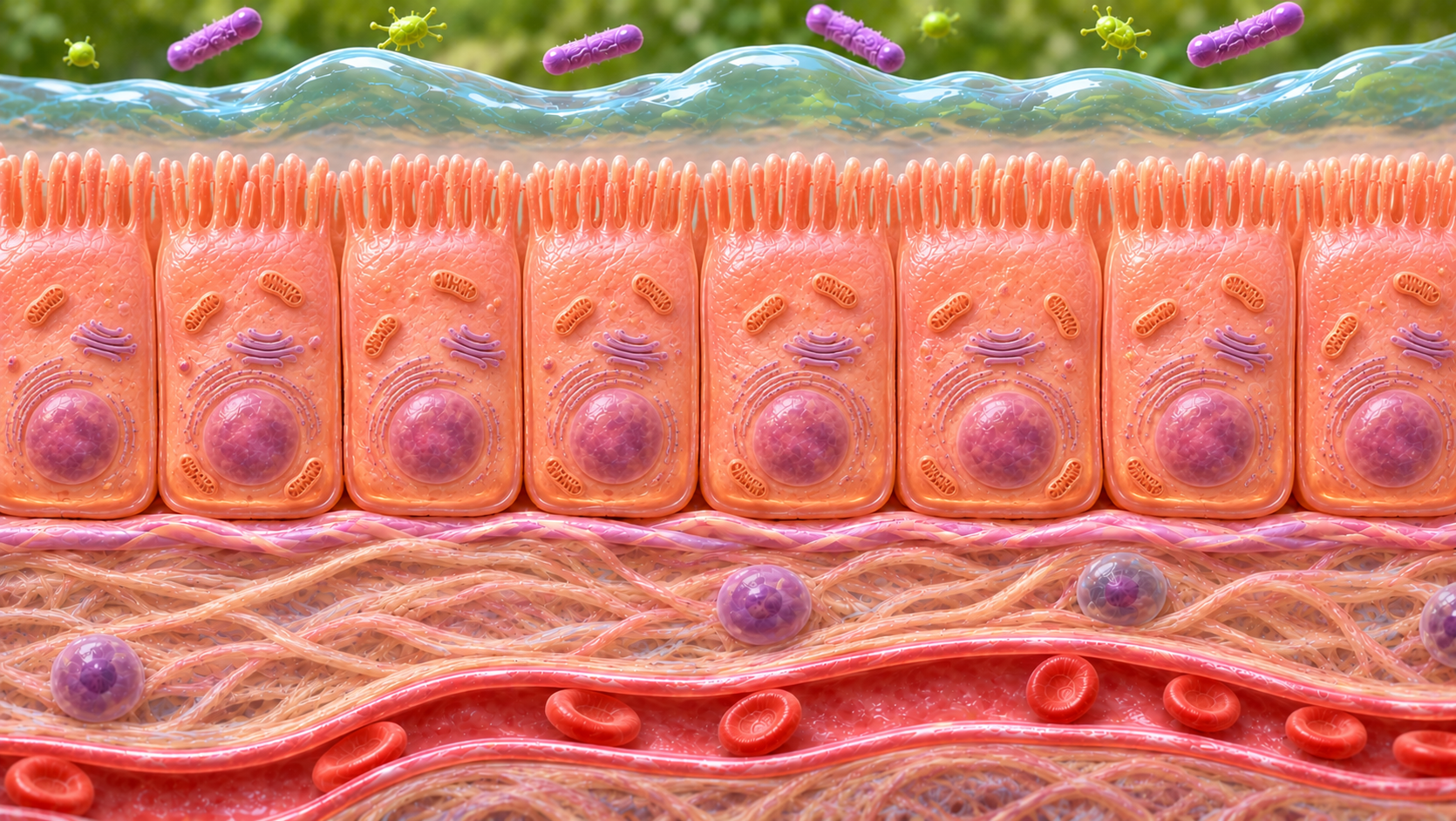
One way the gap between cells of the gut barrier could be widened is through dysregulation of the protein zonulin, which is involved in regulating the space between these cells. It is thought to be a possible biomarker that can be used to determine intestinal permeability (source). However, recent research has shown that commonly used commercial blood tests used to assess the amount of zonulin in someone’s blood may not specifically detect zonulin and may measure other proteins instead. This means that results using these methods should be interpreted cautiously.
There is a theory that zonulin expression can be impacted by dietary exposure to glyphosate, but this claim has not been proven in human studies. An animal study on rats used serum zonulin levels as an indicator of intestinal permeability following exposure to glyphosate at the acceptable daily intake level and found an increase in the protein, suggesting increased intestinal permeability. However, this does not establish that glyphosate increases intestinal permeability or causes disease in humans.
Proponents of ‘leaky gut syndrome’ assert that the widening of the gap between cells of the gut barrier leads to the ‘leaking’ of harmful pathogens from your gut into your body, causing inflammation and related symptoms (such as bloating, abdominal pain, fatigue, headache) and a range of chronic conditions, from autoimmune diseases such as type 1 diabetes to fibromyalgia, allergies, asthma and chronic fatigue syndrome (source).
However, there is currently little evidence that the symptoms commonly attributed to ‘leaky gut’ are directly linked to increased intestinal permeability (source). There is also not enough evidence to establish that ‘leaky gut syndrome’ plays a role in the pathogenesis of any of the above conditions. Some research has found an association between increased intestinal permeability and conditions such as inflammatory bowel disease (IBD) and coeliac disease, although it remains unclear whether increased permeability is a cause or a consequence of these conditions.
Claim 2: “Eat all organic. [...] get rid of all seed oils. [...] It is that simple.”
Fact-check: This claim is misleading because it isn't supported by the evidence on organic food or seed oils, and it reduces healthy eating to two arbitrary rules.
Daniel Pompa claims in his video that eating all organic and removing seed oils from your diet will change your health. The problem with this claim is that:
1. Organic food has not been shown to provide a clear overall health advantage to non-organic food and is often more expensive.
2. Current evidence does not support avoiding seed oils, and they can be part of a healthy diet.
3. A healthy diet can’t just be reduced to two dietary rules, no matter if those rules have merit or not.
Is organic food healthier?
Organic food is grown without the use of genetic engineering, and with restricted use of pesticides and fertilisers (source). There is a common belief that the nutrient content and safety of organic foods is higher than in conventional ones, but a review of research found that most studies found no meaningful difference between the two groups.
In some instances, organic crops may contain a higher nutrient content and/or lower levels of certain contaminants than their conventional counterpart, but in other instances, the conventional crop may have a better nutrient and heavy metal profile than the organic version (source).
Promoting only eating organic foods may limit an individual’s ability to consume a wide variety of foods due to finances (organic tends to be more expensive) or lack of access (many shops may not have organic options). Eating a wide variety of fruits and vegetables every day is more important than whether these are organic or conventionally grown (source).
To learn more about what the research says about glyphosate, a herbicide used in conventional farming, read our explainer on whether glyphosate is dangerous.

Are seed oils bad for you?
Seed oils have long been controversial for claims that their intake causes inflammation due to their higher content of omega-6 fatty acids, particularly linoleic acid.
A systematic review and meta-analysis found that higher linoleic acid intake was associated with a lower risk of mortality, cancer, and cardiovascular disease. Swapping in unsaturated fats such as seed oils for saturated fats such as butter and lard has long been recommended by public health guidelines to support cardiovascular health (source, source).
Telling people to avoid seed oils without strong supporting evidence may lead to individuals avoiding these products and replacing them with saturated fats, which goes against the current dietary recommendations.
Our foodfacts.org fact-check on whether seed oils cause inflammation breaks down the evidence further.
Can healthy eating be reduced to two rules?
Reducing what makes a healthy diet to a couple of dietary rules, no matter if they are backed by scientific evidence or not, can make it seem like there is a quick fix to healthy eating and distracts from broader health-promoting choices, behaviors, and dietary patterns.
Recent guidance from the American Heart Association highlights the importance of focusing on overall dietary patterns over single foods or nutrients. It recommends choosing more fruits and vegetables, healthy proteins, whole grains, and unsaturated fats while minimising added sugars, salt, alcohol, and ultra-processed foods.
The British Heart Foundation has similar guidance, stating that ‘healthy eating isn’t about cutting out or focusing on individual foods or nutrients,’ but rather looking at the whole diet, eating a variety of foods in the right quantities.

Final take-away
What makes a healthy diet can vary from person to person based on factors including age, sex, body composition, budget, culture, health conditions, and access to foods. There is no one “healthy” diet that works for everyone, and no diet can prevent or cure every health condition. Nutrition is just one component that influences health, but many other factors play a role as well, including physical activity level, genetics, smoking status, air quality, access to quality medical care, and many other lifestyle, physiological, and socioeconomic factors.
For most people, eating a balanced diet with a variety of foods is a useful foundation for ensuring that you are getting the nutrients you need. Advice online that recommends cutting out certain foods or food groups misses the nuances of nutrition, as all foods can fit into a balanced and varied diet.
We have contacted Daniel Pompa and are awaiting a response.
Disclaimer
This fact-check is intended to provide information based on available scientific evidence. It should not be considered as medical advice. For personalised health guidance, consult with a qualified healthcare professional.
Independent fact-checking, funded by readers like you.
Misinformation is a growing threat to our health and planet. At foodfacts.org, we're dedicated to exposing the truth behind misleading food narratives. But we can't do it without your support.
Sources
• Hounnou, G. et al. (2002). “Anatomical study of the length of the human intestine.”
• Lacy, B. et al. (2024). “Leaky Gut Syndrome: Myths and Management.”
• Assimakopoulos, S. et al. (2018). “The Role of the Gut Barrier Function in Health and Disease.”
• Vanuytsel, T. et al. (2021). “The Role of the Intestinal Permeability in Gastrointestinal Disorders and Current Methods of Evaluation.”
• Ajamian, M. et al. (2019). “Serum zonulin as a marker of intestinal mucosal barrier function: May not be what it seems.”
• Mesnage, R. et al. (2026). “Impact of glyphosate and its mixture with 2,4-D and sicamba on gut biochemical function, intestinal barrier integrity and microbiome composition in adult rats with prenatal commencement of exposure.”
• Thaise de Oliveira Faoro, D. et al. (2024). “Are organics more nutritious than conventional foods? A comprehensive systematic review.”
• Li, J. et al. (2020). “Dietary intake and biomarkers of linoleic acid and mortality: systematic review and meta analysis of prospective cohort studies.”
• NHS. (2023). “Fat: the facts.”
• British Heart Foundation. (2023). “Healthy food swaps.”
• American Heart Association. (2026). “2026 Dietary Guidance to Improve Cardiovascular Health: A Scientific Statement From the American Heart Association”
• British Heart Foundation. (2023). “Healthy eating.”
• NHS. (2026). “Eating a balanced diet.”



foodfacts.org is an independent non-profit fact-checking platform dedicated to exposing misinformation in the food industry. We provide transparent, science-based insights on nutrition, health, and environmental impacts, empowering consumers to make informed choices for a healthier society and planet.