




The carnivore diet's rise and crash is a lesson in how misinformation sells


Google search interest in the carnivore diet has collapsed back to where it stood before its 2022 surge, while steadier vegan-diet interest has quietly ticked back up. This opinion piece, prompted by a recent presentation from YouTuber Mic the Vegan at Vegan Camp Out UK, unpacks why the all-meat diet boomed, why it's bombed, and what its trajectory says about health misinformation, industry funding and the fragility of internet-driven wellness trends.



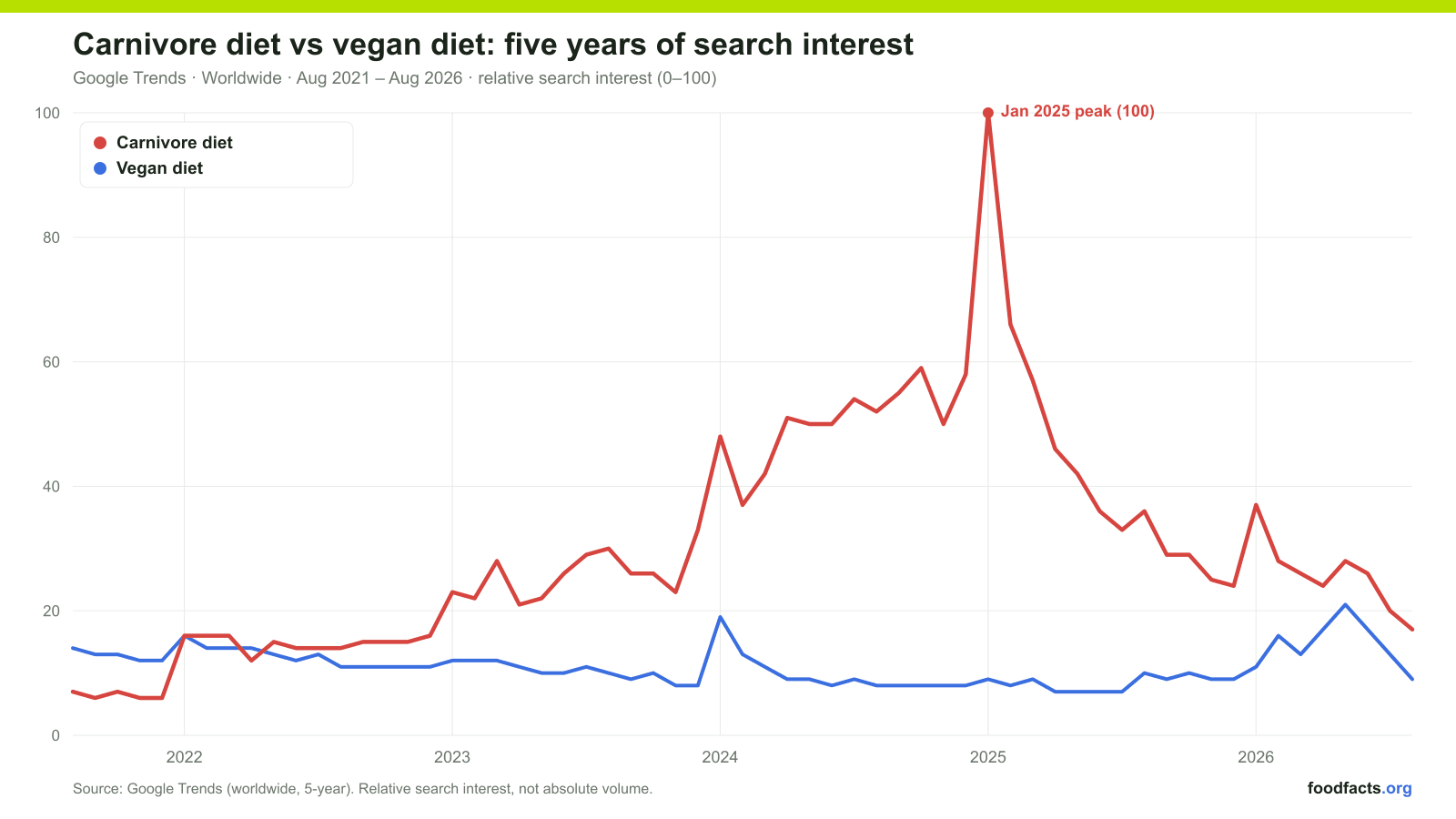
For a few years, the meat mania felt inescapable. Podcasters swore by it with jars of tallow in hand, influencers built entire brands on it, and “steak and butter” became shorthand for a certain kind of misguided biohacking machismo. Now the carnivore diet has cratered. UK search volume for the term fell roughly 74% between 2025 and 2026, one of the sharpest declines of any major diet trend tracked that year. In the US, Google Trends data shows the same pattern: a slow climb from 2022, a sharp peak in 2025, and a rapid fall back to baseline. It was total carnivore collapse.
I think that arc deserves scrutiny, not just celebration by vegans. A diet built almost entirely on meat, salt, and water captured global attention for three years despite having a research base you could read in an afternoon. Understanding why it worked, and why it stopped working, tells us something uncomfortable about how health trends actually spread, and how to stop there being a second coming of this brand of hyper-carnism.
Vegan interest was never close to disappearing
One narrative that took hold alongside the carnivore boom was that veganism was dying, that plant-based eating had had its moment and lost. The search data tells a more interesting story. Yes, ‘carnivore diet’ searches climbed hard and, at their January 2025 peak, ran far ahead of ‘vegan diet’ searches, hitting the maximum score of 100 while vegan sat in single digits. But that was a fad spike, and it behaved like one: it has since collapsed by around three-quarters. Vegan-diet interest, by contrast, stayed low but remarkably steady across the whole period, and has ticked upward again through 2026. The carnivore diet’s entire multi-year cycle amounted to a bacon-powered blip; one line spiked and crashed, the other held its ground.
That matters because a fad and a settled habit leave very different traces. A burst of curiosity-driven searching fades as fast as it arrives; an established way of eating doesn’t spike because it isn’t news. Plant-based food companies did suffer a genuine market correction (more on that below), but that reflects speculative investment cycles more than collapsing interest in eating this way. Conflating a search spike, or a share price, with the underlying direction of travel was, and still is, a mistake worth correcting.
Why the diet took off in the first place
The carnivore diet’s success wasn’t really about nutrition science. It was about a broken healthcare system and a well-funded industry willing to capitalize on that gap, as well as a cultural drive to eat high-status, animal-based foods.
In the US, people frustrated by inaccessible or unaffordable medical care increasingly took a do-it-yourself approach to chronic illness, gut problems and autoimmune conditions. That desperation created fertile ground for a diet promising simple, dramatic fixes. It’s a pattern nutrition misinformation exploits again and again: when official guidance feels distant or unhelpful, an anecdote-driven alternative with a confident spokesperson can seem more trustworthy than a cautious clinical guideline, even when the guideline is the one backed by evidence. A doctor saying “you don’t need to eat vegetables” is a dream come true for a certain subset of the population.
Money mattered too. Meat and livestock represent a roughly $1.5 trillion global industry, one with the resources to fund favourable research, sponsor podcasters and bankroll subscription meat-delivery services that pay influencers directly (source, source). Plant-based advocacy operates on a comparatively tiny budget. That funding imbalance doesn’t make carnivore claims true, but it explains why they got so much airtime relative to their evidence base.
The science never caught up with the hype
This is where the carnivore diet’s central weakness sits. Vegan and plant-based eating patterns have been studied in thousands of peer-reviewed papers (source, source). Carnivore-specific research amounts to a few dozen studies, several of them case reports rather than controlled trials, and a number of them reporting concerning results.
A 2026 scoping review in the peer-reviewed literature put it plainly: the carnivore diet “may offer short-term health benefits but carries substantial risks of nutrient deficiencies, reduced intake of health-promoting phytochemicals, and the development of cardiovascular disease,” concluding that “at this time, long-term adherence to a CD cannot be recommended.” The British Heart Foundation reaches a similarly blunt verdict, stating outright that it does not recommend the diet.
One frequently cited “Harvard study” claiming a carnivore diet improves 90% of diseases doesn’t hold up to scrutiny either. The underlying paper was a 2021 self-reported social media survey of over 2,000 people who had already chosen to follow the diet, a design riddled with selection and recall bias. It was a step away from carnivore influencers asking their followers, “Do you like my diet? Y/N.” As one scientific fact-checking review noted, people who had bad experiences on the diet were unlikely to still be in carnivore social media groups to be surveyed in the first place, and the study never independently verified anyone’s actual health outcomes. Citing it as clinical proof, as it was repeatedly cited online, misrepresents what the data can actually support.
Case reports that did emerge from the diet’s boom years weren’t flattering. A widely reported case published in JAMA Cardiology documented a man who developed xanthelasma, visible cholesterol deposits erupting through the skin of his hands, feet and elbows, after eight months of a fat-heavy carnivore regimen pushed his cholesterol above 1,000 mg/dL, roughly five times the healthy threshold. In response I deemed this condition “cheese hands,” though in retrospect that might be a bit insensitive. Cases of scurvy, gout and kidney stones tied to the diet’s total absence of vitamin C, folate and fibre that have also surfaced in the medical literature and press. Our review of the diet’s effects on female health found much the same gap between confident marketing and thin data.
Appeals to authority don’t fix a missing evidence base

Every fringe diet finds its doctors, and carnivore had several vocal ones, including Ken Berry and Shawn Baker. Baker’s medical licence was revoked in New Mexico in 2017 on grounds of “incompetence to practice as a licensee,” before being reinstated under supervision; Berry has faced Tennessee medical board disciplinary action over his prescribing practices, including prescribing controlled substances without following board rules and prescribing to family members, while continuing to promote the diet through bestselling books. Having a medical degree, or even practicing medicine, doesn’t automatically make someone a reliable source on nutrition science, and it’s worth checking a doctor’s actual specialism and disciplinary record before treating their diet advice as authoritative.
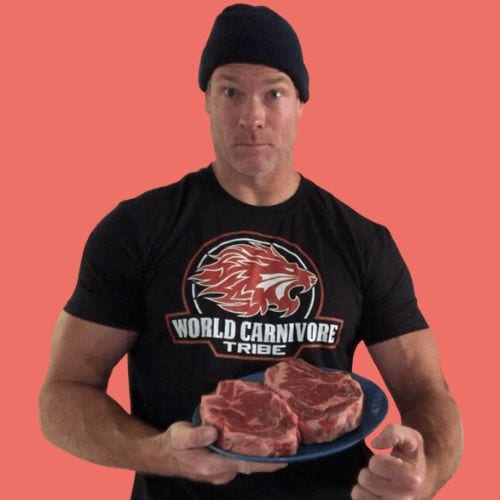
Tellingly, Baker himself has since walked back the diet’s central promises. Asked directly whether his eating pattern would extend anyone’s life, he answered: “I don’t know if my diet is going to make somebody live longer. I don’t know if it’s going to either prevent or increase the likelihood of some disease cuz we just don’t have the data that shows that now.” That’s a remarkable admission from one of the diet’s most prominent public faces, and it undercuts years of confident marketing built on his name, but unfortunately most of his followers will never hear it.
Quitting became its own trend
Perhaps the clearest sign the carnivore diet failed on its own terms is how many of its most visible advocates eventually left it. Paul Saladino, author of The Carnivore Code and one of the diet’s most influential proponents, reversed course after experiencing crashing testosterone and sleep disturbances. He has since said fruit “makes up the majority” of his current diet, alongside honey, squash and raw dairy. He has publicly reflected that “long-term ketosis is probably not a great thing for most humans.” It is ironic to have an allegedly super-manly diet drain your body of testosterone, but here we are.

He isn’t alone. Public accounts of quitting the diet after a near-fatal heart blockage, admissions of secretly seasoning meat with plant-based ingredients, and a stroke that prompted one former carnivore advocate to switch to a whole-food, plant-based Esselstyn-style diet have all circulated widely within the same community that once championed the diet as a cure-all.
Cost is a real and underdiscussed barrier
Beyond the health questions, the carnivore diet is simply expensive. A 2023 randomised trial published in JAMA Network Open found participants assigned to a low-fat vegan diet cut their grocery spending by about 16%, saving roughly $1.51 a day, or more than $500 a year, compared with a diet that included meat and dairy. Follow-up analysis put the savings closer to 19% against a standard diet and 25% against a Mediterranean diet, worth over $870 a year. Meanwhile, a diet built around two pounds of steak a day runs well past $25 a day for even mid-range cuts, several times the cost of a plant-based equivalent. Cost rarely features in carnivore marketing, but it’s a genuine access barrier that deserves more attention in these conversations.
What this doesn’t mean for veganism, and where a real solution sits
None of this should be read as vindication that plant-based eating has “won.” Beyond Meat and Oatly both suffered severe stock declines during the same period the carnivore diet was rising, and it’s tempting to draw a straight line between the two. But stock prices reflect speculative investment cycles, IPO overreach and market sentiment as much as consumer demand. They’re a poor proxy for how many people are actually choosing to eat less meat, and our analysis of plant-based meat alternatives and cholesterol shows the underlying health case for these products remains solid even when their share prices don’t.
Cultivated, or lab-grown, meat is frequently proposed as a bridge for people unwilling to give up meat’s taste for ethical or environmental reasons. Its regulatory picture in the US is messier than a simple “now legal” headline suggests. Federal approval exists, but at least seven states, including Florida, Alabama, Texas, Montana and Nebraska, have since passed laws banning its sale or production outright, while others have introduced labelling restrictions. Our look at farmers’ actual response to lab-grown meat and our fact-check on the cancer cell myth are worth reading if you want the fuller, less politicised picture.
The takeaway
Diet trends move in pendulum swings, and it’s easy to mistake a swing for a permanent shift in either direction. The carnivore diet’s rapid rise and equally rapid fall shows how far a confident narrative, backed by industry money and a handful of vocal doctors, can travel even with a threadbare evidence base behind it. It also shows those trends don’t last when the health claims don’t hold up under real scrutiny, and when the people making the loudest promises quietly change their own diets.
The lesson isn’t to gloat, though I did quite a bit of that on stage in the UK. It’s to keep asking the same question of every diet, carnivore or vegan: what does the actual evidence say, and who benefits from you believing otherwise?

Independent fact-checking, funded by readers like you.
Misinformation is a growing threat to our health and planet. At foodfacts.org, we're dedicated to exposing the truth behind misleading food narratives. But we can't do it without your support.
Sources
- Vallone, S., & Lambin, E. F. (2023). “Public policies and vested interests preserve the animal farming status quo at the expense of animal product analogs.”
- López-Moreno, M., et al. (2025). “Industry study sponsorship and conflicts of interest on the effect of unprocessed red meat on cardiovascular disease risk: a systematic review of clinical trials.”
- Capodici, A., et al. (2024). “Cardiovascular health and cancer risk associated with plant based diets: An umbrella review.”
- Oussalah, A., et al. (2020). “Health outcomes associated with vegetarian diets: An umbrella review of systematic reviews and meta-analyses.”
- Lietz, A., et al. (2026). “Carnivore Diet: A Scoping Review of the Current Evidence, Potential Benefits and Risks.”
- British Heart Foundation (2025). “The carnivore diet: why it's not good for your health.”
- Lennerz, B. S., et al. (2021). “Behavioral Characteristics and Self-Reported Health Status among 2029 Adults Consuming a Carnivore Diet.”
- Science Feedback (2023). “No evidence that a carnivore diet leads to ‘90% reduction in all diseases’ or treats diabetes”
- Marmagkiolis, K., et al. (2025). “Yellowish Nodules on a Man Consuming a Carnivore Diet.”
- Kahleova, H., et al. (2023). “Vegan Diet and Food Costs Among Adults With Overweight: A Secondary Analysis of a Randomized Clinical Trial.”




foodfacts.org is an independent non-profit fact-checking platform dedicated to exposing misinformation in the food industry. We provide transparent, science-based insights on nutrition, health, and environmental impacts, empowering consumers to make informed choices for a healthier society and planet.






.svg)


.svg)

