
Fact-Checking:
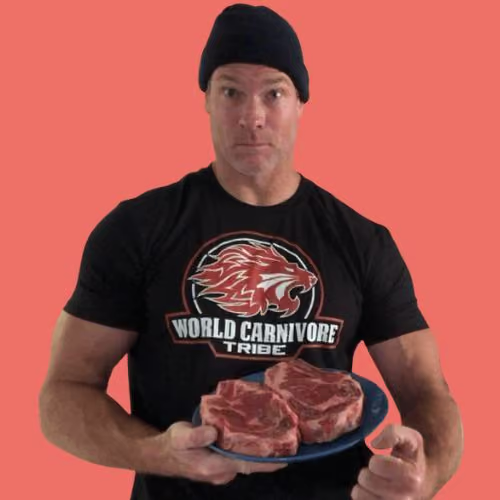
Shawn Baker
Shawn Baker is a US orthopaedic surgeon now carnivore‑diet promoter whose New Mexico medical licence was revoked in 2017 on grounds of “incompetence to practice as a licensee.”


Profession: Orthopaedic surgeon (medical licence revoked 2017, later reinstated with supervision), carnivore‑diet influencer, clinic founder
Credentials: MD, no specialist qualifications in nutrition or dietetics
Tagline: “Carnivore heals” and #Yes2Meat advocate
Shawn Baker is a US orthopaedic surgeon now carnivore‑diet promoter whose New Mexico medical licence was revoked in 2017 on grounds of “incompetence to practice as a licensee.” He later petitioned for and obtained reinstatement of his licence with supervision requirements, but now focuses on promoting a near‑exclusive meat diet through books, social media, and a telehealth clinic rather than returning to surgical practice.
An investigation by the Changing Markets Foundation into the online backlash against the EAT‑Lancet report identified Baker as the single most influential pro‑meat “mis‑influencer” by engagement on X (Twitter), playing a key role in driving the #Yes2Meat campaign and amplifying disinformation about the report’s findings.
F – Financial incentive
Are there visible revenue streams associated with the content?
Baker monetises his pro‑carnivore stance primarily through Revero, a subscription‑based virtual clinic built around a promise to treat chronic disease “at the root cause.” Revero markets its approach as “nutrition therapy” providing benefits “without the risk, expense, and inconvenience of pharmaceutical treatment.” It is worth noting that Revero subscriptions however do come with a cost.
For example, Revero advertises a programme at 199 USD per month for the first four months, which includes lab tests, a personalised plan, and supervision by clinicians and coaches. Patients with hypertension or diabetes are also required to purchase a Revero‑connected blood‑pressure or blood‑glucose device for 100 USD each, a non‑refundable extra cost on top of the subscription.
In addition, Carnivore.Diet appears to be a branded community website offering paid membership for access to carnivore‑diet guides, advertised live meetings with Dr. Shawn Baker, and a curated online community, further tying his public narrative about meat‑based healing to subscription‑based products built around his persona and approach.
Beyond Revero, Baker has also written books and engages in speaking appearances at low‑carb events or carnivore conferences. In his public messaging he frequently contrasts mainstream medicine (described as “pushing pills” and “just managing symptoms”) with diet‑based interventions that he says can put chronic disease into remission by addressing “root causes,” and Revero offers paid access to clinicians who work within this framework. Taken together, this means that for people who accept the narrative that conventional medicine is poorly suited to treating modern chronic disease, the practical next step may not just be a simple, low‑cost dietary tweak, but enrollment in a venture‑backed subscription clinic and associated products.
A – Authority signalling
How do they get perceived as sources of nutritional information?
Baker presents himself as a professional who has “seen” the failures of mainstream medicine and now focuses on diet to tackle the “root causes” of chronic disease, often framing this as an either/or opposition.
His past role as an orthopaedic surgeon and “Dr” title contribute to his perception as an authority figure, however it is worth noting that he has no specialist training in nutrition or population‑level risk and chronic conditions. He emphasises his and his clinicians’ experience with patients to describe people reversing or managing diabetes, gout, autoimmune disease or mental‑health problems on carnivore or low‑carb diets. These observations might be perceived as support for the success of his approach, however they are not systematically tracked or published in ways that would allow independent evaluation.
Take‑away: His authority rests less on formal expertise in nutrition science and more on the combination of an MD title, a compelling personal story and repeated (though often unverifiable) claims about what he and his network “see” in practice.
C – Claims
What is the core messaging, and what is left out?
Core idea:
Baker’s core idea is that meat‑centred, very low‑carb eating is not just safe but actively healing, and that a carnivore‑style diet can resolve or remit many modern chronic conditions.
From idea to certainty:
By appearing as an authority on carnivore eating and repeatedly showcasing striking success stories and positive outcomes, he may increase trust in his approach, even while occasionally acknowledging that long‑term data are lacking and that he cannot say whether his diet will make people live longer (source). He openly notes limitations in his own projects (such as a self‑selected 90‑day “N≈100” carnivore survey), which can make him appear transparent and cautious, but what he repeatedly chooses to highlight to the public (weight loss, “normal” bowel movements, improved mood and energy, symptom relief, etc.) can powerfully affect the audience’s perceptions of the carnivore diet and its effects on the body. At the same time, he rarely foregrounds evidence that might complicate this picture, such as research on how higher saturated‑fat intake affects cardiovascular risk over time or the benefits of dietary fibre and mixed dietary patterns, so the combination of selectively reassuring stories and omitted counter‑evidence may give a more certain and one‑sided impression than the science supports.
“Broken” nutrition science and what is left out
In talks and posts, Baker repeatedly stresses what he views as deep flaws in nutrition science: reliance on food‑frequency questionnaires and observational epidemiology, difficulty blinding and controlling diet trials, the cost of long‑term studies, and the variability of biomarkers such as cholesterol, vitamin D, uric acid and microbiome measures (“we don’t even know what they mean”). From this, he has concluded that there are effectively “no long‑term studies” on any diet, carnivore or otherwise, and that he can’t say for sure whether his dietary pattern will lengthen or shorten life or prevent specific diseases. This emphasis on uncertainty highlights real limitations but largely leaves out how evidence is actually built: by combining many imperfect studies (cohorts, shorter‑term trials, mechanistic work) and looking at the overall pattern, which can make some conclusions reasonably robust even if they never reach 100% certainty.
While he criticises epidemiology and biomarkers in general, he does not fully engage with the stronger parts of those literatures: decades of converging evidence on how certain dietary patterns (including high intakes of processed meat, or very low intakes of plant foods and fibre) relate to cancer and cardiometabolic risk. Similarly, he sometimes focuses on extreme or narrow counter‑examples (such as toxicology experiments using unrealistically high doses of compounds from heavily charred meat) to downplay broader concerns about red and processed meat, without discussing the more nuanced questions of dose, processing, and overall pattern that the research actually addresses. Evidence on the role of dietary fibre in gut and heart health, and what it might mean to eat a diet that contains virtually none, is also rarely part of his content.
Elevating anecdotes and short‑term change
Alongside this scepticism about formal studies, Baker sometimes strongly elevates anecdotes and short‑term changes. He tells conference audiences that most of them started carnivore because of stories rather than research and calls anecdotes a “powerful” tool for changing the narrative.
He states that “the best predictor of your future health is your current health.” Combined with his critique of nutrition science, this can create a compelling picture for followers: instead of weighing distant, probabilistic outcomes like arterial plaque or long‑term cancer risk which we can’t directly observe, ask how you feel now: stronger, leaner, more energised, less in pain? These stories are highly motivating and could give the impression that visible short‑term improvement is a reliable proxy for long‑term safety.
What is not emphasised as strongly are the well‑known limitations of anecdotal evidence. We usually do not know what else changed at the same time (for example, cutting ultra‑processed foods and alcohol, prioritising sleep, exercising, or gaining more medical and social support), or whether the same person would have improved similarly on a less restrictive evidence‑based pattern. Nor do we see systematic information about how many people tried the approach and did not improve, developed new problems, or left the community.
The main problem is that other online communities might report similar success with drastically different diets, leaving the consumer with the question: what works? In standard evidence hierarchies, anecdotes are starting points for questions, not endpoints that resolve them, and they are not designed to answer whether one diet reduces heart attacks or cancer over 10–20 years compared with alternatives. That broader context is largely missing when anecdotes are presented as potential proof.
One‑sided treatment of conflicting stories and data
In his material, unsuccessful or negative carnivore experiences are much less visible than successes, and when the diet does not seem to work, explanations may focus on implementation (“doing it wrong”).
A similar pattern appears with formal evidence. Baker focuses on methodological weaknesses when discussing the existence of evidence linking high red meat consumption with negative health effects. However, when studies seem to favour low‑carb or point to negative associations of vegan diets—such as observational work linking some plant‑based patterns with cognitive impairment, or trials where ketogenic diets outperform alternatives for particular markers—he seems willing to highlight them, even though they rely on the same types of epidemiology or biomarkers he elsewhere calls unreliable.
This inconsistent standard—high scepticism for data that complicate his message, low scepticism for data that support it—is a form of cherry‑picking.
Selective showcasing and the perception it creates
Although Baker sometimes acknowledges uncertainty and limitations, the way he presents information can shape perception powerfully. Followers see a steady flow of success stories, or before‑and‑after images paired with confident slogans like “meat heals.” They see few detailed discussions of research that might raise caution, such as meta‑analyses on saturated fat and heart disease, or reviews of the benefits of fibre and plant‑rich diets for long‑term health. Over time, this selective emphasis can reinforce the idea that concerns about carnivore diets are exaggerated and that meat‑centred, very low‑carb eating is both safe and broadly curative, even though the underlying evidence remains incomplete.
Take‑away: Baker draws attention to real weaknesses in nutrition science and to the importance of how people feel in the short term, but he consistently amplifies evidence and stories that favour his carnivore‑centred model while sidelining or dismissing data that might complicate it. The result is a picture of risk and benefit that appears clearer and more one‑sided than the science actually allows.
T – Tone
How is the information packaged, and what makes it appealing?
Through his social media content, Baker’s communication style sometimes turns a complex, uncertain area into an emotionally charged narrative. He uses humour, vivid metaphors and memes to portray mainstream nutrition science as a crashing plane with “broken wings” and mainstream advice as oversimplified and misguided: overweight, pill‑pushing doctors telling people to swap steak for plant patties, butter for margarine, tallow for seed oils and raw milk for soy milk, and to avoid the sun. In contrast, he presents carnivore and very low‑carb elimination as human‑appropriate food, tied to images of muscular, energetic bodies and people moving away from medications.
Some of Baker’s content makes use of the straw man fallacy, which occurs when someone’s arguments or ideas are slightly modified (generally exaggerated), in a way that makes them easier to refute. Let’s look at a few examples.
Simple cartoons like “This is Bill. Bill was told red meat would kill him. Bill ate steak anyway. Bill lost 60 pounds and feels amazing. BE LIKE BILL” suggest that doctors literally tell patients that red meat will kill them. Other memes might suggest that guidelines push veganism forward, when in reality they recommend moderating high and processed red‑meat intake and focusing on overall patterns, not total avoidance. He also juxtaposes frail, sickly or unhinged‑looking “vegans” (often AI images) with strong, vibrant “carnivores,” reinforcing the idea that plant‑based eating inherently leads to weakness and animal‑based eating to strength, even though real‑world outcomes are far more varied. The emerging perception is that ‘you might be told plant-based is good for you, but look at what it does, and look at what meat does.’
Nutrient concerns are treated in a very similar way. For example, he alludes to the absurdity of scurvy concerns, joking that you are as likely to develop scurvy on a carnivore diet than you are to get struck by lightning. In reality, recent modelling of plausible carnivore meal plans suggests that frank scurvy may not be the main concern at all; in fact, it has been suggested that meat may provide enough vitamin C to reduce that specific risk. However, carnivore diets can fall short on several other micronutrients and contain virtually no fibre, so researchers may recommend careful monitoring. By focusing the debate on “you won’t get scurvy,” this rhetoric may brush aside these broader issues around micronutrient balance and the unknown long‑term consequences of combining very high saturated‑fat intakes with zero fibre and restricted variety.
Take‑away: By regularly pitting vivid success stories against simplified versions of what guidelines or experts “say,” this style can encourage people to trust anecdotes and personal interpretations over more cautious, probabilistic conclusions. For audiences who feel failed or unheard by conventional care, it can be highly appealing: it offers a clear villain (broken science and pill‑pushing medicine) and a clear hero (meat‑centred, low‑carb eating) backed by real stories that offer promise. But it does so in a way that sometimes caricatures mainstream advice, that may undermine nuance and uncertainty, and reinforce the idea that when health authorities disagree with this narrative, it might be because they are out of touch or untrustworthy (just concerned with pushing pills), rather than because the evidence is more complex than some slogans allow.
Disclaimer
FoodFACT profiles summarise public-facing claims and marketing alongside our analysis. Quotes, prices, and membership figures are taken from linked sources as viewed at the time and may change. This content is for information only and is not medical advice. See something wrong or outdated? Let us know and we’ll update.


.svg)
