
Fact-Checking:
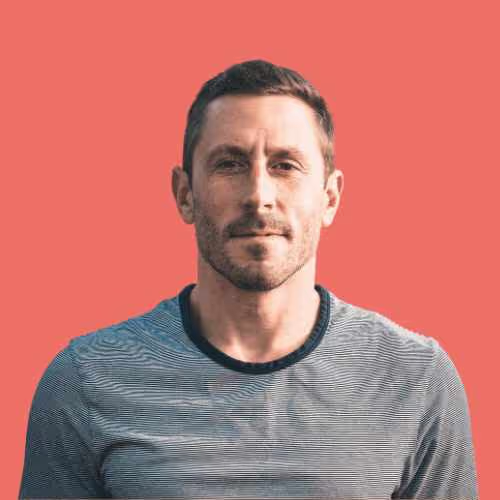
Paul Saladino MD
Formerly known online as “CarnivoreMD”, he is now a firm advocate of an “Animal-Based Diet”, framed as the “most species-appropriate diet for humans.” He has a following of ~2.95M on Instagram, and counts over 1M subscribers on YouTube (as displayed on channel page at time of writing).


Profession: Online health/nutrition creator. Founder of Heart & Soil, a supplement company
Credentials: MD (Doctor of Medicine). Board-certified Physician Nutrition Specialist (certified by the National Board of Physician Nutrition Specialists)
Tagline: "Welcome to the Remembering”; Reclaim your health with an animal-based diet
Formerly known online as “CarnivoreMD”, he is now a firm advocate of an “Animal-Based Diet”, framed as the “most species-appropriate diet for humans.” He has a following of ~2.95M on Instagram, and counts over 1M subscribers on YouTube (as displayed on channel page at time of writing).
F - Financial incentive
Are there visible revenue streams associatedwith the content?
Saladino monetises his content through sales of animal-derived supplements (notably desiccated organ products and colostrum) marketed with broad ‘health support’ claims. His dietary messaging frames meat and organs as central to ‘optimal’ human nutrition—for example, he defines an animal-based diet as centered on ‘the most optimal foods for humans; meat, organs, fruit, honey, and raw dairy,’ and presents organ intake as a core feature of the approach. He then directly connects this framing to purchasing supplements on the same page: ‘If you aren't ready for fresh organs, check out Heart & Soil Supplements for desiccated organs,’ and he includes Heart & Soil items in an example daily routine—blending dietary guidance with product prompts. Some products are positioned toward sex-specific outcomes (e.g., the ‘Whole Package’ page headline ‘REINFORCE YOUR MANHOOD WITH WHOLE PACKAGE’), alongside a broader catalogue. He has also written a book connected with his earlier carnivore era (The Carnivore Code: Unlocking the Secrets to Optimal Health by Returning to Our Ancestral Diet).
A - Authority signalling
How do they get perceived as sources of nutritional information?
His medical title (“MD”) is a strong authority cue, and his content often references scientific studies - together, this can make his interpretations feel especially credible to a general audience. In his own positioning, he explicitly contrasts himself with “Western medicine”, stating that it “fails to treat the root cause of chronic illness.” This framing can encourage audiences to see his approach as a corrective to conventional care, and may resonate with people who feel undersupported or overwhelmed. However, it can also understate that mainstream healthcare and public guidance do recognise nutrition as important for disease prevention and management (source, source), while also weighing other real-world factors (for example, access and affordability constraints, time pressures, co-existing medical conditions).
He further strengthens trust-building by appealing to instinct and “design” logic— which can feel intuitively compelling even when it is not presented as a conclusion reached by weighing the full breadth of evidence (archeological evidence, lifespan changes, etc.)
C - Claims
What is the core messaging, and what is left out?
Core idea — His worldview is anchored in the claim that optimal health comes from whole foods with a strong emphasis on “nutrient-dense animal foods,” described as “the most species-appropriate diet for humans.”
From idea to certainty — The messaging is often framed as a high-confidence solution to a range of issues, with promises to thrive.
What is left out — the key pattern — The most consequential pattern to note isn’t just observed from looking at the claims made, but at what is left out. For example, while Saladino often cites scientific studies to support his arguments, he also leaves out existing and significant evidence which don’t align with his narrative, in a way that vastly contrasts with how scientific conclusions are typically built. Let’s take a closer look at a few examples:
Cherry-picking data on red meat: Saladino has stated that there is “no good evidence that red meat causes cancer.” In the same reel, he appears to type the PubMed query “interventional trials red meat harm” and highlights “zero results” to reinforce that conclusion. While he cites studies that focus on the nutrients found in red meat, he does not appear to engage with the broader outcomes literature that comes up under arguably more relevant search prompts like “red meat cancer”: several studies then appear, where findings are typically discussed in terms of associations, acknowledging uncertainty and limitations, rather than simply stating causal proof. Scientific conclusions are usually formed by weighing the overall balance of evidence across study types and acknowledging constraints; presenting only the most supportive slice alongside a narrow “no results” search frame can therefore leave viewers with a stronger impression of certainty than the wider evidence base supports.
Cherry-picking data on seed oils: Saladino’s stance on seed oils is often framed in categorical terms (e.g., “no place in the human diet” appears in his seed-oils newsletter, for example). He presents the case against seed oils as strong and often refers to the Minnesota Coronary Experiment as robust support. What is left out of those discussions is that nearly 75% of participants dropped out in the first year, as well as other confounding variables which limit the study’s reliability (source). By contrast, multiple lines of evidence (including meta-analyses, Mendelian randomisation findings, and trial syntheses) which contradict the narrative that seed oils are toxic are also left out, highlighting a recurring “balance of evidence” gap.
Evidence standards shifting (epidemiology): Saladino has publicly criticised epidemiology, including in a video entitled “Why EPIDEMIOLOGY is GARBAGE!”, where he argues epidemiology cannot support causation and is easily confounded, in a way that encourages distrust of observational nutrition findings as a class. However, he then later uses epidemiologic findings himself as persuasive support when aligned with his preferred narrative: in a recent post, he cites an epidemiologic study and quotes its conclusion that colostrum is “at least 3 times more effective than a flu vaccine”, presenting the result in a confident manner, without addressing any of the study’s limitations (for example, patients weren’t tested for the flu, but self reported flu-like symptoms), all the while holding his own product.
Why this is problematic - Science typically builds confidence gradually, not by treating one striking sounding result as a final verdict. It tests ideas across multiple methods (for example: controlled trials where feasible, observational studies to identify patterns or generate hypotheses, and mechanistic research), looks for consistency and replication, and pays close attention to context such as “compared to what?”—because in nutrition, effects often depend on what a food replaces. When different lines of evidence point in the same direction, certainty increases; when they conflict, the scientific response is usually to refine the question, improve study design, and update conclusions rather than dismiss inconvenient findings.
This differs from messaging that “sells certainty” either by elevating a single supportive study, narrowing the frame of what counts as evidence, or leaning on instinct-based narratives that appeal to ancestral living ideas.
T - Tone
How is the information packaged, and what makes it appealing?
Absolute tone (despite an evolving stance on what the optimal diet is): His messaging shows continuity in language and certainty. His earlier book title frames the carnivore approach as a route to “optimal health” via an “ancestral diet” (“The Carnivore Code: Unlocking the Secrets to Optimal Health by Returning to Our Ancestral Diet”), and his current website headline similarly promises “optimal health”, but through a slightly different framework (“Unlock your Optimal health with an Animal-based Diet”). In other words, the framing remains the same, even as he no longer recommends a strict carnivore diet after having himself suffered from negative experiences (source). The earlier carnivore book remains commercially available, and Saladino’s confident tone when promoting the approach which he now believes to be the most optimal for human health remains the same.
“All-or-nothing” rules: Saladino’s high-certainty style often extends beyond diet into strict exposure-avoidance behaviours. For example, in a travel reel he presents bringing coconuts on planes as a “traveling hack” to avoid drinking from plastic bottles (highlighting concerns around microplastics). In another post about oral health, he frames toothpaste as optional/“overrated” and recommends avoiding fluoride toothpaste. He has also posted content warning against thermal-paper receipts and advising avoidance of touching them to reduce exposure to chemicals like BPA/BPS. He also questions the use of suncream.
Us-versus-them framing: many claims start with highlighting what appears as a shocking concern (often revolving around poisoning) before presenting the solution. Instead of “here are practical ways to improve diet, movement, and sun-safety within real-life constraints”, the messaging is frequently positioned as a correction to what audiences have “been told”, implying that established guidance is broadly untrustworthy. Over time, this can condition engagement to depend on distrust of mainstream advice and authorities, because adopting the “solution” is tied to accepting the premise that conventional recommendations are fundamentally wrong or concealing the truth.
This tone pairs naturally with marketing: when the audience is encouraged to see mainstream approaches as fundamentally misguided, creator-led solutions (including paid products) may feel uniquely trustworthy by contrast.
Some reactions from health professionals and nutrition scientists
While Dr Saladino’s emphasis on reducing intake of ultra-processed foods is consistent with public health guidance, several health professionals have expressed concerns at his restrictive approach, which leads him to demonise health promoting foods without engaging with vast amounts of evidence that do not support his claims.
In a thorough discussion of Saladino’s claims made on a Joe Rogan podcast episode, Dr Gil Carvalho expresses concern regarding Saladino’s dismissal of “some of the most well-established in biomedical science , both because of the scale and the rigor and the consistency of all of these different experimental approaches all pointing in the same direction.” You can watch his full analysis here, and here. Dr Layne Norton has also published a full fact-check of the same episode here, in which he also points at patterns whereby large bodies of evidence are ignored to promote unfounded claims.
Dr Idz has also called out Dr Saladino for misrepresenting study’s findings to support his own narrative.
Final take-away
The underlying assumption from Saladino’s narrative is that there is a single “right” way to eat: studies are then selectively emphasised or interpreted in ways that can overstate confidence and cast foods outside that model as uniquely harmful. The core risk is the certainty with which his message is delivered: it can erode trust in more balanced advice from experts, in well-established evidence, and may discourage people from practical, affordable, healthy options that don’t align with his template.
Disclaimer
FoodFACT profiles summarise public-facing claims and marketing alongside our analysis. Quotes, prices, and membership figures are taken from linked sources as viewed at the time and may change. This content is for information only and is not medical advice. See something wrong or outdated? Let us know and we’ll update.









.svg)
