




Does unprocessed red meat cause cancer? What the evidence actually shows


A common sentiment, especially among proponents of carnivore or animal-based diets, is that unprocessed red meat is not only harmless, but may even be protective against cancer. One vocal advocate of this claim is Paul Saladino, MD, who stated in a viral Instagram post:
“There is no good evidence that red meat causes cancer. And in fact, it may protect you against it. There are multiple nutrients found exclusively or predominantly in red meat that have been found in research studies to be protective against cancers, and there are simply zero randomized controlled trials in humans showing that more red meat is either inflammatory or increases your risk of cancer…”
This fact-check evaluates the accuracy of these claims against current scientific evidence.



While no single food guarantees or prevents cancer, the scientific consensus suggests that regular consumption of red meat, even unprocessed, can modestly increase cancer risk, particularly colorectal cancer. Current evidence does not support the idea that red meat is cancer-protective in humans.
Nutrition misinformation, especially around cancer, spreads rapidly on social media. While it’s true that not all cancer-related food claims are grounded in science, dismissing decades of epidemiological research in favour of anecdotal evidence or preclinical studies is dangerous. Contrary to what some wellness influencers claim, only a few foods are recognised by global health authorities as probable or known carcinogens: alcohol, processed meats, salted/preserved fish, and yes, unprocessed red meat.


Claim 1: “There is no good evidence that red meat causes cancer.”
Fact-check: This claim overlooks a substantial body of research associating unprocessed red meat with increased risk of several cancers. While processed meats carry a higher risk, unprocessed red meat is not off the hook. A systematic review that included 37 prospective cohort studies and a nested case-control study found a weak but statistically significant association between unprocessed red meat and both colorectal and breast cancers.
Another large meta-analysis of 148 publications on red and processed meat consumption and cancer incidence found that unprocessed red meat was associated with increased risk for breast, endometrial, colorectal, lung, and liver cancers. In dose–response analysis, each 100-gram daily increase in red meat consumption (roughly a 3.5 oz steak) was linked to an 11% higher risk of breast cancer, a 14% higher risk of colorectal cancer, a 17% increase in colon cancer, a 26% increase in rectal cancer, and a 29% increase in lung cancer.
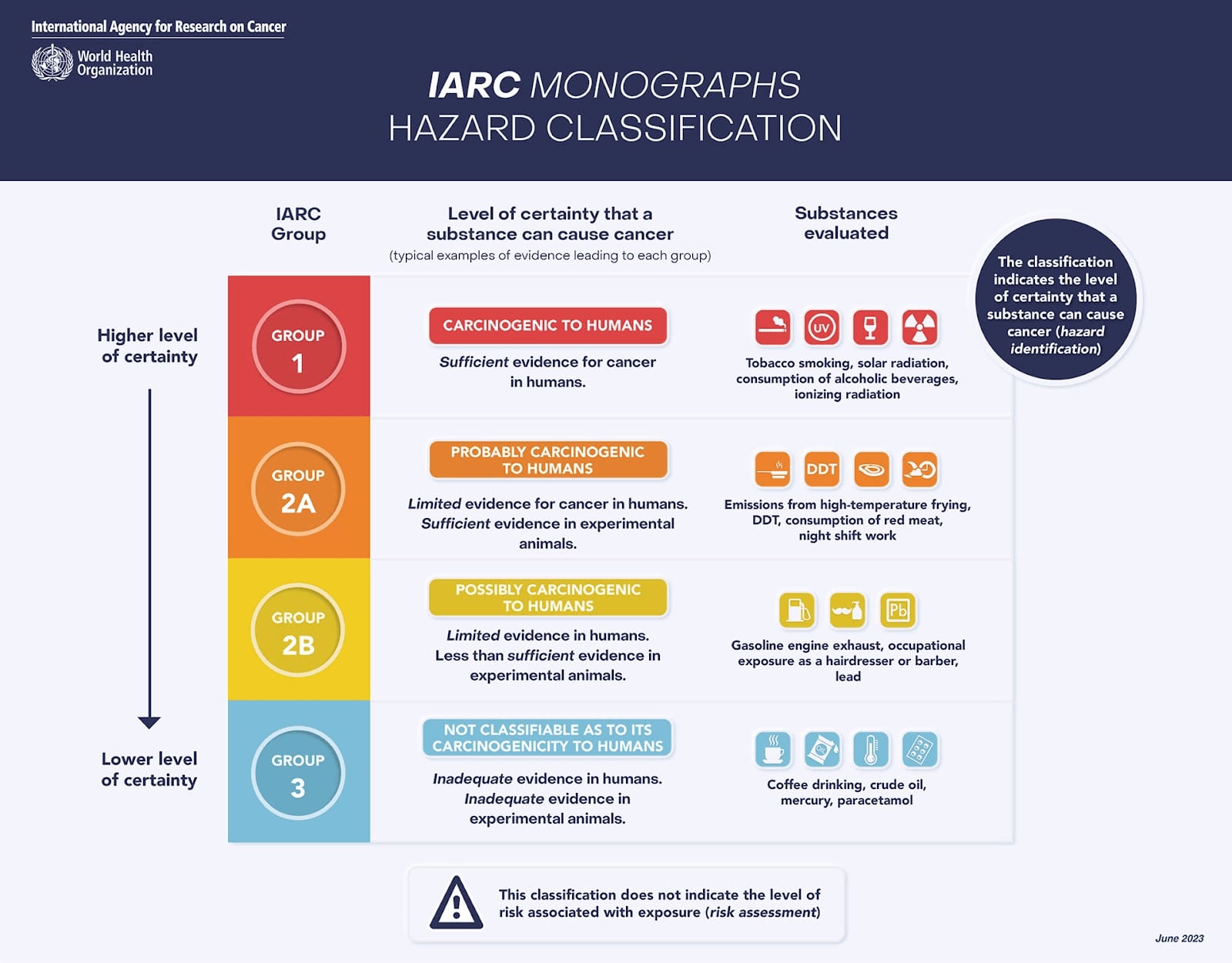
These findings are supported by the World Health Organization’s International Agency for Research on Cancer (IARC), which evaluated more than 800 epidemiological studies. The IARC classified unprocessed red meat as a Group 2A carcinogen, meaning it is “probably carcinogenic to humans,” based on evidence linking it primarily to colorectal cancer, as well as pancreatic and prostate cancers. This classification puts red meat just one tier below processed meat, which is in Group 1 (“carcinogenic to humans”). While red meat alone is not considered a strong carcinogen, dismissing the risks entirely is inconsistent with the available evidence.
Claim 2: “And in fact, it [red meat] may protect you against it [cancer].”
Fact-check: The suggestion that red meat protects against cancer is speculative and not supported by human data. Saladino references a list of compounds found in animal foods—such as trans-vaccenic acid (TVA), taurine, creatine, carnitine, anserine, and 4-hydroxyproline—as having anticancer properties. While preclinical research has studied the potential roles of these compounds in immune modulation or tumor biology, the evidence remains preliminary.
Biological mechanisms vs. real-world health outcomes
For example, taurine, TVA, and creatine have been shown in animal and cell studies to enhance CD8+ T cell activity, which plays a role in cancer immunosurveillance. Carnitine is involved in fatty acid metabolism, a process that some cancer cells may exploit to support their growth and survival. Anserine may enhance the effectiveness of doxorubicin, a chemotherapy drug, in preclinical models, but it has not been shown to have anticancer effects on its own. And 4-hydroxyproline, found in collagen, is being explored for its potential role in reshaping the environment around tumors, which plays a role in how cancers grow, spread, and respond to treatment.
These findings are interesting, but the majority of them come from in vitro or animal studies and are not backed by clinical research in humans. Translating biological effects seen in rodents or isolated cells into real-world human health outcomes is fraught with challenges. Without rigorous human trials, there is no credible basis to claim that red meat consumption provides a protective effect against cancer. The presence of potentially beneficial compounds in a food does not cancel out the overall epidemiological signal suggesting harm.
Claim 3: “…there are simply zero randomized controlled trials in humans showing that more red meat is either inflammatory or increases your risk of cancer.”
Fact-check: While it is true that there are no long-term randomized controlled trials (RCTs) showing a causal relationship between red meat intake and cancer, this is not unusual in nutrition science and does not undermine the broader evidence base. Long-term RCTs examining diet and chronic disease are extremely difficult to conduct due to logistical, financial, and ethical constraints. It is not feasible or ethical to assign participants to consume high quantities of a suspected carcinogen for decades.
As a result, nutrition science often relies on large-scale, prospective cohort studies. When designed well and replicated across multiple populations, epidemiological studies can provide strong evidence of risk. These types of studies have been critical in establishing now-undisputed links between smoking and lung cancer, trans fats and heart disease, and sugar-sweetened beverages and type 2 diabetes—all in the absence of long-term RCTs.
Some short-term RCTs have looked at red meat and intermediate markers of disease risk, such as inflammation or cholesterol levels. For example, a meta-analysis of 36 randomized trials with an average study duration of 8.5 weeks evaluated red meat consumption against cardiovascular risk factors. However, short-term trials are limited in their ability to detect long-latency outcomes like cancer, which can take decades to develop. The absence of RCTs should not be interpreted as evidence of no risk, but rather a reflection of the complexity of studying diet and disease in human populations.
Final take-away
Saladino’s claims misrepresent the state of nutritional science by dismissing the well-established links between red meat and cancer, overstating early-stage findings on meat-derived compounds, and minimising the value of decades of epidemiologic research. While red meat can be included in a balanced diet, current evidence consistently shows that regular consumption, particularly in large amounts, is associated with an increased risk of colorectal cancer and potentially other cancers.
There is no compelling evidence from human studies that red meat protects against cancer. Selective use of preclinical data to make sweeping health claims, while ignoring the broader body of high-quality human research, does not offer a reliable basis for dietary guidance.
We have contacted Paul Saladino and are awaiting a response.
Disclaimer
This fact-check is intended to provide information based on available scientific evidence. It should not be considered as medical advice. For personalised health guidance, consult with a qualified healthcare professional.
Independent fact-checking, funded by readers like you.
Misinformation is a growing threat to our health and planet. At foodfacts.org, we're dedicated to exposing the truth behind misleading food narratives. But we can't do it without your support.
Sources
Chalecka, M., et al. (2025). “The new insight into the role of hydroxyproline in metabolism of cancer cells”
Fan, H., et al. (2023). “Trans-vaccenic acid reprograms CD8+ T cells and anti-tumour immunity”
Farahzadi, R., et al. (2023). “Clinical Significance of Carnitine in the Treatment of Cancer: From Traffic to the Regulation”
Farvid, M.S., et al. (2021). “Consumption of red meat and processed meat and cancer incidence: a systematic review and meta-analysis of prospective studies”
Guasch-Ferré, M., et al. (2019). “Meta-analysis of randomized controlled trials of red meat consumption in comparison with various comparison diets on cardiovascular risk factors”
International Agency for Research on Cancer. (2018). "Working Group on the Evaluation of Carcinogenic Risks to Humans Red Meat and Processed Meat"
Lescinsky, H., et al. (2022). “Health effects associated with consumption of unprocessed red meat: a Burden of Proof study”
Ma, N., et al. (2022). “Taurine and Its Anticancer Functions: In Vivo and In Vitro Study”
Malik, V. S., et al. (2010). “Sugar-sweetened beverages and risk of metabolic syndrome and type 2 diabetes: a meta-analysis”
Mozaffarian, D., et al. (2009). “Health effects of trans-fatty acids: experimental and observational evidence”
Sadzuka, Y., & Sonobe, T. (2007). “Anserine induced advantage effects on the antitumor activity of doxorubicin”
US Department of Health, Education, and Welfare. (1964). “Smoking and Health Report of the Advisory Committee to the Surgeon General of the Public Health Service”
Zhang, L., & Bu, P. (2022). “The two sides of creatine in cancer”


foodfacts.org is an independent non-profit fact-checking platform dedicated to exposing misinformation in the food industry. We provide transparent, science-based insights on nutrition, health, and environmental impacts, empowering consumers to make informed choices for a healthier society and planet.








.svg)


.svg)

