
Fact-Checking:
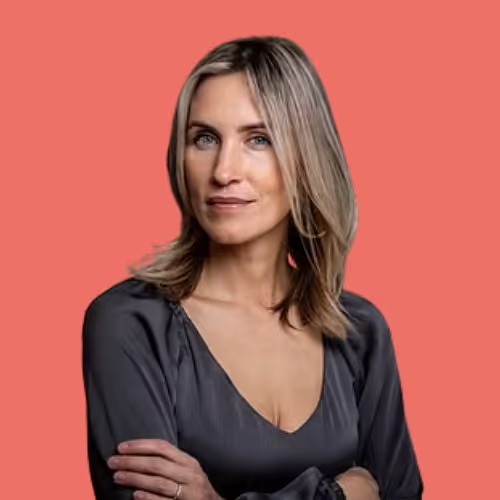
Candi Frazier
Candi Frazier is a functional nutrition practitioner and online educator who runs the Primal Bod brand, promoting a restrictive, meat‑centred “ancestral” diet as the key to hormone balance, weight loss and general health.


Profession: Owner of the Primal Bod weight loss/lifestyle programme.
Credentials: Board-Certified Functional Nutritionist and Medical Professional Nutrition Educator (FNTP, BCHN), as described on her website.
Candi Frazier is a functional nutrition practitioner and online educator who runs the Primal Bod brand, promoting a restrictive, meat‑centred “ancestral” diet as the key to hormone balance, weight loss and general health. She frequently frames insulin as a “master fat‑storing hormone,” suggests that carbohydrates and plant foods are not meant for humans to thrive on, and presents modern diets and lifestyles as domesticated and toxic compared with a romanticised vision of “the wild.” Her titles appear to come from private certification bodies rather than regulated health professions, and she markets online coaching programmes and conference access to a large social media audience, while including a broad medical disclaimer on her website that stresses that her content is “not a substitute for professional medical advice.” Critics such as The Willetts and Dr Idz have argued that her messaging uses fear-based appeals, misrepresents the evidence on consumption of carbohydrates and plant foods, gives little weight to higher‑quality evidence on weight loss and chronic disease, and offers expensive, restrictive protocols without robust scientific backing.
F – Financial incentives
Are there visible revenue streams associated with the content?
Frazier has built a substantial online business around the Primal Bod brand. Her website offers paid programmes such as a “full coaching” package (12 weeks of Primal Path videos, weekly group coaching calls, access to a private Facebook community) reportedly priced around 1,500 USD, and a “basic” tier with 12‑week access to recorded material and group support at a lower price point. She also sells access to a three‑hour recorded conference, and maintains an online shop featuring branded merchandise. Earlier in her career she founded and practiced at The Family Holistic, and according to a podcast interview appears to have moved from one‑to‑one practice towards scalable online programmes via Primal Bod. The Family Holistic’s website also has a shop selling various supplements.
Take‑away: Frazier’s narrative invites people to see her as someone who has uncovered the ‘real’ truth about weight loss and hormones, offering unique insights and solutions through her online presence, which can make signing up to her high‑priced programmes feel like the logical next step.
A – Authority
How do they get perceived as an authority on the topics discussed?
On public websites and in interviews, Frazier presents herself as a “Board‑Certified Functional Nutritionist and Medical Professional Nutrition Educator,” listing credentials such as FNTP and BCHN. These credentials come from private certification organisations rather than regulated health‑professional bodies or accredited medical boards, meaning the titles are not protected in the way that “registered dietitian” or “medical doctor” are, and holders are not subject to the same statutory oversight or discipline.
On the Primal Bod’s website, Frazier is also presented as a medical professional nutrition educator. Her messaging throughout her website and online presence profiles the “secrets” she’s uncovered about hormones and weight loss or her unique insights, often invoking her personal experience, including being married to a person with type 1 diabetes. At the same time, her website carries an extensive disclaimer emphasising that Primal Bod is “a lifestyle program providing online education on nutrition and related topics,” that its information is not medical advice, and that employees are “strictly prohibited from offering medical advice or making claims regarding the efficacy of any product or procedure,” while also building an online presence that focuses heavily on messages framed around hormone health and other health-related concerns, and explicitly stating that doctors’ advice on weight loss is not reliable. This may create a tension between the strong authority implied by her titles and storytelling on social media, and the legal framing of her work as non‑medical, educational content that should not be relied upon in place of qualified care.
Take‑away: Unlike practitioners in legally protected health professions, who are subject to formal oversight and can be held accountable when things go wrong, holders of private nutrition certifications operate outside these regulatory structures. When confident messages about health are broadcast to an audience of nearly a million people rather than delivered in individual counselling, the potential for misunderstanding is much greater, especially when followers’ medical histories and levels of background knowledge are unknown.
C – Claims
What is the core messaging, and what is left out?
Core ideas. Several recurring themes stand out in Frazier’s messaging:
- Carbohydrates, insulin and fat gain: She portrays insulin as the “master fat‑storing hormone,” often implying that carbohydrate intake, even from foods like fruit, directly drives visceral fat gain and blocks fat loss, using stark comparisons such as “one apple + peanut butter = a Snickers bar” or suggesting that half an apple will cause visceral fat accumulation.
- Plants, grains and “toxins”: She frequently portrays grains, legumes and plants as either “toxic”, inherently harmful, or not meant for us; instead she appears to promote an “ancestral” meat‑heavy diet (though not necessarily carnivore) as the best way of eating for hormonal health and weight control.
- Ancestral diet as uniquely correct: She frames her programme as a return to “the wild;” on social media she occasionally contrasts images of wolves with domesticated pets or highlights AI-generated pictures of obese people in modern societies following mainstream advice, suggesting that living and eating “like our ancestors” (with a heavy emphasis on meat and exclusion of modern plant foods) is inherently superior.
What is left out or downplayed. Across her content, Frazier’s narrative gives little visibility to:
- The role of overall calorie intake, physical activity, sleep and stress in driving insulin resistance and weight gain, beyond demonised carbohydrate or plant foods.
- Evidence from randomised trials and meta‑analyses that a range of dietary patterns—including Mediterranean style and other plant-inclusive patterns—can support fat loss and cardiometabolic health when appropriately structured.
- The risks and practical downsides of highly restrictive, meat‑centric diets (e.g. micronutrient gaps, sustainability and adherence challenges, increased risks associated with high consumption of saturated fat, etc.).
When referencing research to support her own arguments, Frazier tends to lean on a small number of outlier voices (such as Sally Norton on oxalates; Dr Saul Justin Newman on blue zones, Dr Wendy Sellens on breast cancer and hormones) rather than the larger body of peer‑reviewed work.
Take‑away: Some of Frazier’s public claims touch on real concerns—weight struggles, frustration with ultra‑processed diets and modern lifestyles—but they present insulin, carbohydrates and plant foods in an alarmist, oversimplified way, heavily privileging anecdotes and ancestral rhetoric while ignoring or brushing aside, in her public messaging, large bodies of evidence showing that balanced, plant‑inclusive diets can support weight management and metabolic health; as a result, her audience may see a stark, high‑certainty picture in which only a restrictive, meat‑centred “primal” diet is appropriate, even though current science supports a much wider range of effective and sustainable approaches. It is also important to note that the risks associated with a very high consumption of meat products do not appear to be explored in her narrative.
T – Tone
How is the information packaged, and what makes it appealing?
Frazier’s tone on social media is assertive, emotionally charged, and often rooted in fear and appeal‑to‑nature themes. For example, she regularly discusses plants as being ‘engineered’ foods containing ‘toxic’ compounds, often paired with vivid imagery, which can make everyday staples sound inherently dangerous despite a lack of supporting evidence for those specific claims.
Another recurring pattern is her “peasant food” rhetoric (source, source), where foods that do not fit her programme (such as many staple plant foods) are framed as foods you can survive on but that will leave you tired, inflamed, or even looking unattractive, while her approved foods are cast as the route to being “sexy,” feeling and looking optimal. This plays on a false dichotomy: it suggests that foods are either ‘peasant‑tier’ (for mere survival) or ‘elite‑tier’ (for real health and beauty), glossing over evidence that many of the foods she disparages - including whole‑grain staples — are consistently associated with lower risks of cardiovascular disease, type 2 diabetes, several cancers, and premature death when eaten in appropriate amounts (source, source). The framing can feel intuitively plausible, but it rests on a combination of appeal to nature (“wild, ancestral = good”) and oversimplified explanations that ignore dose, context, and overall patterns.
This binary framing ties into another prominent pattern, a ‘you’ve been misled’ narrative, even when not stated outright. Her messaging suggests that mainstream guidance about carbohydrates, grains, and balanced diets has failed her followers; that their struggles may be due to neglected truths about hormones and toxins that conventional professionals perhaps ignore; and that she has uniquely uncovered the solution through her personal journey and functional‑style training. When a lot of people feel overwhelmed or confused, messaging suggesting that you can’t trust guidelines or ‘mainstream’ professionals can be especially powerful, but it can also make it harder to engage with nuanced, evidence‑based advice or to see different tools — from dietary changes to medical care — as working together rather than in opposition.
Take‑away: Frazier’s communication style is compelling because it offers a clear villain (carbs, plants, toxins, “domestication”) and a clear hero (a strict, ancestral meat‑based programme) packaged in emotive stories and visually striking content, but by leaning heavily on fear, exclusivity and the sense that mainstream advice is fundamentally wrong, it risks undermining trust in more nuanced, evidence‑based guidance and could push vulnerable audiences—for example women concerned about hormones, fertility or pregnancy—towards restrictive, unproven protocols that are marketed as the only path to optimal health.
Final take away
Although Frazier presents her protocol as a lifestyle and weight‑loss approach, many of the promises and explanations in her content go well beyond short‑term fat loss, framing her way of eating as a cure‑all for fatigue, hormonal problems, and other health issues in ways that sound medical but are not backed by the kind of rigorous evidence normally required for clinical claims.
Disclaimer: This profile summarises publicly available information about Candi Frazier’s roles, statements and publications, with the aim of helping readers understand how her narrative may influence public debates on nutrition and health. It does not assert motives and does not represent legal, medical or dietary advice; while care has been taken to reference sources accurately and to reflect differing expert views, the analysis is necessarily selective, and readers should review the underlying studies, reports and statements before drawing firm conclusions.




.svg)
