





Sweetened toddler milks: guidance in context


An article in The Daily Mail on 29 April claimed that sweetened plant-based milks, such as oat and soy, should not be given to toddlers. It refers to a recent clinical statement reporting that “doctors, dentists and dietitians” are “advising parents not to give children under five plant-based milk alternatives containing sweeteners, which can be high in sugar and low in vital nutrients.”
This fact check verifies the accuracy of these claims to provide clarity on the role of plant-based and follow-on milks in the context of a young child’s diet.



The Daily Mail accurately reports new guidance warning against sweetened plant-based growing-up milks, but omits that the same guidance applies equally to dairy versions like Aptamil and Cow & Gate. The real issue is sweetened, unregulated toddler drinks across the board, not plant-based milks specifically.
Newspaper headlines can, and often do, oversimplify dietary guidance, vilifying some foods or ingredients while hailing others as superfoods. In their efforts to grab our attention, important contextual information is often omitted from both the headline and the article itself. It is vital to give accurate information and provide nuance around any dietary advice - as it’s rarely black and white. The foundations of a healthy, nourishing diet involve whole dietary patterns, not one single food in isolation. Milk, in its many varieties, often forms an important part of a young child’s diet, so parents and caregivers must have clear information about the health and nutritional profile of milk-based drinks so they can make informed decisions.


Background and context
In May 2026, the British Society of Allergy and Clinical Immunology (BSACI) published a clinical statement entitled 'Recommendations on plant-based drinks for children aged 1 year and over,' supported by the British Dental Association (BDA) and the Food Allergy Specialist Group of the British Dietetic Association (FASG). The statement builds on a 2025 UK government report from the Scientific Advisory Committee on Nutrition and the Committee on Toxicity (SACN/COT), which concluded that cow's milk remains the recommended option for children aged 1–5 not being breastfed, but that unsweetened, fortified plant-based drinks are acceptable alternatives.
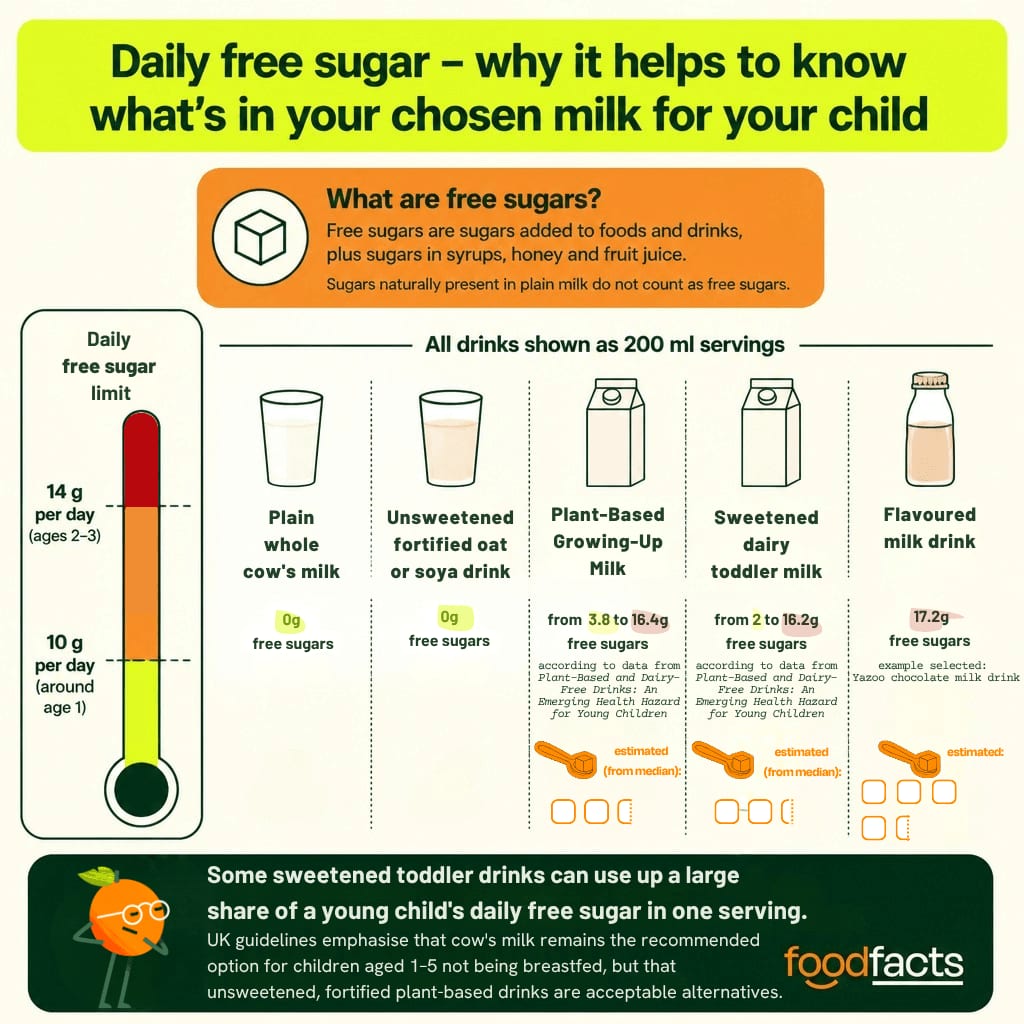
The BSACI statement's central concern is free sugars intake in young children. UK guidance recommends that free sugars should make up no more than 5% of total energy intake - the equivalent of no more than 10g per day for a one-year-old and 14g per day for a two-to-three-year-old (source). Growing-up milks, both plant-based and dairy, are the top source of free sugars in the diets of 12-to-18 month olds in the UK, contributing to around 50% of free sugars intake in this age group (source).
What do toddlers drink?
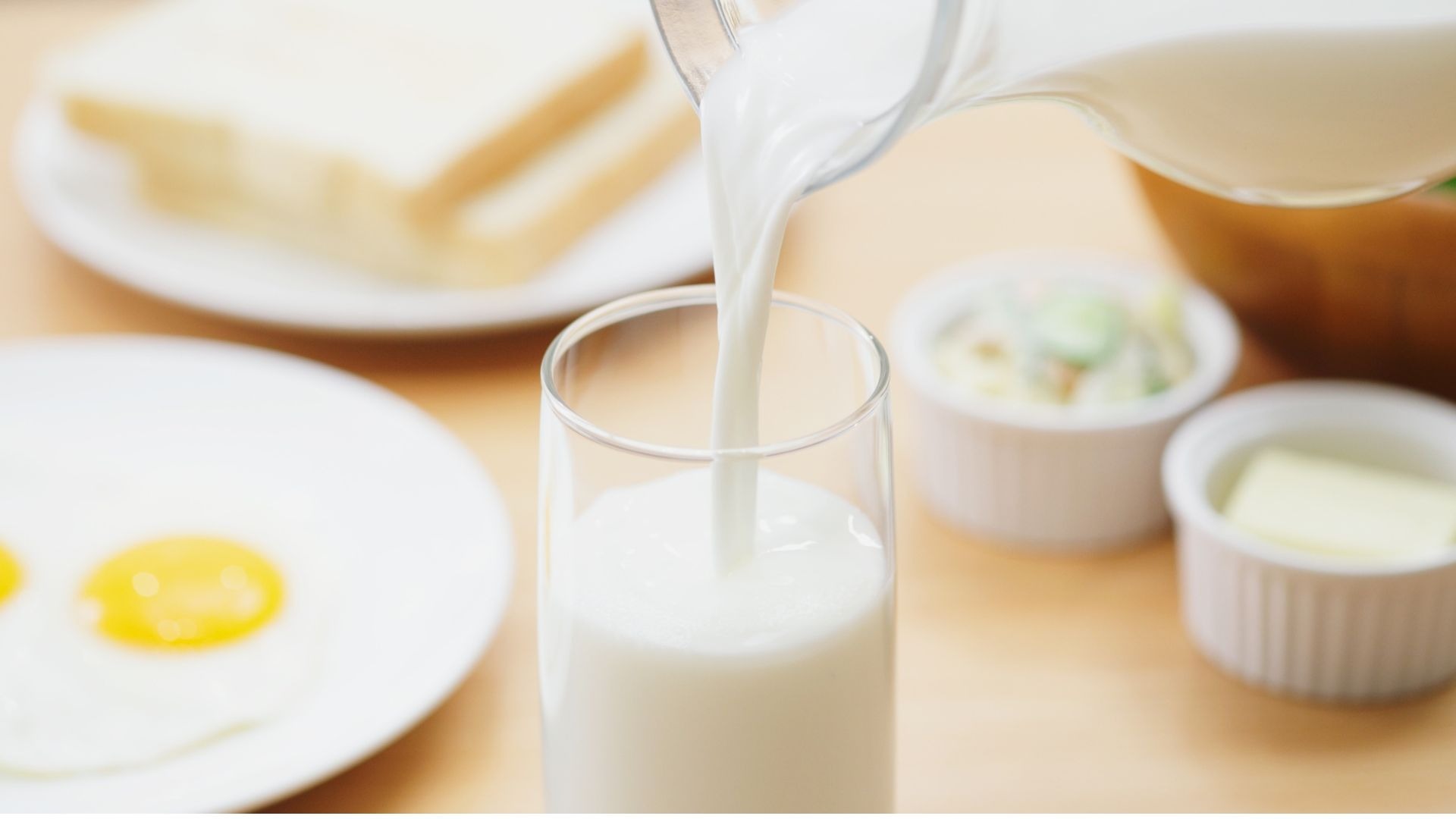
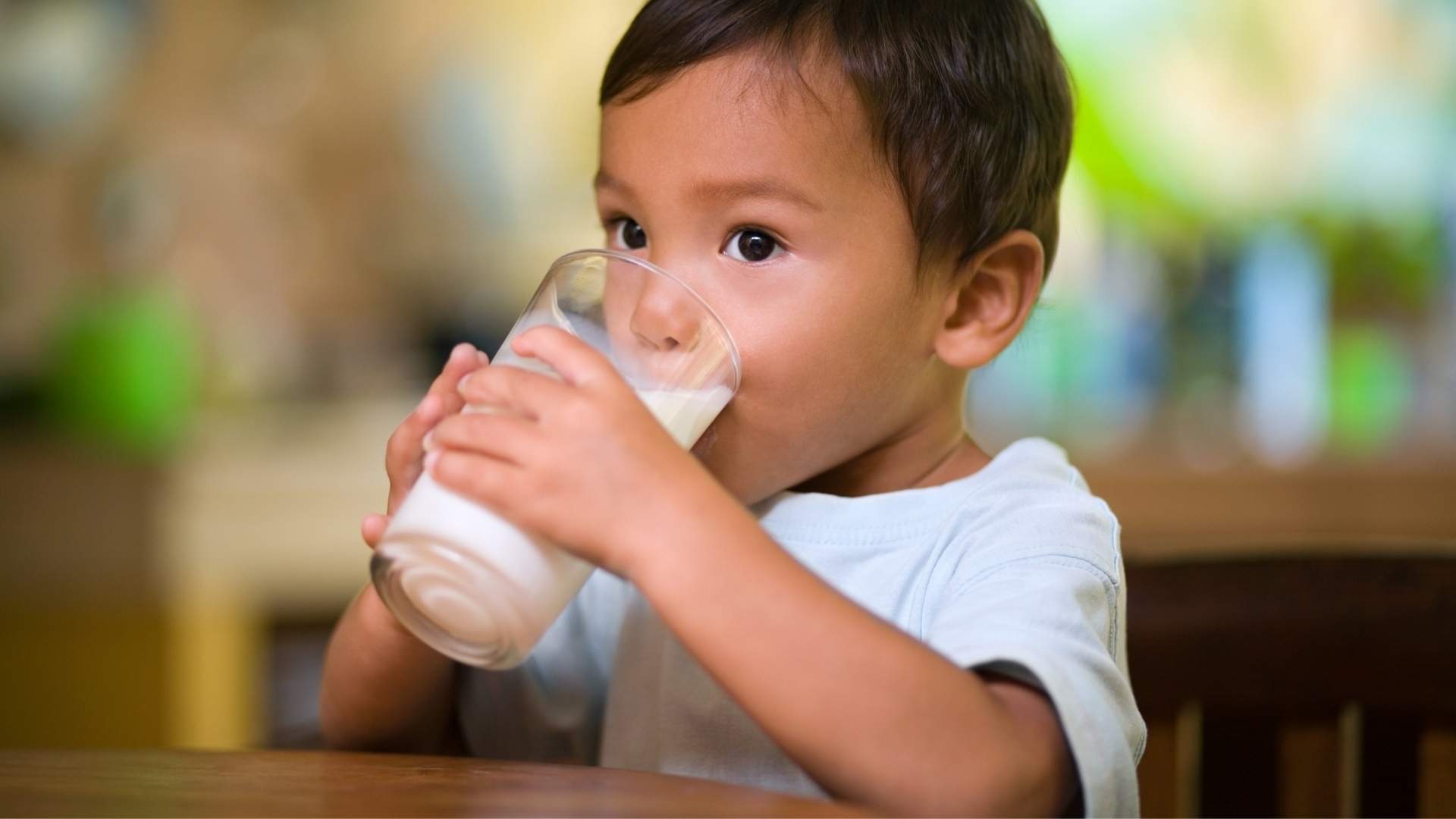
Once a child reaches one year of age, they can start to drink other types of milk in addition to breastmilk or standard infant formula, including cow’s milk, plant-based milks, and toddler-specific follow-on or growing-up milks (GUMs), be they dairy- or plant-based. While infant formula is tightly regulated, follow-on milks are not subject to the same compositional and marketing rules as infant formula, and may contain ingredients such as added sugars, maltodextrin, glucose syrup and vegetable oils (source, source). As a result of rising rates of childhood obesity and tooth decay in the UK (source), the nutritional quality of drinks marketed to young children has come under increasing scrutiny. Although many families transition to cow’s milk after the age of one, some choose plant-based alternatives for lifestyle or medical reasons, while others opt for growing-up milks, available in both dairy and plant-based varieties. Despite not being necessary as part of a healthy diet, GUMs represent a large and growing category (source) and are often marketed with bold claims about added vitamins and minerals, making them a potentially appealing option for parents.
What constitutes a plant-based milk?
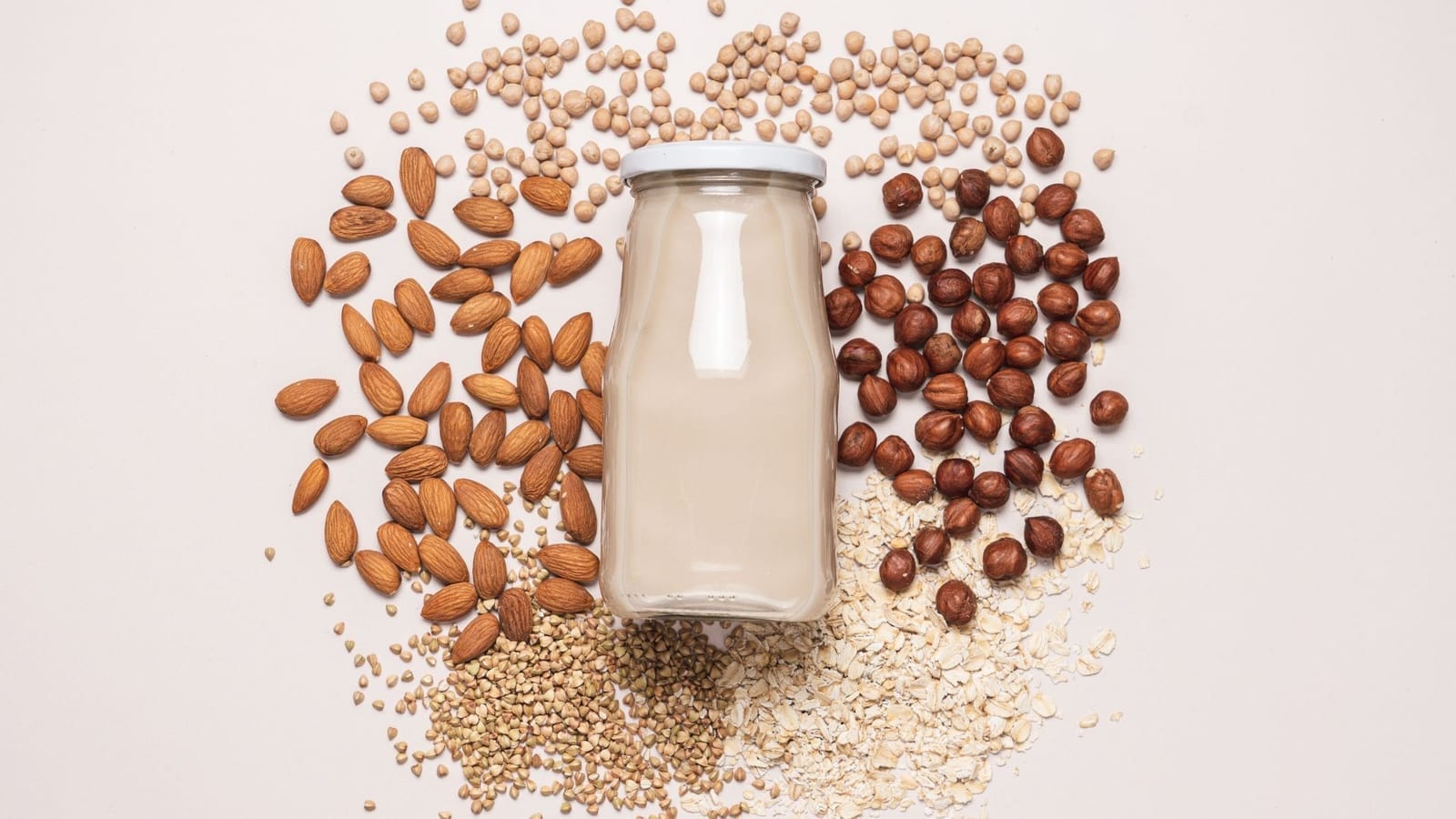
Plant-based milks are a broad and diverse category, used by both adults and children. They include a wide range of milks from oat and soy to pea and hazelnut, and many more in between. Some are sweetened, while others contain no added sugars; some are fortified with vitamins and minerals, while others are not; and ingredient lists range from products made primarily from water and a plant base to those containing multiple added ingredients. This variability extends to toddler-specific plant-based GUMs, which also differ substantially in their nutritional composition.
Bottom line: Treating plant-based milks as a single, uniform category is unlikely to be useful when assessing their nutritional quality or suitability for young children. While concerns raised by the BSACI primarily relate to sweetened plant-based milks and, in particular, growing-up milks, this nuance is often absent in media reporting. For example, The Daily Mail article does not distinguish between product types, which risks encouraging overly simplistic interpretations of plant-based milks as uniformly ‘unhealthy’.
Claim 1 (headline): Sweetened oat and soya milks risk causing obesity, tooth decay and malnutrition in young children.
Fact check: Misleading.
The headline is The Daily Mail's own framing - it does not appear in the BSACI statement. By naming oat and soya specifically, the headline may suggest the problem is the plant-based nature of these drinks and could be interpreted as oat and soya being particularly problematic. In reality, the BSACI statement's concern, while giving examples of growing-up soya and oat-based drinks, is with sweetened, less-regulated growing-up drinks as a category, more so than with the base ingredient.
The dental risks of sweetened beverages, including GUMs, are well-documented (source, source). The obesity and malnutrition claims are only partly supported as direct evidence for sweetened oat/soy milks in young children is limited. The literature supports a broader claim about sweetened beverages' link to obesity (source) and a narrower claim about plant-based milks’ nutritional adequacy (source), but not a strong, direct claim that sweetened oat and soya milks specifically cause obesity or malnutrition in young children. Malnutrition is unlikely to come from one single drink, but rather an overall dietary pattern where children are missing key core nutrients across their whole diet.
Claim 2: “Doctors, dentists and dietitians issued new joint guidance, backed by the BSACI, British Dental Association and BDA's Food Allergy Specialist Group, recommending under-fives avoid sweetened plant-based milk alternatives.”
Fact check: True, but incomplete.
The issue isn’t confined to sweetened plant-based milks only but rather to “growing-up milks” in general, a category that also includes dairy-based drinks. The BSACI’s statement issues guidance on plant-based milk consumption for children over one year old, where they advise families to choose “unsweetened and fortified” alternatives when plant-based milks are being used. The endorsing bodies are correctly identified, and the joint nature of the statement is accurately reported by The Daily Mail. The article describes the guidance as advising parents to avoid 'sweetened dairy-free milks', which is a fair summary of part of the statement.
While the focus of the BSACI communication is on plant-based milk, their communication goes on to clarify that “growing up/toddler’ drinks and follow-on formulas, whether they are plant-based drinks or cow’s milk-based drinks or prescription low-allergy formulas (unless specifically requested by a dietitian), are not recommended due to the free sugar content.”
What’s notable in The Daily Mail article is what it leaves out: that the BSACI's recommendation explicitly extends the same warning to cow's milk-based growing-up drinks and prescription low-allergy formulas. By reporting only the plant-based element of the recommendation, The Daily Mail paints an incomplete picture of what the BSACI actually advises.
Claim 3: “Sweetened plant-based growing-up milks are 'unregulated ultra-processed products' with no compositional, labelling or marketing rules.”
Fact check: True, but incomplete.
It is correct that there is a regulatory gap in the follow-on milk category, where products are not subject to the same regulations as infant formula. The Baby Feeding Law Group UK states that there are no specific UK regulations relating to the composition, marketing or labelling of milks manufactured for children over 12 months. A 2025 peer-reviewed paper in Maternal & Child Nutrition called for legislative reform on this basis.
However, the claim stated in The Daily Mail article refers only to plant-based GUMs, while the same lack of regulation also applies to dairy growing-up milks like Aptamil Stage 3 and Cow & Gate, which are also less regulated, processed, and sold with health claims. Referring only to plant-based is selective in the way that it omits the dairy category without justification.
Claim 4: “Organic plant-based versions are the least likely to be fortified with the nutrients children need.”
Fact check: True.
This claim is broadly correct. Organic, plant-based follow-on milks appear to be rare in the market. Non-organic dairy and plant-based milks are nearly always fortified, and organic dairy infant formulas, such as HIPP and Kendamil, often are too. However, there appears to be a gap in the category for organic, plant-based follow-on milks.
Claim 5: “Growing-up” and “toddler” milks are frequently promoted as supporting optimal growth and development beyond infancy… [But] most plant-based toddler drinks contain free or added sugars such as glucose syrup, maltodextrin, sucrose, fructose or other refined carbohydrates.”
Fact check: True.
This is correct. Academic research (source) and a scan of supermarket product ranges confirm this.
That said, some well-known dairy toddler drinks, such as Cow & Gate, also contain ingredients like maltodextrin. And interestingly, Aptamil growing-up milk (made by Danone), one of the leading infant and follow-on formula brands, does not contain free or added sugars in the UK market, but does in other markets such as Spain, for example.
The concern around free and added sugars in toddler milk drinks is understandable for health bodies and families alike. If products are presented to shoppers with loud health halos about their nutritional benefits, it is reasonable that parents will consider it a good option for their children. Additionally, when sugar is listed in the ingredients under less familiar terms such as ‘maltodextrin’ or ‘fructose’, it’s plausible that consumers will not register that this is a potentially sugar-heavy product.
Tip: Tools such as Open Food Facts, a free, non-profit, crowdsourced database of food products from around the world, allow users to search or scan barcodes to access information on ingredients, nutrition, allergens, food processing (NOVA), packaging and environmental impact.
Claim 6: “A 350ml glass of typical growing-up soya milk can contain up to 30g of added sugars, and oat-based versions up to 21g - far exceeding the 14g/day limit for 2–3 year-olds.”
Fact check: True.
The study “Plant-Based and Dairy-Free Drinks: An Emerging Health Hazard for Young Children” illustrates that plant-based follow-on milks generally contain higher levels of free sugars* than their dairy counterparts (source). The figures cited in The Daily Mail article can be confirmed by multiplying the free sugars per 100ml values in that paper's table by 3.5. That said, the research also shows that SMA (dairy) growing-up milk has nearly identical free sugar content (8.1/10ML) to the highest plant-based GUM in the table (8.2/10ML). Again, a more complete framing would have been to outline how GUMs, in general, can contain high levels of free sugars, depending on the brand.
*The authors of the study note that they have categorised maltodextrin as a ‘free sugar’ in their analysis due to its high glycaemic index and the role it plays in tooth decay. They elaborate further by saying that while not officially classified as a free sugar in the UK, it is in countries such as the United States, Canada, New Zealand and Australia where it is considered an added sugar.
Claim 7: “Children may struggle to absorb added calcium and vitamin B12 from plant-based drinks, even when included in ingredients.”
Fact check: Misleading.
The bottom line on nutrient absorption is more nuanced than the article implies. Calcium in plant-based drinks can be slightly harder to absorb than calcium in cow's milk, depending on how the product is fortified. But modern products using calcium carbonate are broadly on a par with dairy (as noted in the BSACI appendix): for example, this study in young women showed it can have equivalent bioavailability to cow's milk (source).
The bigger and better-evidenced concern is vitamin B12: children swapping cow's milk for unfortified plant-based drinks consistently end up with lower B12 levels, though this is likely down to the amounts present in the drink rather than the body failing to absorb it (source).
Either way, the practical takeaway is the same - if a child isn't drinking cow's milk, the plant-based alternative should be fortified, unsweetened, and given in adequate amounts.
Claim 8: “The health halo around the plant-based options is especially misplaced, given they have the highest sugar content of all.”
Fact check: Misleading.
The claim that plant-based options have 'the highest sugar content of all' is only appropriate within a specific context: the growing-up milk sub-category, and only when maltodextrin is classified as a free sugar. The BSACI statement's own nutritional data shows that a dairy GUM - SMA Advanced Growing Up Milk - contains 8.1g of 'free sugars' per 100ml, almost identical to Alpro Soya Growing Up at 8.2g. While overall, plant-based GUMs generally contain more free sugar than dairy versions (source), it’s worth noting that this is not the case for all plant milks, and neither are all dairy milks free from free or added sugars.
Final take-away
The Daily Mail article was based largely on the BSACI joint guidance statement on plant-based drinks for children aged one year and over, so in terms of factual correctness, it’s pretty faithful. However, it lacks context and is a missed opportunity. It could have provided more clarity to readers on the broader issue of sweetened milks for toddlers and young children - whether they are plant- or dairy-based. It could also have been clearer about the differences between plant-based milks and GUMs, as they are not the same product, usually have a different ingredient make-up, and are sold at quite different price points.
High sugar content is a cross-category problem, not just plant-based, and the issue is sweetened, highly-processed drinks with health halos - not plant-based ingredients per se. A child given unsweetened fortified oat milk could be better served than one given SMA Advanced Growing Up Milk. The Daily Mail's framing may inadvertently shift attention away from the wider issue of sweetened drinks and misdirect parental concern.
Bottom line: The core concern is well-grounded in science, but the headline overstates the risk and omits critical context (sweetened vs. unsweetened, fortified vs. unfortified, and risks of sweetened dairy-based drinks).
We have contacted Rosie Taylor and are awaiting a response.
Disclaimer
This fact-check is intended to provide information based on available scientific evidence. It should not be considered as medical advice. For personalised health guidance, consult with a qualified healthcare professional.
Independent fact-checking, funded by readers like you.
Misinformation is a growing threat to our health and planet. At foodfacts.org, we're dedicated to exposing the truth behind misleading food narratives. But we can't do it without your support.
Sources
SACN, (2025). Assessing the health benefits and risks of consuming plant-based drinks.
NHS, (n.d.). Sugar: the facts
First Steps Nutrition Trust (2024). Drinks for young children marketed as ‘growing up’ and ‘toddler’ milks and drinks
European Union (2015). Compositional requirements for infant and follow-on formula set out in Annex I and II of Commission Delegated Regulation (EU) 2016/127 (retained in UK law). Official Journal of the European Union
Baby Feeding Law Group, UK. (n.d.) Current UK laws: Infant formula, follow-on formula and infant milks marketed as Foods for Special Medical Purposes
UK Parliament (2026). British Dental Association Submission to the House of Commons Health and Social Care Select Committee Inquiry on Food & Weight Management.
Dunford EK, Popkin BM. (2023). Ultra-processed food for infants and toddlers; dynamics of supply and demand. Bull World Health Organ.
Echeverria MS, et. al. (2025). Sugar consumption and early childhood caries: a systematic review and meta-analysis of cohort studies. Braz Oral Res.
Large JF,et. al. (2024). Impact of unhealthy food and beverage consumption on children's risk of dental caries: a systematic review. Nutr Rev.
Liu Y, et al. (2025). The Association of Sugar-Sweetened Beverages Consumption Patterns and Overweight/Obesity: Evidence from a Large-Scale Survey of Chinese Children and Adolescents. Nutrients.
Ramsing R, et al. (2023). Dairy and Plant-Based Milks: Implications for Nutrition and Planetary Health. Curr Environ Health Rep.
BSACI, 2026. Recommendations on plant-based drinks for children aged 1 year and over
Kamata M, et al. (2025) Formula Labelling in the United Kingdom: Manufacturers' Compliance With the Code, UK Law and Guidance Notes. Matern Child Nutr.
Walther B,et. al. (2022). Comparison of nutritional composition between plant-based drinks and cow’s milk. Front. Nutr.
Childs, R.M., et. al.(2024). Plant-Based and Dairy-Free Drinks: An Emerging Health Hazard for Young Children. Clin Exp Allergy.
Zhao Y, et al. (2005) Calcium bioavailability of calcium carbonate fortified soymilk is equivalent to cow's milk in young women. J Nutr.
Kersting et al. (2025). Replacing cow’s milk with plant-based drinks: consequences for nutrient intake of young children on a balanced diet in Germany. Journal of Health, Population and Nutrition


foodfacts.org is an independent non-profit fact-checking platform dedicated to exposing misinformation in the food industry. We provide transparent, science-based insights on nutrition, health, and environmental impacts, empowering consumers to make informed choices for a healthier society and planet.






.svg)


.svg)

