
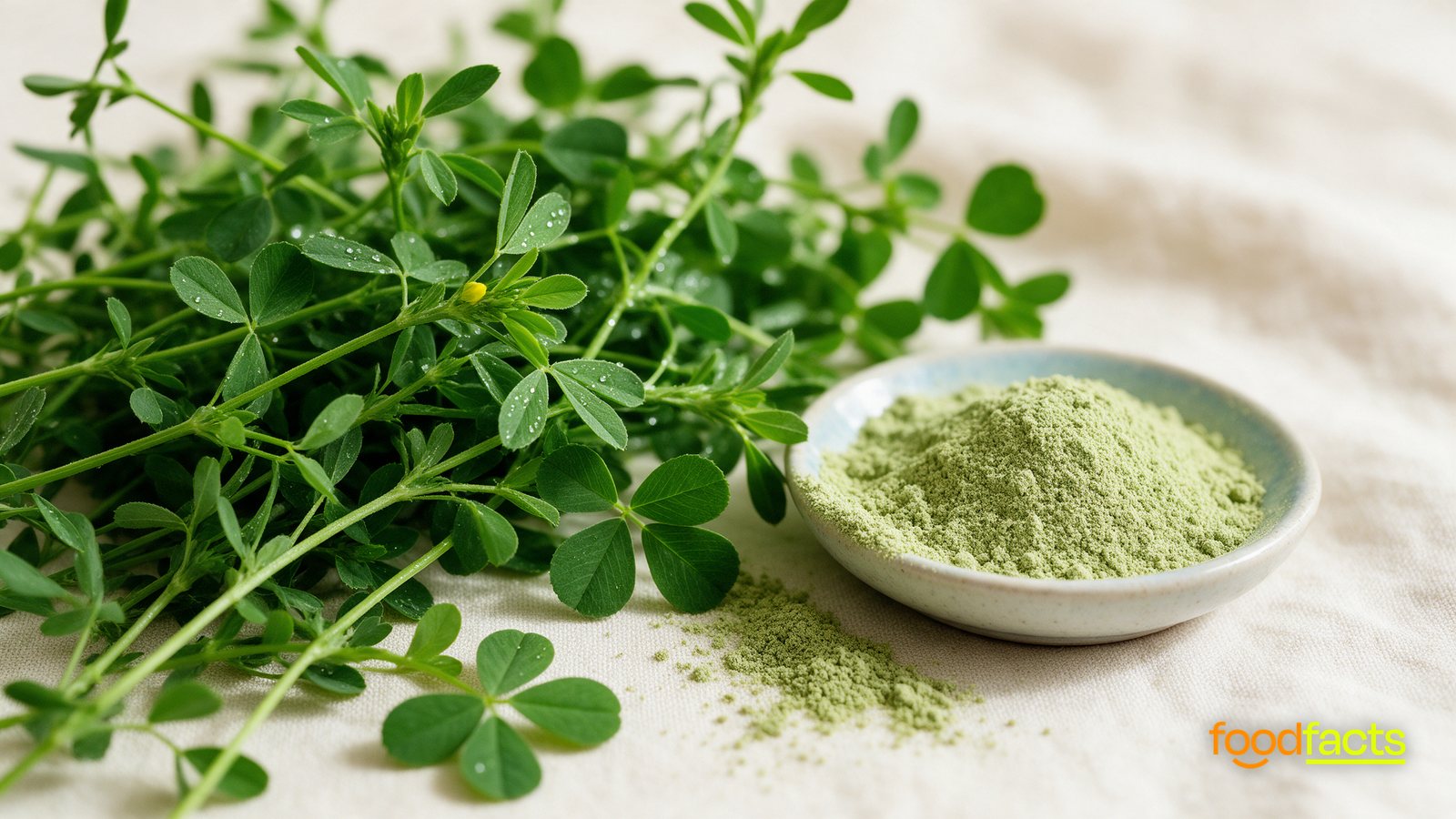




Rubisco: could the world’s most abundant protein become a sustainable food ingredient?


Rubisco is the enzyme that helps plants turn carbon dioxide into food, and it is often called the most abundant protein on Earth. Startups now want to pull it out of leaves and turn it into shakes, baked goods and egg alternatives. foodfacts.org spoke to one of them, New Zealand’s Leaft Foods, and weighed the promise against what the evidence can actually support today (TIME).



There is a paradox at the heart of the rubisco story. The protein is everywhere. It sits inside every blade of grass, every spinach leaf and every field of clover, quietly doing the most important job in biology. Yet almost nobody has knowingly eaten it as an ingredient, and until recently no company had sold it as food at any real scale. A protein that is, by mass, the most common on the planet has been almost entirely absent from the human diet.
That gap is exactly what a handful of food-technology companies are now trying to close. A recent TIME feature put rubisco in the spotlight as an emerging protein ingredient, and the pitch is seductive. If the most abundant protein on Earth grows in ordinary green leaves, why not extract it directly, rather than growing crops to feed animals and eating the animals instead? As always, foodfacts.org is less interested in the pitch than in what stands behind it.
What is rubisco?
Rubisco is short for ribulose-1,5-bisphosphate carboxylase/oxygenase, an enzyme that sits at the centre of photosynthesis. It captures carbon dioxide from the air and helps convert it into the sugars a plant uses to grow, and it is especially concentrated in green leaves. Because plants make so much of it, it is widely described as the most abundant protein on Earth.
Here is the first distinction worth holding onto. “Abundant in the world’s biomass” and “available as a food ingredient” are not the same thing. A protein can be spread across every meadow on the planet and still be difficult, slow and costly to isolate in a clean, food-grade form. Abundance in nature is not the same as abundance on a supermarket shelf.
“This is a protein you have been consuming every day. Every time you eat a green leaf, one of the main proteins you eat is rubisco.” — Leaft Foods, speaking to foodfacts.org
Leaft’s point is that the human body is already deeply familiar with rubisco. The harder question is whether pulling it out of leaves and concentrating it changes the picture, for better or worse.
Why food companies are suddenly interested
Two things make rubisco attractive to product developers: nutrition and function.
On nutrition, companies point to its amino-acid profile. Leaft told foodfacts.org that its ingredient measures a PDCAAS of one, the top of a common protein-quality scale, and that in its own laboratory digestion tests the protein breaks down quickly. We will come back to what that does, and does not, prove.
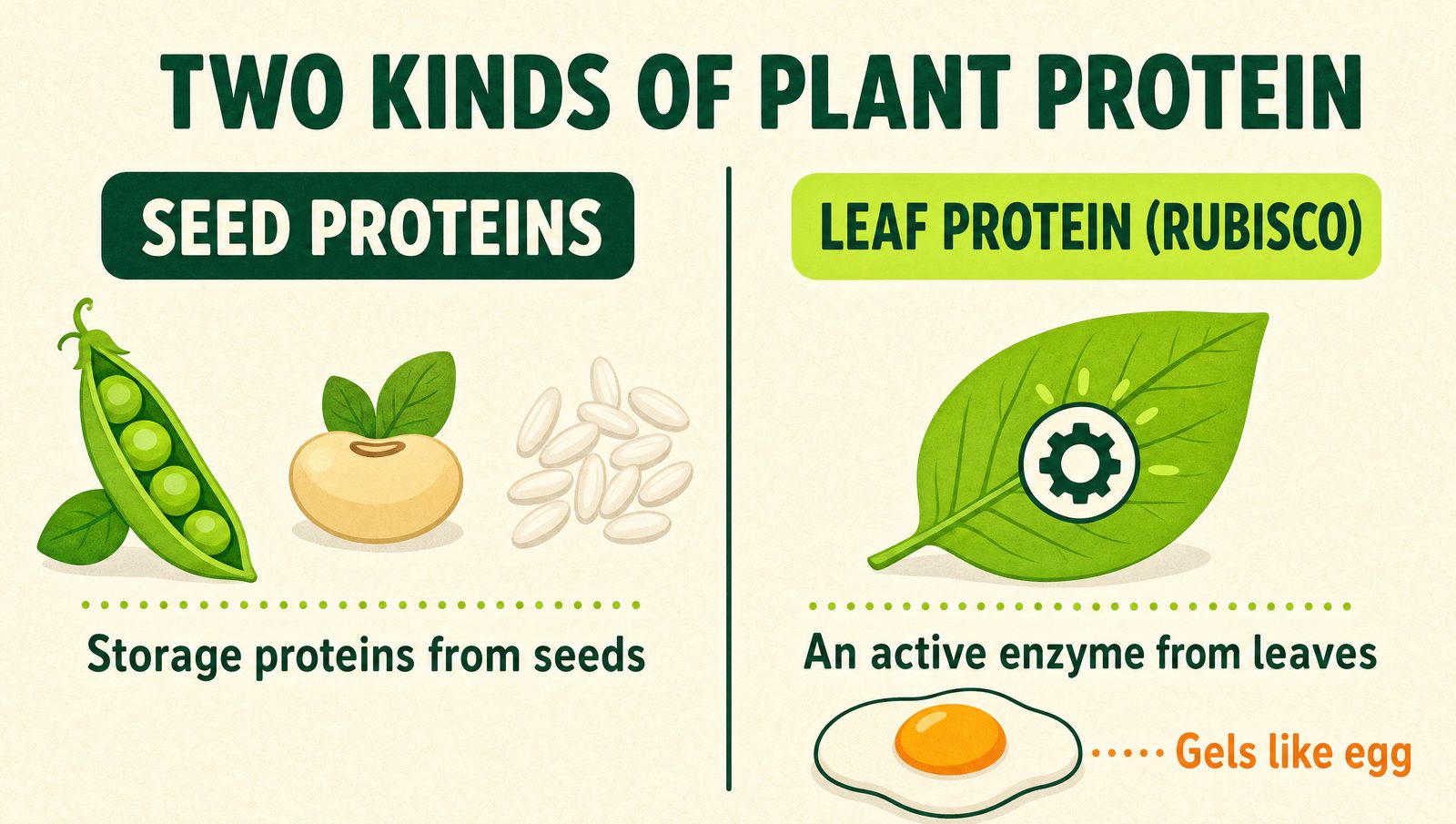
The second reason is “functionality,” and it matters more than it sounds. A protein ingredient is judged not only on grams of protein but on what it can do in a recipe: whether it can foam, gel, emulsify, thicken or set. Leaft argues that rubisco behaves differently from the plant proteins already on the market. “When you think about plant proteins to date, you are really referring to seed proteins,” the company said, pointing to pea, soy, rice and hemp, which are storage proteins milled from seeds. Rubisco, by contrast, is an active enzyme taken from living leaves, and the company says it gels in a way “very similar to the gels that eggs form.” That is why the same ingredient is being eyed for shakes, yogurts, baked goods, egg replacements and, in principle, plant-based meat.
The hard part: getting it out of the leaf
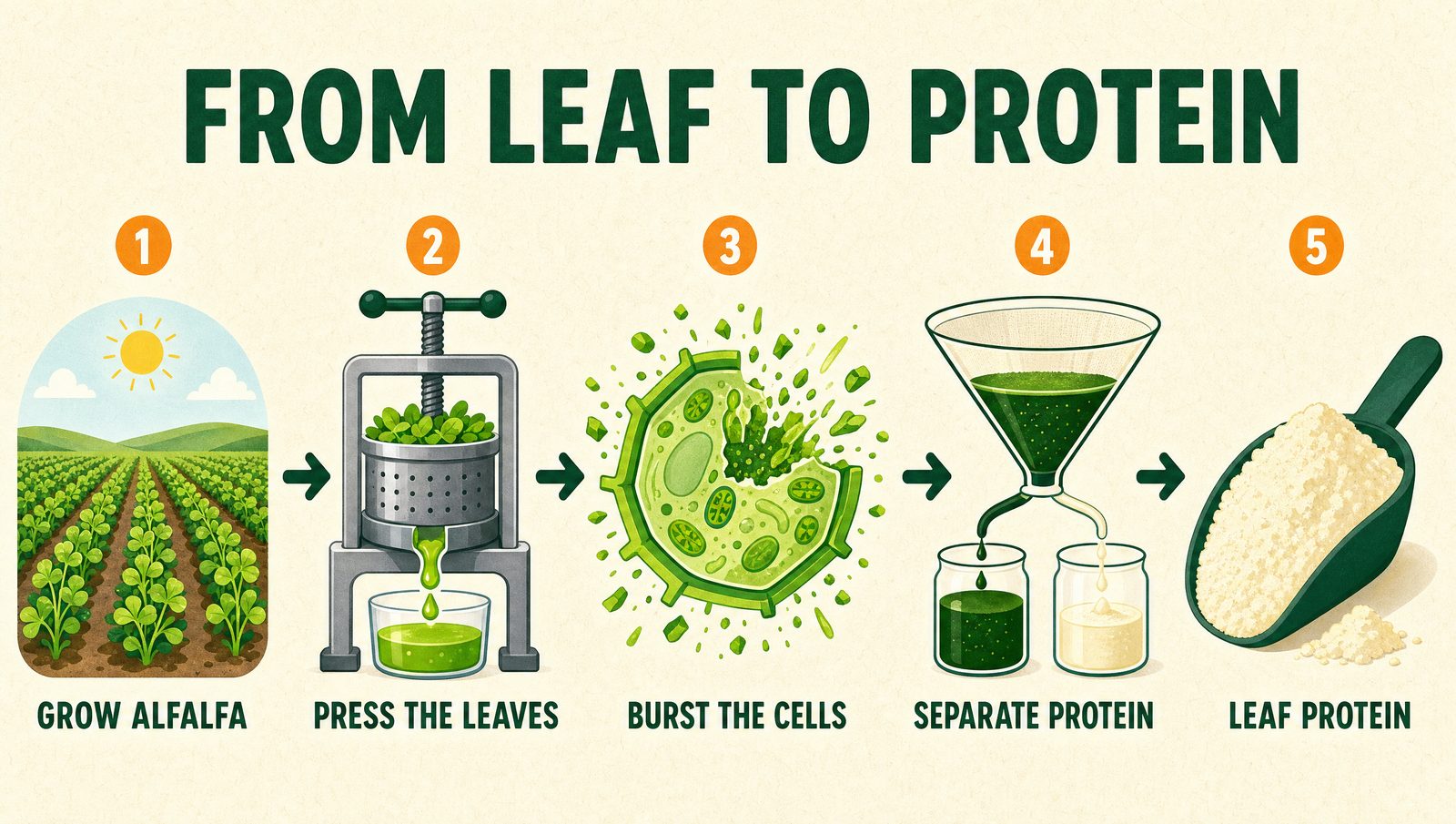
This is where the reality check begins. Rubisco may be abundant, but it is only a fraction of a leaf, so a manufacturer has to process a large volume of foliage to recover a useful amount of protein. “Most abundant” has never meant “easiest to harvest.”
Worse, the very thing that makes rubisco appealing also makes it fragile. The moment a leaf’s cells are broken open, a cascade of enzymatic reactions begins, the same browning you see when a cut apple is left on the counter, and much of it degrades the protein. “We have to open up those plant cells and protect it very quickly, and in the right way,” Leaft said. “That is what has prevented this from being mainstream for the last seventy-odd years.”
That timeline is not marketing. Attempts to turn leaf protein into human food stretch back to the Second World War, and for decades the results were disappointing: low yields, a strong green colour and a denatured protein few people wanted to eat. Independent scientists quoted by TIME, including Grant Pearce at the University of Canterbury and Slavko Komarnytsky at North Carolina State University, have made the same point about how technically stubborn the problem has been. Leaft says it has now solved the speed-and-gentleness problem well enough to reach “commercial-demonstration” scale, producing on the order of a tonne of protein products a week from a 30,000-square-foot site in Canterbury. Independent reporting broadly matches that description. Whether the process scales from tens of tonnes a month to the hundreds it would need for mainstream food, at a competitive cost, is still an open question, and one the company is refreshingly candid about.
The nutrition reality check
A PDCAAS of one and fast laboratory digestion are genuinely promising signals. But they are laboratory characteristics, not proof of what happens in people, and they are, for now, largely company-reported. The standard we hold ourselves to on any protein claim is simple: has the digestibility, amino-acid quality or tolerability been shown in independent human studies, or only in internal testing and lab models?
Leaft points to standard measures, a PDCAAS score and an Infogest laboratory model of digestion, and to strong anecdotal reports from customers with sensitive stomachs. That is a reasonable start, and more than many ingredient start-ups offer. It is not the same as peer-reviewed human trials, and the company was open about that distinction when we asked.
It is also worth resisting the word “complete.” People do not get their amino acids from one food eaten in isolation; they get them across a whole day’s diet. How much protein we actually need, and whether plant-based eaters struggle to get enough, are questions we have looked at before, and the short answer is that most people in wealthier countries already get plenty. An isolated leaf protein, however elegant, is still an isolated ingredient. It is not a stand-in for the fibre, micronutrients and structure of whole beans, grains and vegetables.
The climate and land-use claims
The most striking claims are environmental, and they are the ones that most need independent scrutiny. Leaft told foodfacts.org that its consumer product carries a footprint of about 0.82 kg of carbon dioxide equivalent per kilogram of product, that this is roughly 97% lower than animal proteins and about 3% of the figure for United States whey, and that its system can yield around four times more protein per hectare than a dairy farm.
If those figures hold, they would be a genuine step change, and the logic behind them is intuitive. Growing a leafy crop and extracting protein directly is, in principle, more efficient than growing forage, feeding it to a cow, and then eating the cow or drinking its milk. It echoes the argument at the heart of Europe’s new protein plans, which lean on the same “eat the plants more directly” idea.
But a company-reported footprint is a claim, not a conclusion. A credible number depends on the boundaries of the assessment: the crop and how it is grown, fertiliser and irrigation, the energy used to harvest, chill, extract and dry, transport, packaging, and how the leftover plant material is counted. It also depends on what the product actually replaces. The honest position is the one this story demands. We would want to see the full, independent life-cycle assessment, with its assumptions and comparison products stated, before treating “97% lower” as settled fact.
In Leaft’s favour, alfalfa, also called lucerne, is a sensible crop to build on: a perennial legume that fixes its own nitrogen and sends down a deep taproot, so it tends to need less fertiliser and water than many alternatives. One part of the story is quietly more convincing than the headline number: what happens to the rest of the leaf.
The whole-leaf argument
Leaft describes its process as a biorefinery rather than a single product. After the protein and minerals are removed for human food, the company says the leftover fibre is sold into pet food, and the cellulose-rich material is fed back to cattle, where, it argues, removing the soluble protein may make the animals a little more efficient. “There are around 4,000 individual compounds inside that green leaf,” the company said. “The question is how to separate it into its parts and use each in the most sensible way.” Using the whole crop, rather than discarding most of it, is the kind of circular thinking that makes a sustainability story more plausible, provided those co-product markets are real and durable.
What consumers might actually see
For now, the most visible product is Leaft’s own “Blade,” a small performance-nutrition drink sold directly to consumers in New Zealand and the United States, with roughly 17 grams of protein per serving. Beyond that, the more realistic near-term path is business-to-business: rubisco sold as an ingredient to companies making bakery, drinks and egg alternatives, where it competes on function as much as on protein content. A South Island supermarket group in New Zealand is already trialling it as an egg alternative. Plant-based meat, despite obvious interest, remains a “watch this space” rather than a product on shelves, which fits the wider picture of shifting demand for meat alternatives.
Rubisco is not a one-company field, either. TIME notes California’s Plantible, which makes a duckweed-derived rubisco ingredient called Rubi and has had an FDA “no questions” response to its GRAS safety notice, and Fudi Protein, which positions rubisco as an egg-white alternative. A GRAS “no questions” letter is useful context, but it is worth being precise about what it means. The agency is saying it does not question the company’s own conclusion that the ingredient is safe for its stated uses. It is not a blanket endorsement of every rubisco product, or of any health or environmental claim attached to one.
The bottom line
Rubisco is a genuinely fascinating piece of food science. The idea that we have been eating the planet’s most abundant protein all along, and that we might now extract it cleanly and use the rest of the leaf as well, is exactly the kind of innovation foodfacts.org is glad to see explored. Leaft, to its credit, answered our harder questions openly and did not oversell the gaps.
But fascinating is not the same as proven. The nutritional signals are promising and mostly from the lab. The environmental figures are striking and mostly from the company. The processing, while clearly improved, still has to show it can scale affordably. Rubisco could well expand the plant-protein toolkit in a real way. Before anyone calls it a food-system breakthrough, it needs what every strong claim needs: independent evidence on nutrition, a transparent life-cycle assessment, and a track record at scale. Abundant in nature, promising in the lab, still unproven on the shelf. That is the honest state of play.
Rubisco at a glance
| Question | Clear answer |
|---|---|
| What is it? | A plant enzyme essential to photosynthesis, found in green leaves. Often called the most abundant protein on Earth. |
| Why is it interesting? | It may combine a strong amino-acid profile with useful food-formulation properties, gelling and emulsifying closer to egg than to seed proteins. |
| Why isn’t it already common? | Isolating a stable, pale, food-grade protein from leaves is technically hard and costly. It degrades within minutes once the cells are opened. |
| Is it automatically sustainable? | No. Company-reported footprints look very low, but the real figure depends on cultivation, energy, processing and supply chain, and needs an independent life-cycle assessment. |
| Does it replace whole foods? | No. It is an isolated ingredient, not a substitute for the fibre, micronutrients and structure of whole legumes, grains, vegetables and fruits. |

Independent fact-checking, funded by readers like you.
Misinformation is a growing threat to our health and planet. At foodfacts.org, we're dedicated to exposing the truth behind misleading food narratives. But we can't do it without your support.
References
- foodfacts.org interview with Leaft Foods (Maury Leyland Penno, co-founder, and Ross Milne, CEO), 27 August 2026.
- TIME, “What is rubisco, the most abundant protein on Earth?”
- Leaft Foods, company site and Leaft Blade product information.
- US FDA, Generally Recognized As Safe (GRAS).
- Independent trade coverage of Leaft’s scale and footprint claims (AgFunderNews, Food Dive, Green Queen), cited for context and treated as company-reported.




foodfacts.org is an independent non-profit fact-checking platform dedicated to exposing misinformation in the food industry. We provide transparent, science-based insights on nutrition, health, and environmental impacts, empowering consumers to make informed choices for a healthier society and planet.






.svg)


.svg)

