
-jacob-hero.jpeg)




Meat, masculinity and Jacob Smith's Meta ban




Editor's note: foodfacts.org contacted Jacob Smith for comment for this feature but had not received a response by the time of publication.
Jacob Smith, who has a masters in dietetics, story begins with a tofu video and ends, at least for now, inside one of Meta's harshest moderation categories. It is a story about platform power, but it is also a story about masculinity, misinformation, and the strange cultural force that still turns plant protein into a political trigger.
In most corners of the internet, tofu is just tofu. It is dinner, a cheap protein, a weeknight ingredient, maybe a slight obsession if you know how to crisp it properly. But online, especially in the culture-war end of nutrition discourse, tofu can become something else entirely: a symbol, a provocation, a test of masculinity.

That is the atmosphere hanging over Jacob Smith's case. Smith, a nutrition creator, became the subject of wider public attention after Vox reported on the backlash he faced for eating tofu, framing it as part of a larger story about how meat became a measure of manhood. In public comments and in videos about the ban, Smith has said he was removed from Meta's platforms under its "dangerous individuals and organizations" category, with notices that he says cited reasons such as promoting terrorism and human trafficking.
Tofu today, gone tomorrow.
The surreal quality of this story is hard to ignore. One moment, a creator is talking about plant protein. The next, he appears to be caught inside a policy framework designed for some of the most serious harms Meta says it polices on its platforms.
Smith has publicly said the ban was not framed as a routine moderation error or a vague community-standards strike. In a comment on a Vox Instagram post about the case, he wrote that he had been removed from Meta's platforms for "dangerous individuals and organizations", and that the notice cited reasons such as "promoting terrorism" and related offences. In a separate video, he said the account had been banned for "terrorism or human trafficking", and that there was no option to appeal, which he believed meant the account was gone for good.
That is a shocking category for any nutrition creator to encounter, even before the underlying facts are fully explained. Meta's own public materials show that the company uses its dangerous organisations and individuals rules for entities such as terrorist groups, and for content that offers praise or substantive support, while also saying that news reporting, neutral discussion, academic discussion, and condemnation should still be allowed when the user's intent is clear.
The old myth in new clothes
What happened to Smith does not sit in a vacuum. It sits inside a much older story about meat and masculinity, one that keeps finding new language and new audiences online.
Hubbub's High Steaks research on young men and meat found that men aged 16 to 24 are nearly three times more likely than the general population to say they have increased their meat consumption in the last year, and that men are 50% less likely than women to identify as vegetarian or plant-based. Hubbub also points directly to meat-and-masculinity stereotypes when explaining that pattern, which matters because Smith's case appears to have unfolded in exactly that cultural terrain.

The same research goes further, connecting this shift to the rise of the manosphere, which Hubbub says is having a big impact on how young men think about image, identity, and what counts as masculine behaviour. Eating Better, writing about the same High Steaks findings, said young men are more than twice as likely as older men to say they are eating more meat year on year, reinforcing the idea that this is not a fringe dynamic but a measurable one.
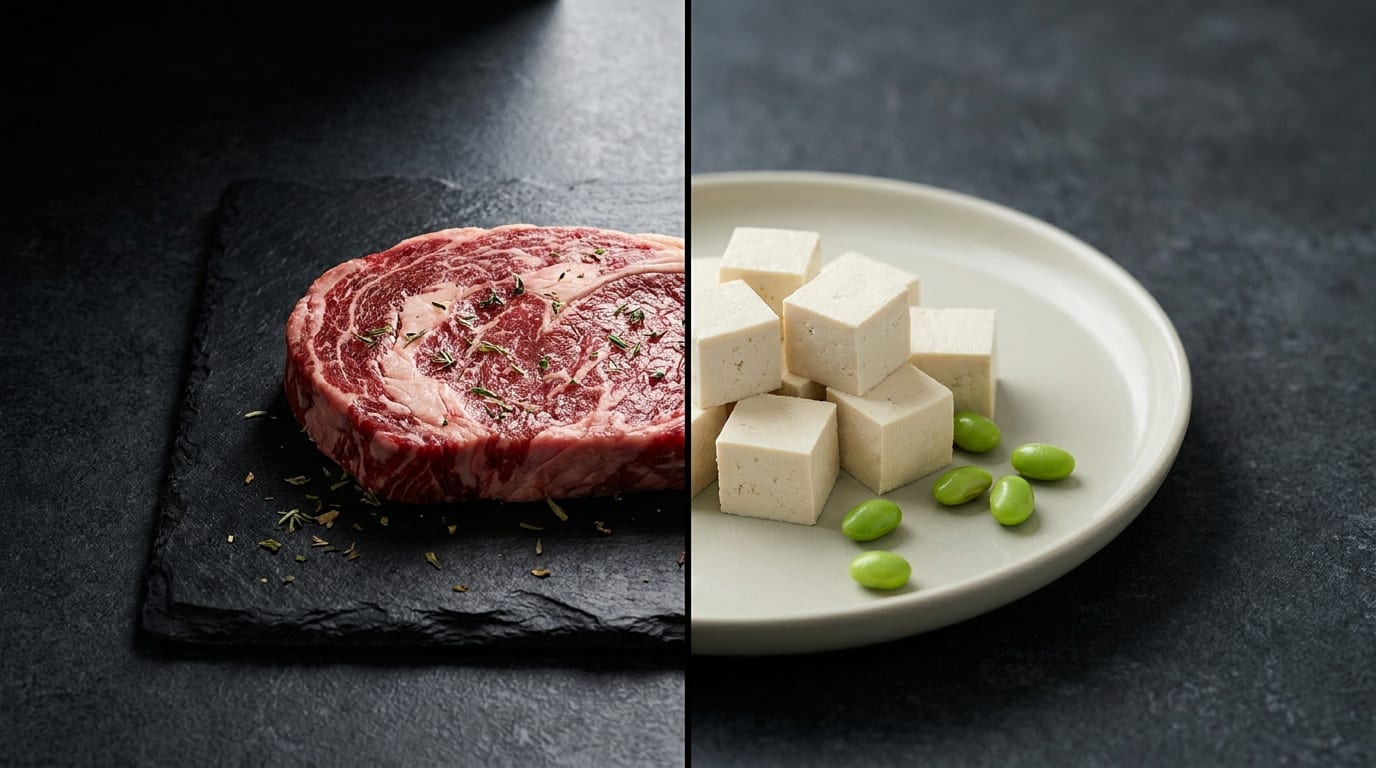
That helps explain why tofu can attract such a disproportionate reaction. In this worldview, food is not just food. It becomes a performance of strength, dominance and belonging. A creator who eats tofu is not simply trying a different protein source. He is read, by the loudest corners of the internet, as stepping outside the rules.
Vox's related video coverage states the basic scientific point plainly: eating soy foods does not change men's hormonal makeup, and soy products are widely understood to be safe foods that can offer health benefits, especially when they replace processed and red meats. The underlying evidence is robust: an expanded 2021 meta-analysis of 38 clinical studies in the journal Reproductive Toxicology found that neither soy foods nor isoflavone supplements affect testosterone or oestrogen levels in men. We dig into the full body of human evidence in our guide on whether soy lowers testosterone, and whether soy is bad for men. Yet myths about soy and masculinity remain sticky precisely because they are not mainly about science. They are about identity. We have looked at this directly before, in our explainer on whether texturised soy protein is really as harmful as influencers claim.
The irony is that tofu is one of the most extensively studied foods in nutrition science, with evidence linking soy consumption to benefits including lower risks of prostate cancer and other chronic diseases. Yet discussing tofu online can sometimes provoke more controversy than discussing genuinely harmful health claims, which is a worrying reflection of the current information environment.
— TJ Waterfall, MSc, Director of Nutrition at foodfacts.org
A policy built for the worst cases
The more closely this case is examined, the stranger the fit appears. Meta's dangerous organisations and individuals system is meant for high-severity content and high-risk actors, not for everyday nutrition videos.
Meta has said publicly that organisations such as Hamas are designated under this policy and that the company removes praise and substantive support for such groups, while continuing to allow social and political discourse, including news reporting, human-rights discussion, academic content, neutral discussion and condemning discussion. That distinction matters, because it shows Meta knows this policy can sweep up legitimate public-interest speech if context is not interpreted carefully enough.

Civil liberties groups have raised that concern repeatedly. The Electronic Frontier Foundation has argued that Meta's dangerous organisations and individuals framework has disproportionately restricted expression in some contexts, and has also said companies must provide accurate and transparent information when posts are removed, so users can understand what happened and challenge it effectively.
That is where Smith's case becomes larger than one account. If a creator discussing tofu and plant protein can end up publicly saying he was penalised under a category associated with terrorism and organised violence, then the moderation problem is not just harsh. It is opaque.
What this case says about nutrition speech
Food misinformation online rarely stays limited to the facts of nutrition. It spills into identity, tribe, gender politics and performance. The tofu backlash that appears to sit behind Smith's story makes sense only in that wider context, where eating meat can be marketed as virility and eating plants can be mocked as weakness.
There is also the question of how his account came to be reviewed in the first place. While there is currently no public evidence showing that mass reporting was the reason for the ban, Smith described receiving significant hostility from some corners of the carnivore and anti-vegan community and implied that his account may have been targeted by opponents, which may have contributed to his account being reviewed.
That is why this case matters to foodfacts.org readers. It shows how quickly a conversation about protein can become a conversation about manhood, and how quickly that conversation can be shaped by a platform with the power to remove a creator first and explain later, if at all. The public record does not prove every detail of what triggered Smith's ban, and it does not justify jumping beyond the evidence. But it does show enough to ask a serious question: what happens to evidence-based nutrition speech when masculinity myths are rewarded by the algorithm and moderation systems fail to distinguish ordinary food content from genuinely dangerous conduct?
That question is bigger than Jacob Smith. It reaches into every fight over soy, meat, masculinity and misinformation online. It is also why we keep pushing back on the deflection tactics used to spread bad nutrition content and writing practical guides to spotting false claims — because the alternative is letting the loudest voices decide what counts as food.
Frequently asked questions
Does eating soy lower testosterone?
No. An expanded 2021 meta-analysis of 38 clinical studies in the journal Reproductive Toxicology found that neither soy foods nor isoflavone supplements affect testosterone or oestrogen levels in men. The claim that soy lowers testosterone is not supported by the human evidence.
Is soy bad for men?
No. Soy is a complete plant protein that is safe for men and is in fact associated with numerous health benefits, including a lower risk of cancer overall and, specifically, of prostate cancer. The belief that soy “feminises” men confuses the plant phyto-oestrogens in soy with human oestrogen, which are chemically different and do not behave the same way in the body.
Is tofu bad for men, and does it cause "man boobs"?
No. Tofu and other soy foods contain isoflavones, but at normal dietary intakes they do not raise men's oestrogen, lower testosterone, or cause breast tissue. The rare case reports of feminising effects involved extreme intakes, such as around three litres of soy milk a day, which bear no resemblance to a normal diet.
What is a "soy boy"?
"Soy boy" is an online insult aimed at men seen as insufficiently masculine because they eat soy or plant-based food. It rests on the false idea that soy feminises men, a claim with no basis in nutrition science, and is closely tied to "manosphere" messaging that frames meat as masculine and plants as weak.
Why did Meta ban Jacob Smith?
Smith, a nutrition creator, has said publicly that Meta removed his account under its "dangerous individuals and organizations" policy, with notices that he says cited reasons such as "terrorism". Meta has not publicly confirmed the details of his case. It drew attention because that policy is built for high-severity threats, not everyday food content.

Independent fact-checking, funded by readers like you.
Misinformation is a growing threat to our health and planet. At foodfacts.org, we're dedicated to exposing the truth behind misleading food narratives. But we can't do it without your support.
Sources + Further Reading
Eating Better (8 June 2025). High Steaks: Why we need to talk about young men and meat.
Electronic Frontier Foundation (26 March 2024). Meta Oversight Board's Latest Policy Opinion a Step in the Right Direction.
Electronic Frontier Foundation (19 September 2025). Companies Must Provide Accurate and Transparent Information to Users When Posts Are Removed.
Hubbub (31 December 2022). High Steaks: How young men are beefing up their diets.
JacobFoods (16 February 2026). JacobFoods Instagram page is banned forever and here's what happened.
Meta (12 October 2023). Meta's Ongoing Efforts Regarding the Israel-Hamas War.
Meta Transparency Center (30 April 2020). Community Standards Enforcement: Dangerous Organizations.
Vox (31 March 2026). How meat became a measure of manhood.
Vox / YouTube (30 March 2026). Does eating tofu impact your masculinity?.
Vox / Instagram (30 March 2026). Nutrition influencer Jacob Smith posted a video of himself cooking tofu.




foodfacts.org is an independent non-profit fact-checking platform dedicated to exposing misinformation in the food industry. We provide transparent, science-based insights on nutrition, health, and environmental impacts, empowering consumers to make informed choices for a healthier society and planet.






.svg)


.svg)

