
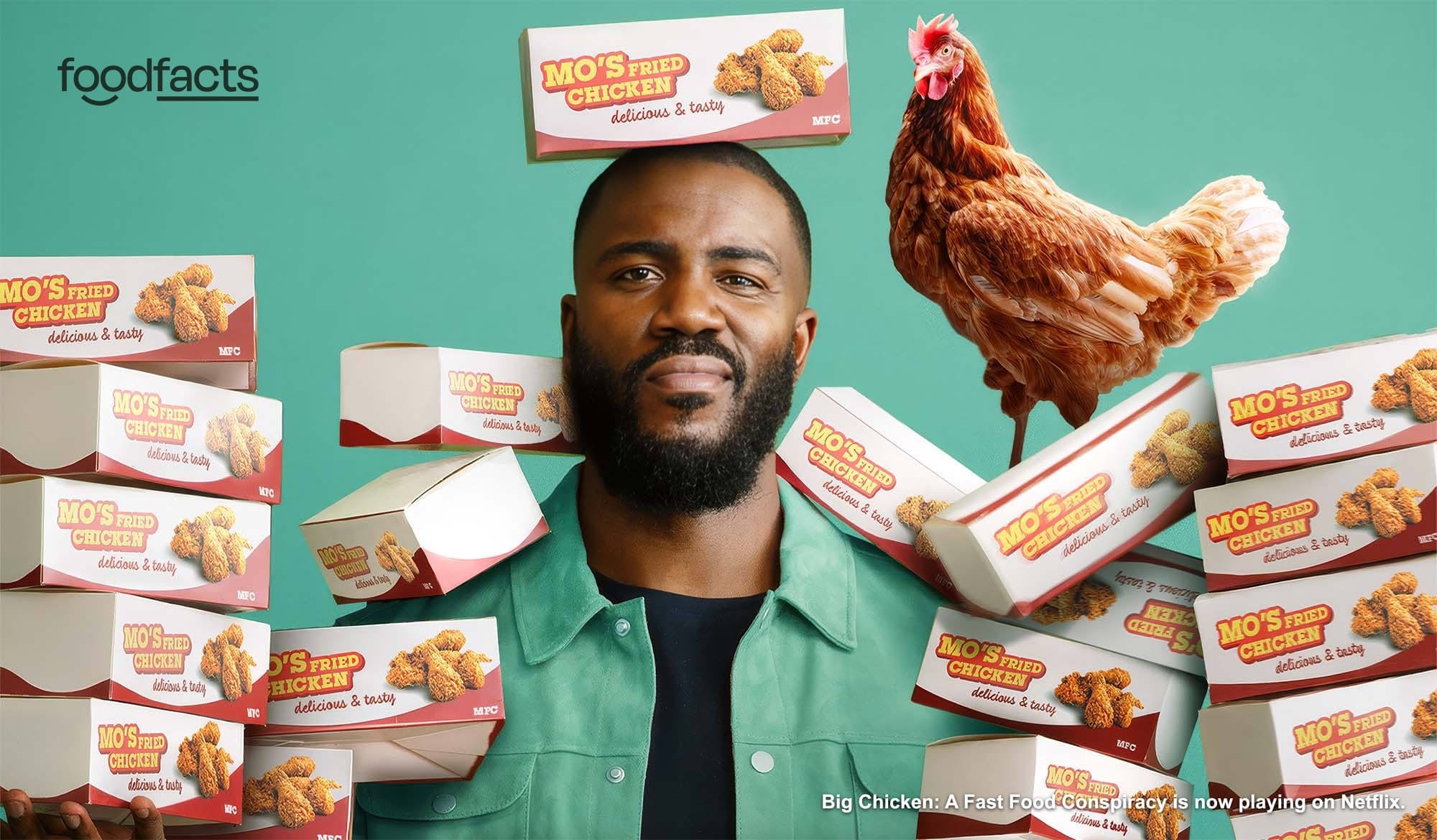




Big Chicken: what Mo Gilligan's Netflix documentary reveals about your fried chicken


Netflix's Big Chicken: A Fast Food Conspiracy sends comedian Mo Gilligan on a 28-day fried-chicken binge that becomes a hard look at how the world's most-eaten meat is really farmed — reopening a row about the gap between marketing and the shed.



Mo Gilligan loves fried chicken. That's the whole premise of Big Chicken: A Fast Food Conspiracy, Netflix's new 96-minute documentary in which the BAFTA-winning comedian eats it three times a day for 28 days straight to find out what his favourite takeaway is actually costing him, and the planet. The film launched globally on Netflix on Wednesday 5 August 2026, and it's already reopening a row that's been simmering in the UK since 2022: the gap between how chicken is marketed and how it's actually farmed.
What the documentary covers
Produced by Mindhouse, the company behind Louis Theroux: Inside the Manosphere, and directed by Liana Stewart, the film follows Gilligan from South London to the United States as he traces fried chicken's historical origins and the industrial machine that turns it into the world's most eaten meat. As a Black British comedian, he also pushes back on the stereotypes attached to fried chicken, unpacking how the dish has been culturally appropriated and marketed. Along the way, according to Netflix's official synopsis, he "uncovers shocking revelations" that force him to reckon with "the unsettling realities behind his favourite takeaway."
Critics have largely welcomed the film's ambition while noting it isn't breaking entirely new ground. Ben Dowell at the Times called it "stark and shocking," pointing out that mass-produced chicken now generates enough faecal waste in America each year to cover London, and that an additive used in processed chicken is also used to lubricate condoms. He also flagged one of the film's more startling comparisons: if human babies grew at the same rate as modern "frankenchickens," they'd be the size of an adult pig within two months.
Benji Wilson at the Telegraph was blunter about where the story goes. Gilligan travels to a British chicken farm in Lincolnshire with animal rights activists, hoping to film current welfare conditions, but backs out at the last minute after security has been tightened. The film's message, as Wilson summarised it, still lands: eat less meat, check the ingredients, and if you don't know what's in your food, don't eat it. Critics at Decider and POV Magazine drew comparisons to Morgan Spurlock's Super Size Me, noting Gilligan brings warmth and comic timing to a format that's been tried before, even if the conclusions feel familiar. IMDb users have rated it 6.5 out of 10 so far.
The KFC connection Glover flagged
The documentary's timing matters to Matthew Glover, co-founder of Project Slingshot and vegan chicken brand VFC, because it revisits a controversy he was personally involved in. Writing on LinkedIn the day after the film launched, Glover called it "worth ninety-six minutes of your time," describing how what "begins as a Super Size Me style stunt becomes increasingly less fun as [Gilligan] follows the supply chain backwards from the chicken shop to the factory farm." He also drew a direct line back to 2022: "KFC UK & Ireland took the YouTuber Niko Omilana to a farm in Lincolnshire to show him how well its chickens were treated."
That reference points straight at an exposé the Guardian reported in April 2022, when KFC's promotional film "Behind the Bucket" showed Omilana touring a supplier farm with fresh straw, working perches and plenty of space. VFC sent its own team to the same farm shortly after and found a very different scene: sodden bedding, dead birds left on the floor, and perches the chickens couldn't actually reach. Glover didn't hold back at the time, calling the KFC video "disingenuous" and "utterly misleading," and asking the question that's still relevant now: "did the farm lie to KFC about its welfare standards, or is KFC lying to the rest of us?"
Ahead of the film's release, Glover had already confirmed Project Slingshot's involvement behind the scenes, writing on LinkedIn that the group "collaborated with Mindhouse on the film, providing footage and context about broiler chicken farming here in the UK." That's the same footage and expertise that underpins much of Project Slingshot's own campaigning against what it calls "frankenchickens."
Project Slingshot and the Frankenchicken campaign
Project Slingshot is the UK's best-funded farmed animal welfare campaign group, running a multi-million-pound push it calls "Don't Buy It," aimed at making factory farming socially unacceptable by 2040. Its latest advert, directed by Simon Amstell, features comedians Jon Richardson, Sara Pascoe and Kerry Godliman taking part in a mock quiz about the conditions inside British chicken sheds, hosted by Sam Campbell. The adverts have also run across the London Underground for six weeks, with Joanna Lumley lending her voice to the campaign, saying frankenchickens should be banned "because we're better than this."
The term "frankenchicken" refers to fast-growing broiler breeds that now make up roughly 90% of the 1.1 billion chickens raised for meat in the UK each year. Project Slingshot co-founder Naomi Hallum put it plainly: "Factory farming has broken the chicken... they spend so long sitting in their own waste, they suffer painful skin burns that you can still see on chicken meat in the supermarket." The comparison that's stuck with critics and campaigners alike, that these birds are bred to grow so fast a human baby on the same trajectory would weigh as much as two gorillas by eight weeks old, is the kind of detail that's hard to shake once you've heard it.
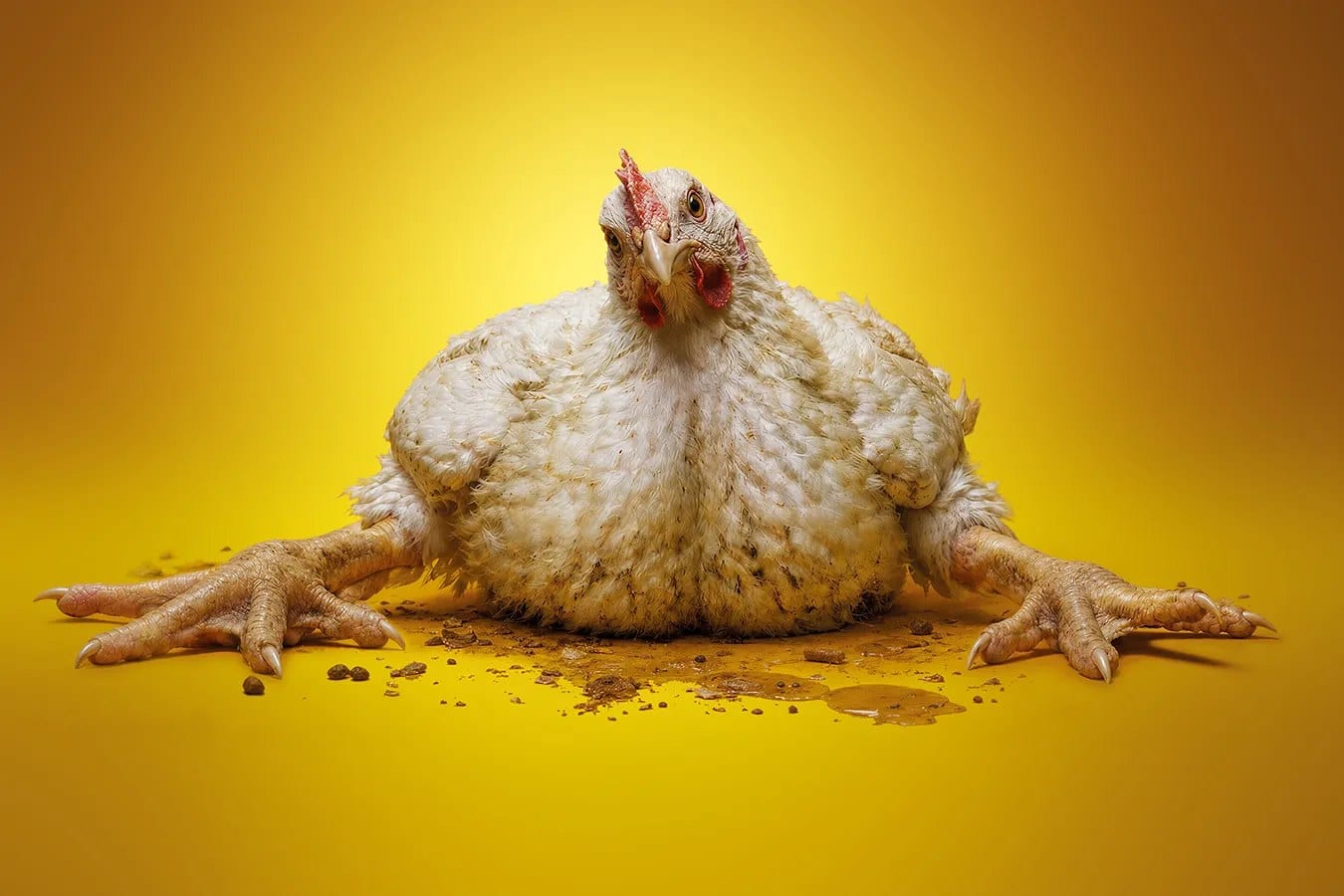
That rapid growth rate isn't a side effect of poor farming; it's the intended outcome of decades of genetic selection, and it's linked to leg disorders, heart failure and an inability to express basic natural behaviour, as foodfacts.org has previously reported. Most of these birds, along with the vast majority of UK meat chickens, are also killed using CO2 gas stunning systems that campaigners argue cause real distress before death, despite being marketed as a welfare improvement.
The same gap, across the Atlantic
Big Chicken follows Gilligan to the United States, and the disconnect he keeps returning to — between how chicken is sold and how it is actually raised — is not confined to the UK. The campaign group Mercy For Animals recently released an undercover investigation alleging extreme cruelty, broken organic promises and serious biosecurity failures at a US farm supplying Costco. The organisation says its findings spanned “blatant animal cruelty,” health protocols “being broken” and “USDA organic standards not being upheld,” and it was the second time in five years it had investigated Costco’s chicken supply chain. foodfacts has not independently verified the footage, and the allegations have not been tested in court.
It is the same question Big Chicken and Project Slingshot keep asking, just with a different retailer’s label on the box: does what is printed on the packaging match what happens in the shed? We unpacked that investigation, and what it means for shoppers, in our report on Costco’s “organic” chicken.
Why it matters beyond one documentary
Whatever you make of the Super Size Me comparisons, Big Chicken lands at a moment when chicken consumption has climbed sharply worldwide, with the average person now eating roughly six times more chicken than in 1961. That growth has been driven almost entirely by the intensive systems the documentary and Project Slingshot are both drawing attention to. Higher welfare alternatives exist, but they're a small fraction of the market, and greater scrutiny of what "welfare" claims actually mean on packaging remains one of the clearest gaps between industry marketing and farm reality.
Watching a Netflix documentary won't change the food system on its own. But if it pushes even a fraction of its audience to ask the same question Glover asked in 2022, whether the label matches the farm, it will have done something useful.
Big Chicken: A Fast Food Conspiracy is now playing on Netflix.

Independent fact-checking, funded by readers like you.
Misinformation is a growing threat to our health and planet. At foodfacts.org, we're dedicated to exposing the truth behind misleading food narratives. But we can't do it without your support.
Broadcast Now (6 August 2026). Critics: Big Chicken: A Fast Food Conspiracy.
Foodfacts.org (23 March 2026). How are chickens killed in the UK? The CO2 method explained.
Foodfacts.org (1 July 2026). Six times more chicken: the hidden costs behind the meat boom.
Foodfacts.org (23 January 2025). Factory Farming: Welfare, Health and Climate Impacts.
Glover, Matthew (9 July 2026). LinkedIn post on Big Chicken: A Fast Food Conspiracy and Project Slingshot's involvement.
Glover, Matthew (6 August 2026). LinkedIn post reviewing Big Chicken: A Fast Food Conspiracy.
Netflix (5 August 2026). Big Chicken: A Fast Food Conspiracy — official synopsis and production notes.
Plant Based News (12 April 2022). 'Humane' KFC Chicken Farm Under Fire As Exposé Discovers 'Filthy' Conditions.
POV Magazine (6 August 2026). Big Chicken: A Fast Food Conspiracy Review — Familiar Nuggets.
The Grocer (2026). Comedians take aim at Frankenchickens in latest Project Slingshot ad.
The Guardian (12 April 2022). KFC faces backlash over 'misleading' portrayal of chicken farming.



foodfacts.org is an independent non-profit fact-checking platform dedicated to exposing misinformation in the food industry. We provide transparent, science-based insights on nutrition, health, and environmental impacts, empowering consumers to make informed choices for a healthier society and planet.






.svg)


.svg)

