




Does the type of fibre in fruit actually affect your blood sugar?


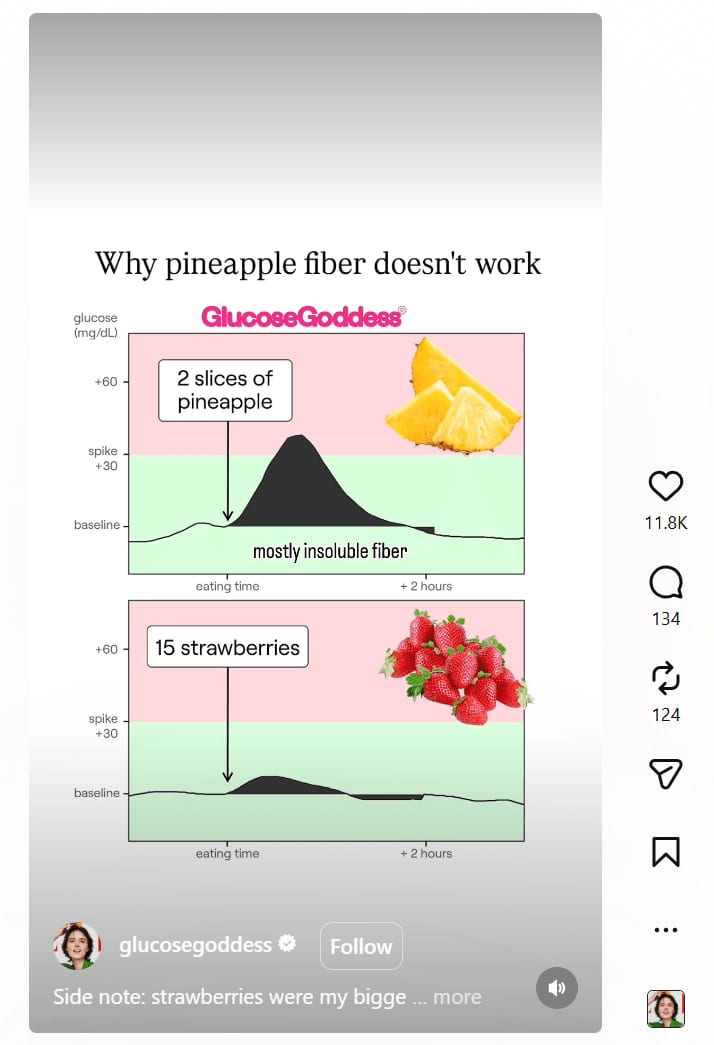
The Glucose Goddess recently posted a reel comparing two graphs, one showing a suggested glucose response following consumption of pineapple, and the second following consumption of strawberries. The reel is entitled “why pineapple fiber doesn’t work”, and suggests that fruits containing more soluble fibre like strawberries are better because they lead to lower glucose spikes compared to fruits containing mainly insoluble fibre.
In this fact-check, we review the evidence on fruit consumption, fibre types and overall health.
Full Claim: Why pineapple fibre doesn’t work? When we eat pineapple you might have noticed it’s quite hard to chew and there is a lot of fibre in there. So you might think “oh well fibre slows down glucose spikes therefore pineapple must create a small glucose spike because of all the fibre there”. Well it turns out there’s two types of fibre. Pineapple is mostly insoluble fibre which doesn’t slow glucose much. It’s mostly good for supporting general digestion and keeping things moving in your gut. Berries on the other hand contain more soluble fibre that actually help reduce spikes by creating a viscous mesh in our intestines that slows down the absorption of glucose.




Both soluble and insoluble fibre play important roles in overall health, and most plant foods contain a combination of both. Focusing on glucose responses in isolation may oversimplify how the body processes whole foods and how dietary patterns influence long-term health.
Comparing foods based on single nutritional components may encourage people to over analyse otherwise healthy choices. For some this could lead to unnecessary restriction of nutrient-rich foods like fruit or increased concern around normal physiological responses such as post-meal rises in blood glucose which may contribute to food anxiety in already healthy populations. Public health guidance consistently supports fruit consumption as part of a balanced diet, without distinguishing between fruits based on fibre type.


Claim: “Why pineapple fibre doesn’t work?...Pineapple is mostly insoluble fibre which doesn’t slow glucose much… Berries on the other hand contain more soluble fibre that actually help reduce spikes by creating a viscous mesh in our intestines”
Fact-check: The claim is based on the common differences between soluble and insoluble fibre, but it is misleading because it overstates the importance of fibre type for blood glucose responses and implies that fibre's primary role is to reduce glucose spikes. In reality, both soluble and insoluble fibres contribute to health through multiple mechanisms, and the effects of whole foods cannot be predicted solely by their soluble-to-insoluble fibre ratio.
What are soluble and insoluble fibres?
Fibre is a type of non-digestible carbohydrate that cannot be broken down by humans (source) . It instead passes through the digestive system and can provide a wide range of health benefits.
This claim is based on the two broad categories of fibre: soluble and insoluble. So to really understand the claim we need to understand these categories.
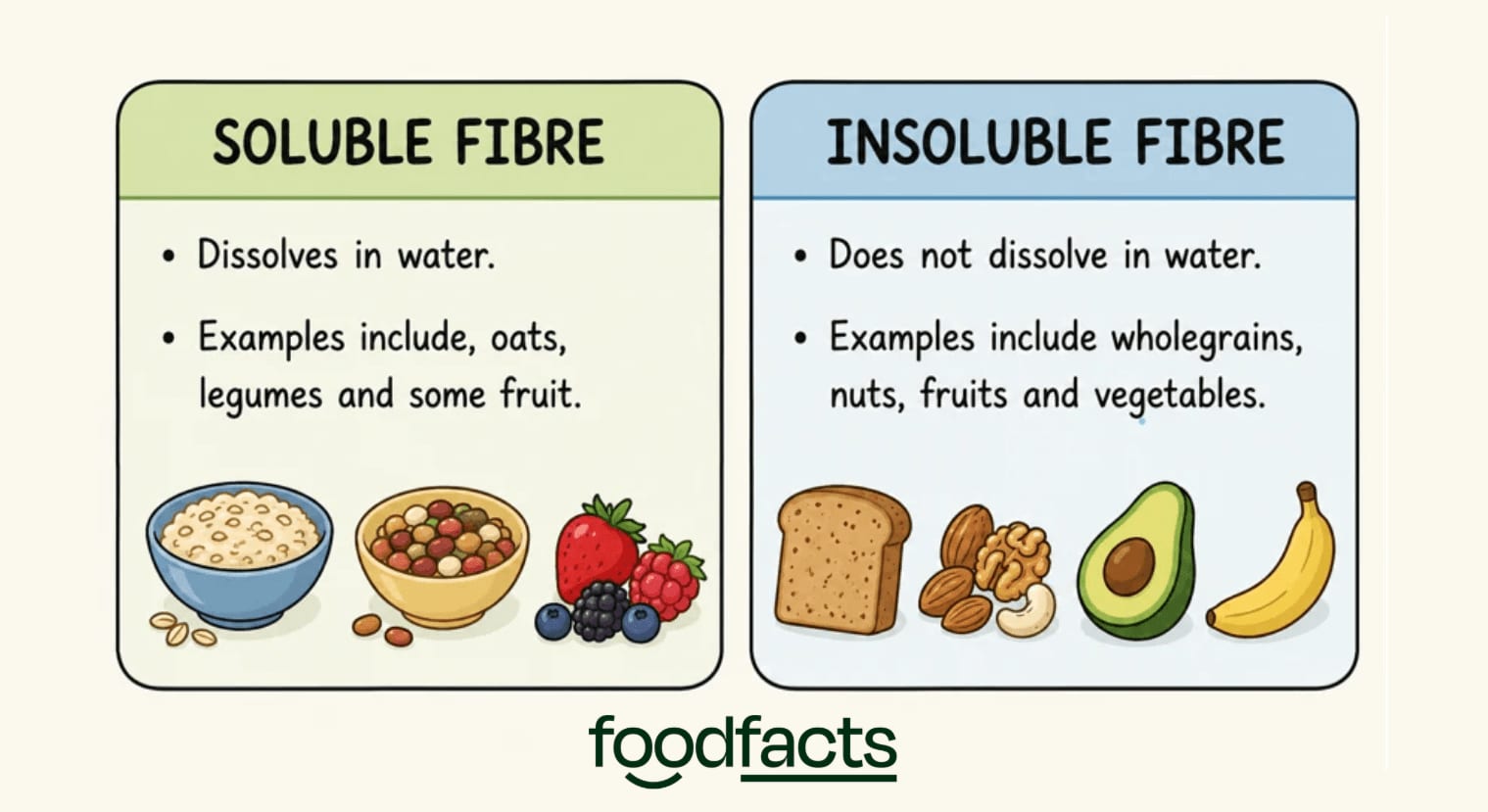
Soluble fibre dissolves in water to form gel like substances in the gut. This can slow gastric emptying and the absorption of nutrients, including glucose. This slowing may help to moderate post-meal rises in blood sugar Foods such as oats, legumes and some fruits contain significant amounts of soluble fibre.
In contrast, insoluble fibre does not dissolve in water and instead adds bulk to stool. This helps to support bowel regularity and digestive health. Fruits, vegetables, whole grains and nuts all contribute insoluble fibre to the diet.
In reality most plant foods contain a mixture of both soluble and insoluble fibre but in varying ratios. In the case of pineapple, although insoluble fibre makes up a larger proportion of its total fibre content, it does contain soluble fibre too!
The claim is therefore mostly correct on the functions of soluble and insoluble fibre, however it is the interpretations of these functions that makes the claim misleading.
Important nuances on soluble and insoluble fibre
Historically, fibre was classified according to whether it dissolves in water (soluble) or not (insoluble). This classification was useful because soluble fibres were often associated with cholesterol lowering and glycaemic effects, while insoluble fibres were associated with laxation and bowel regularity. However, in nutrition science the distinction of soluble and insoluble is increasingly viewed as an oversimplification (source, source, source) and researchers are beginning to recognise that these categories do not always reflect fibre diversity or reliably predict how fibre behaves in the body and its health effects.
Many fibres can exhibit a range of properties. Some are fermentable (broken down by beneficial gut bacteria, helping to support gut health), while others are more viscous (form a gel-like substance that can slow digestion). Fibres also vary in how much water they absorb and in their physical structure. As a result two fibres labelled “soluble” may have different characteristics which influence how they act in the body and affect health outcomes (source).
It’s not that the labels soluble and insoluble are wrong, they just alone might not capture the full picture…
Jessie’s contradicting evidence:
In her caption, Jessie references a study, presumably used to support the statements made in the post/video. The narrative review referenced instead highlights the point that the soluble vs. insoluble classification may be oversimplified, and in doing so contradicts the main point in Jessie’s video.
This narrative review explored existing randomised controlled trials on fibre supplements and their health effects.
The study's central argument is that the common classification of fibre into "soluble" vs. "insoluble" is misleading for predicting health benefits. The authors argue that viscosity (whether a fibre forms a gel when hydrated), not solubility per se, determines clinical effects.
One important note is that this study focuses on fibre supplements; specifically, much of the discussion centres around psyllium and its benefits, making it poor support for Jessie’s argument which focuses on fibre found within whole foods such as pineapple and strawberries. Additionally, the study assesses three main health outcomes: cholesterol lowering, glycaemic control and stool regularity, not just blood glucose alone. This further highlights how the post appears to cherry-pick information to support Jessie’s narrative of ‘glucose spikes’ while overlooking the other key points made within the paper.
In essence, the referenced study actually challenges the main point in Jessie's video rather than supporting it: an important reminder that while the inclusion of scientific references can make a claim seem more trustworthy, studies are not always used in ways that accurately reflect their findings. It's valuable to ensure the study's findings align with the claim being made.
This claim reduces fruit to its impact on blood glucose, overlooking the bigger picture of nutrition. While soluble and insoluble fibre do have different roles in the body, most plant foods contain a mixture of both fibre types. Comparing fruits based on their glucose response is largely irrelevant for most healthy people without an underlying condition and risks distracting from the more important goal of eating a varied, balanced diet.

So does this mean pineapple fibre "doesn't work"?
Overall, the health effects of fibre are not dependent on one type alone, but rather on overall intake and diet variety.
Describing pineapple fibre as something that "doesn't work" is misleading because it implies that the value of fibre should be judged solely on its effect on blood glucose levels. In reality, dietary fibre contributes to health through numerous mechanisms far beyond glucose regulation alone.
Higher fibre intakes have consistently been associated with improved digestive health, metabolic health, weight management, lower risk of cardiovascular disease, reduced risk of colorectal cancer, reduced inflammation and lower overall mortality (source, source). Different fibre types contribute to these benefits in different ways, meaning both soluble and insoluble fibres are important components of a healthy diet.

A reminder on ‘glucose spikes’
The claim focuses heavily on reducing "glucose spikes", but for most healthy individuals, rises and falls in blood glucose after eating are a normal physiological response and not inherently harmful.
In fact, the narrative review referenced by Jessie herself explicitly states that the effects of fibre that were observed on cholesterol lowering and blood glucose levels are greatest in patients being treated for type 2 diabetes and specifically that there ‘no significant effect in euglycemia’ (AKA people with normal blood glucose levels).
Framing foods primarily in terms of their ability to suppress glucose responses may therefore encourage unnecessary concern around normal bodily processes for some individuals. Furthermore, classifying foods as "good" or "bad" based on a single nutritional characteristic ignores the complexity of whole foods and may encourage people to overanalyse otherwise healthy choices.
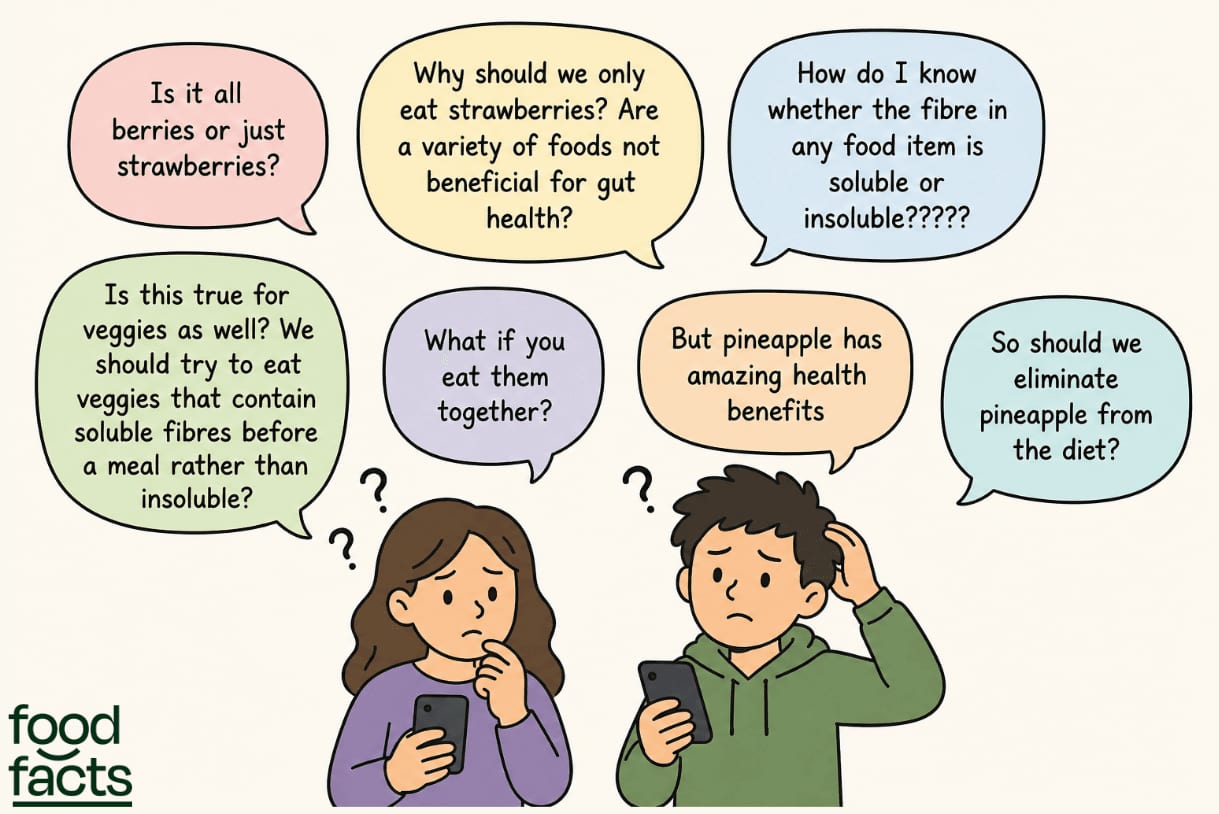
For example, pineapple provides vitamins, minerals, water and fibre, and can contribute to overall fruit intake regardless of the specific proportion of soluble and insoluble fibre it contains.
A more important fibre focus
In the UK, most adults do not consume enough fibre, an issue of greater public health relevance than the differences in specific fibre type between individual fruits. Specifically the recent National Diet and Nutrition Survey found that only 4% of adults meet the 30g per day fibre recommendations. Guidance from many health organisations including the British Nutrition Foundation, emphasises total fibre intake from a range of plant foods, rather than prioritising specific types from individual foods.
These public health recommendations for increasing fibre intake are driven by evidence relating to health benefits such as lower incidence of cardiovascular diseases, coronary events, type 2 diabetes mellitus and colo-rectal cancer, not glucose responses alone. Framing fibre exclusively through the lens of glucose spikes risks understating many of its most important health benefits.
Overall, some aspects of Jessie’s claims in this post may be misleading, because they are framed in a way which risks misrepresenting the role of fibre, and because the study referenced appears to contradict rather than support the main point. . The statement that pineapple fibre "doesn't work" reduces the role of fibre to a single function and overlooks the many health benefits associated with both soluble and insoluble fibre.
Rather than focusing on individual nutrients or bodily responses, we should instead focus on the overall quality and diversity of our diets, aiming for a balanced diet with a variety of fruits and vegetables.
We have contacted Jessie Inchauspe and are awaiting a response.
Disclaimer
This fact-check is intended to provide information based on available scientific evidence. It should not be considered as medical advice. For personalised health guidance, consult with a qualified healthcare professional.
Independent fact-checking, funded by readers like you.
Misinformation is a growing threat to our health and planet. At foodfacts.org, we're dedicated to exposing the truth behind misleading food narratives. But we can't do it without your support.
For a deeper dive into the science and nuances of ‘glucose spikes’ why not check out our previous fact check here.
Sources
- British Dietetic Association (2021). Fibre. [online] British Dietetic Association. Available at: https://www.bda.uk.com/resource/fibre.html.
- NHS inform. (2026). Fibre | NHS inform. [online] Available at: https://www.nhsinform.scot/healthy-living/fibre/fibre/.
- Khorasaniha, R., Olof, H., Voisin, A., Armstrong, K., Wine, E., Vasanthan, T. and Armstrong, H. (2023). Diversity of fibers in common foods: Key to advancing dietary research. Food Hydrocolloids, 139, p.108495. doi:https://doi.org/10.1016/j.foodhyd.2023.108495.
- Williams, B.A., Mikkelsen, D., Flanagan, B.M. and Gidley, M.J. (2019). ‘Dietary fibre’: moving beyond the ‘soluble/insoluble’ classification for monogastric nutrition, with an emphasis on humans and pigs. Journal of Animal Science and Biotechnology, 10(1). doi:https://doi.org/10.1186/s40104-019-0350-9.
- McRorie, J.W. & McKeown, N.M. (2017). Understanding the Physics of Functional Fibers in the Gastrointestinal Tract: An Evidence-Based Approach to Resolving Enduring Misconceptions about Insoluble and Soluble Fiber.
- Barber, T.M., et al. (2020). The Health Benefits of Dietary Fibre.
- Anderson, J.W., et al. (2009). Health benefits of dietary fiber.
- British Nutrition Foundation (2023). Fibre - Nutrition Information.
- Scientific Advisory Committee on Nutrition (2015). Carbohydrates and Health.



foodfacts.org is an independent non-profit fact-checking platform dedicated to exposing misinformation in the food industry. We provide transparent, science-based insights on nutrition, health, and environmental impacts, empowering consumers to make informed choices for a healthier society and planet.






.svg)


.svg)

