
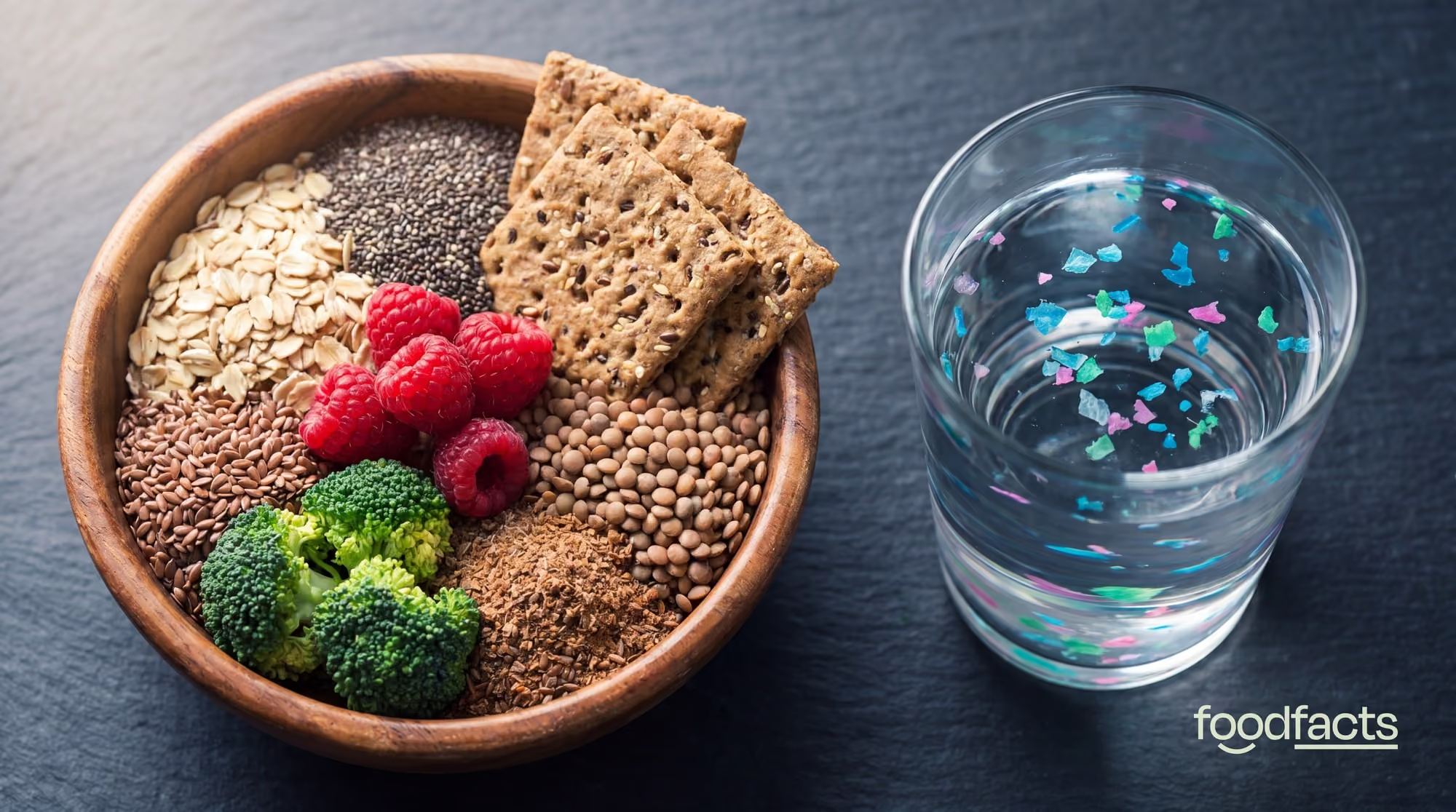




Can fibre help your body excrete microplastics? Here is what the research shows


On a recent episode of the Thomas DeLauer Podcast, Dr. Rhonda Patrick made a claim stating, “Fibre is your best bet against microplastics because insoluble fibre moves them through faster and soluble fibre coats them so they can’t be absorbed.”
In this fact-check, we assess the evidence on fibre and microplastics to establish what current research shows about fibre’s role in microplastic exposure and absorption.



Microplastics have been detected in human blood, which supports the idea that some particles can cross biological barriers. Other research suggests microplastics can affect gut health in animal models, including the gut barrier and microbiome, which is why scientists are interested in whether fibre might help. The claim does not mention that the strongest direct evidence so far comes from animal studies, which might lead the audience to infer the evidence is stronger than it currently is.
This claim sounds practical and reassuring, particularly in the context of heightened conversations online about microplastics and their impact on health. However, short clips that focus on punchy soundbites can sometimes miss balancing actual risks and giving practical advice. For example, in the full interview, Dr. Patrick acknowledges that reducing exposure from plastic in food packaging, water, and the environment are important when looking at the bigger picture. But this added advice was not included in the widely shared clip examined here, which mimics a familiar ‘detox solution pattern’ often observed online. This fact-check highlights the importance of evidence-based claims, because presenting health advice as definitive can lead people to confuse an emerging hypothesis with a proven method. Though Dr. Patrick warned against online detoxing in the full interview, it is important to seek out evidence that contributes to the full picture rather than relying on clips which appeal to fear and lack of knowledge about microplastics.


Claim 1: “Fibre is your best bet against microplastics.”
Fact-check: Microplastics may potentially be reduced through certain dietary fibres like chitosan, but current evidence from human studies remains limited.
Over the last decade, microplastics have become topical, as they pose a significant risk to human health through diet and the food chain. Plastics are a part of everyday life due to their affordability, portability and corrosion resistance; microplastics specifically are new to scientific study as researchers seek to understand the true impact on gastrointestinal health.
The way microplastics can be removed may vary depending on their type, such as whether they are primary or secondary. Primary microplastics are microfibres, microbeads and particles found in items like scrubs and toothpaste, which have been processed and used prior to interacting with the environment. Secondary microplastics consist of tiny fragments from other plastic products over time such as water bottles and single use plastics. Microplastics are not expected to be broken down by normal gastrointestinal digestion, although their fate in the body remains unknown. A 2024 review discusses dietary fibres as a promising way to reduce microplastic impact, but it frames the evidence as emerging, as the mechanism is still being studied. The review suggested that dietary fibres may be a potential strategy to reduce the impact of microplastics on the body, but emphasises the lack of studies addressing an effective removal mechanism from the body. It states that the accumulation of microplastics may be degraded into carbon dioxide and water through intestinal microbial action. In-vivo experiments, those conducted within a living body are needed to test this mechanism.
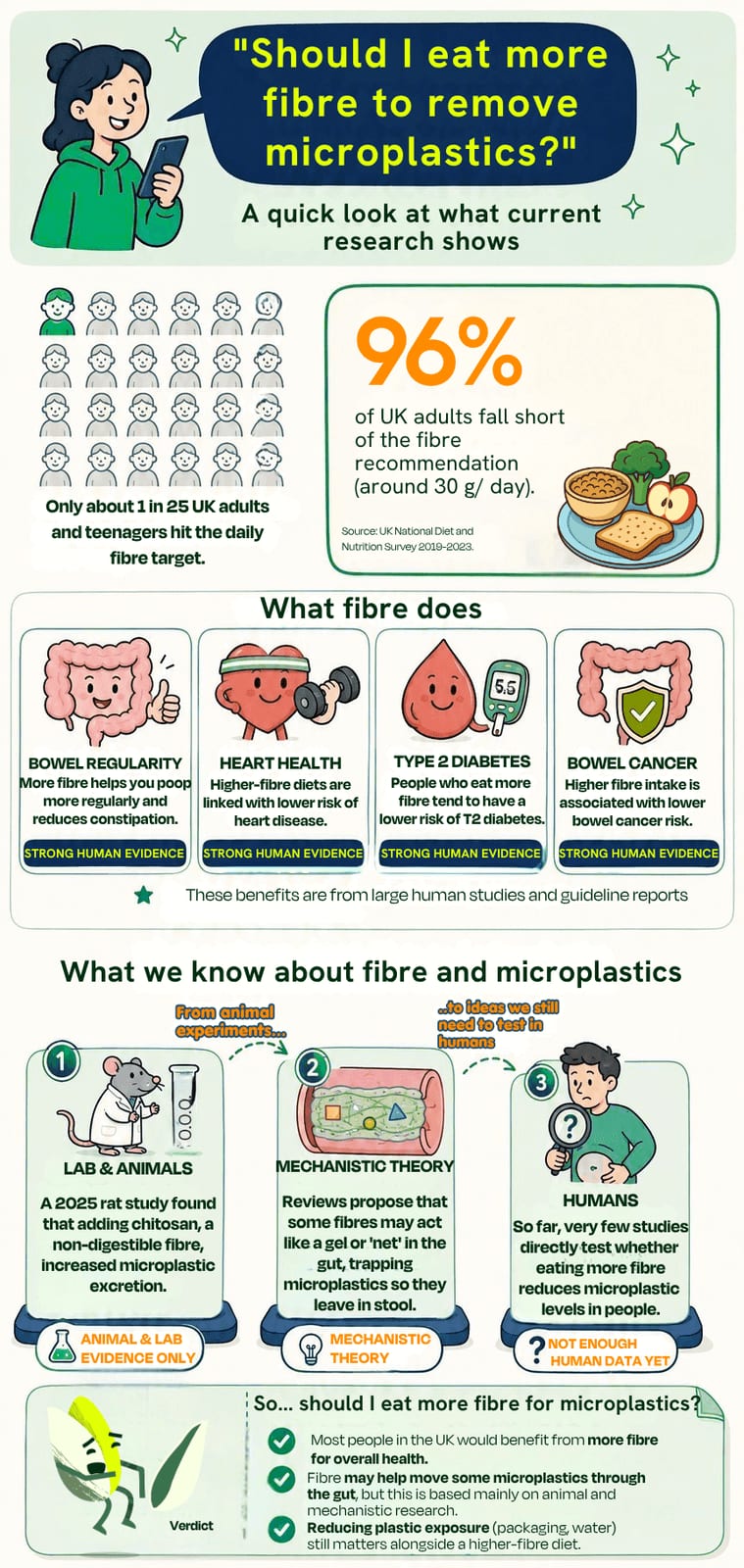
One 2025 animal study found that Chitosan, a non-digestible dietary material, increased microplastic excretion in rats. The group of rats given chitosan saw higher stool weights, higher microplastic excretion and lower intestinal retention of microplastics. However, this does not speak to having the same effect in humans or for all dietary fibres.
Claim 2: “Insoluble fibre moves microplastics through faster, so you poop out more.”
Fact-check: Some scientific evidence has shown that certain fibres may help to bind microplastics together in the gut and help them to be excreted more in stools, but this is yet to be tested in humans.
Speculations have been made into the ability of insoluble fibres to trap microplastics and carry them away with other waste, but to say that the plastics will move along faster is misleading. Faster intestinal transit can reduce contact time with the gut lining, but the claim that insoluble fibre specifically makes people excrete more microplastics is not established by direct human trials in the sources found.
Claim 3: “Soluble fibre coats microplastics and prevents absorption.”
Fact-check: Evidence of soluble fibre coating microplastics and preventing absorption is largely theoretical.
Fibre plays an essential role in maintaining gut health, promoting regular bowel movements, while also helping to control blood sugar levels, particularly for individuals consuming carbohydrates. It is suggested that dietary fibre may help the body get rid of microplastics by helping trap and remove them before they are absorbed. Reviews and popular coverage describe a possible gel-like or binding effect in the gut, but that is still a proposed mechanism yet to be confirmed through in vivo testing.
Final take-away
Though evidence suggests fibre may help support gut health and potentially reduce microplastic uptake, the claim that it is your “best bet” against microplastics appears to be ahead of the science, as it describes a plausible mechanism, not a proven detox strategy.
At the same time, the UK has a major fibre gap: the government guidance recommends 30 g of fibre a day for adults, but the average intake is closer to 16–20 g, and only around 4% of adults actually reach the target. This means that almost everyone could benefit from eating more plant foods for reasons that go far beyond microplastics.
That makes it reasonable to say “more fibre is a good idea anyway” for digestion, heart health and the gut microbiome while being clear that using fibre specifically to “flush out” microplastics is still an emerging hypothesis, not a guaranteed solution.
We have contacted Dr Rhonda Patrick and are awaiting a response.
Disclaimer
This fact-check is intended to provide information based on available scientific evidence. It should not be considered as medical advice. For personalised health guidance, consult with a qualified healthcare professional.
Independent fact-checking, funded by readers like you.
Misinformation is a growing threat to our health and planet. At foodfacts.org, we're dedicated to exposing the truth behind misleading food narratives. But we can't do it without your support.
Sources
- Muneshige Shimizu et al. (2025). “Ingesting chitosan can promote excretion of microplastics.”
- Food Frontiers review (2024). “Fighting microplastics: The role of dietary fibers in protecting health.”
- Science Focus (2026). “The simple, science-backed way to help clear microplastics from your body: fibre.”



foodfacts.org is an independent non-profit fact-checking platform dedicated to exposing misinformation in the food industry. We provide transparent, science-based insights on nutrition, health, and environmental impacts, empowering consumers to make informed choices for a healthier society and planet.








.svg)


.svg)

