
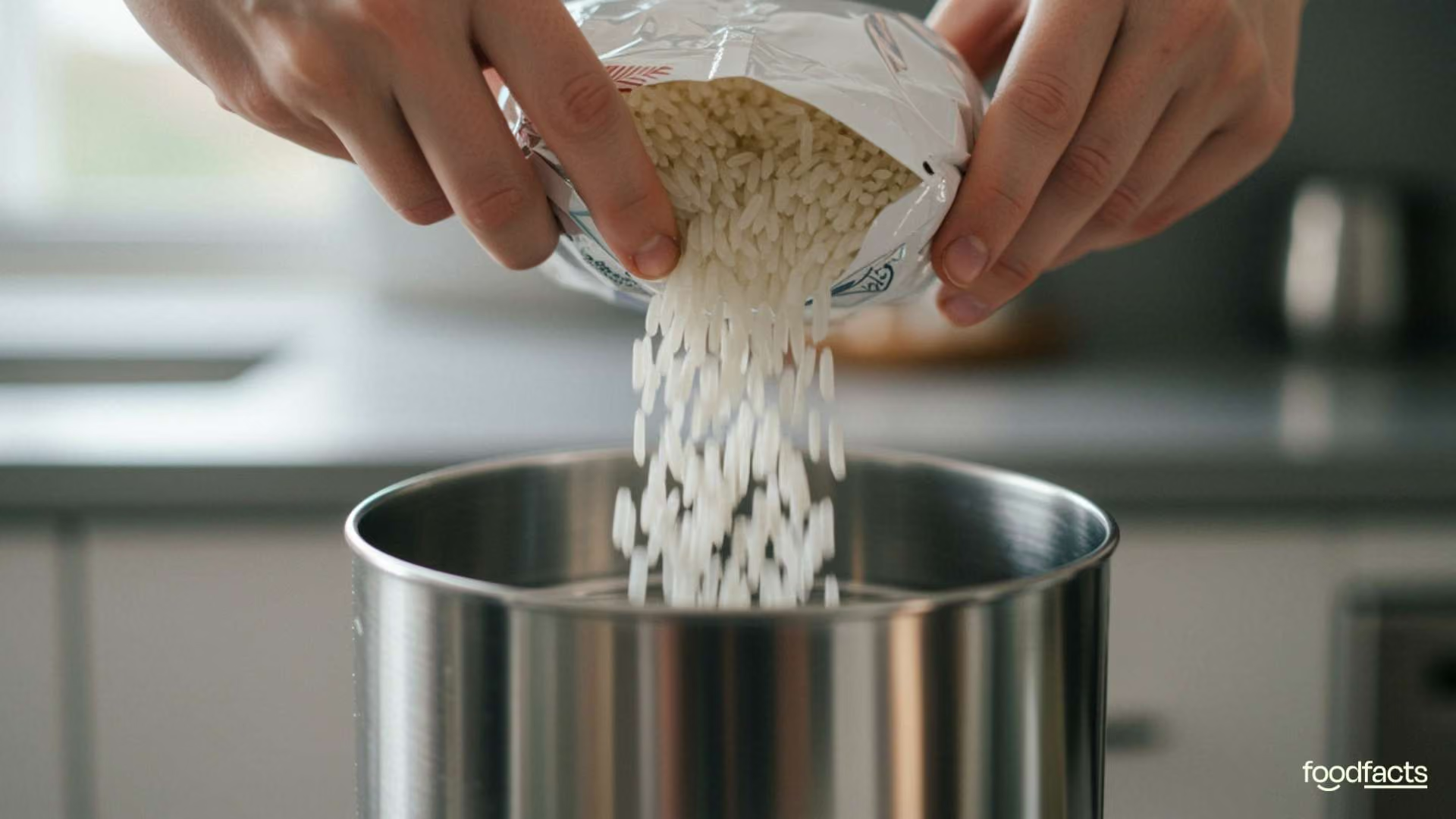




Could white rice be poisoning you? Here's what the evidence actually says about arsenic in rice


Cardiologist Dr. Pradip Jamnadas stated on The Diary of a CEO podcast that “you’d be surprised by how much arsenic there is in rice these days”, implying that white rice could be harming our health.
This fact-check determines whether the concern is justified by examining the scientific evidence behind arsenic in rice.



The claim that white rice is “poisoning” people due to arsenic doesn’t consider the bigger picture. Rice naturally absorbs more inorganic arsenic than other grains, but levels in most Western countries remain within safety limits and risks depend on intake, water quality and preparation. Evidence shows that simple preparation techniques can reduce arsenic, and for most people, rice remains safe to eat.
Arsenic pollution is a real issue in parts of the world, but sensational claims can distort that reality and distract from where the true risks lie. Fact-checking these claims ensures the public understands the difference between genuine health threats and overstated online warnings.


Claim: “While rice is a staple food for many, [Dr. Pradip Jamnadas] warns that regular consumption without awareness could be quietly harming your health.”
White rice is a staple food in many households, often served with curries or stir fries. But this online claim warns us that “arsenic is a very strong poison” and “it will slowly kill you”. So, what does the evidence say?
What is arsenic, and why is it in rice?
Arsenic is a naturally occurring element, found in soils, rocks, groundwater and surface waters of the earth’s crust, and it is widely distributed around the world. As this exists in our environment, it can enter the food chain (source).
It occurs in two forms:
- Organic arsenic, which is generally less harmful;
- Inorganic arsenic is more toxic, a confirmed carcinogen (source).
Rice is known to contain higher levels of inorganic arsenic compared to other grains.
The reason for this is how rice is grown. Many rice varieties are cultivated in flooded paddy fields, where oxygen levels in the soil drop. Under these anaerobic (processes that occur without oxygen) conditions, arsenic in the soil converts to arsenite which dissolves in soil water, becomes available to rice roots and can be absorbed by rice via silicon transporters (source, source).

Does this mean rice is dangerous?
Not necessarily. The presence of arsenic in rice does not automatically make it harmful. The health risk depends on:
· How much arsenic is in the rice
· Where the rice is grown
· How the rice is prepared
· How much rice a person eats
· Whether their drinking or cooking water contains arsenic
Most studies linking arsenic to cancer and cardiovascular disease involve high exposure levels, typically far greater than what most people ingest through diet alone. To put this in perspective, it is like standing in intense sun compared with the mild sunlight people experience daily (source). Still, emerging evidence suggests that even low levels of inorganic arsenic exposure may carry risks, depending on several factors such as dietary intake, duration of exposure and the presence of arsenic in local sources. However, the evidence is not yet conclusive, as these findings mainly show links and are based on estimated intakes, so they cannot prove that arsenic directly causes these effects (source, source).

Why location matters
In regions where groundwater contains naturally high arsenic levels, using that water for drinking or cooking can significantly increase exposure. For example, research in Bengal, India found that even households using safe drinking water still exceeded the JECFA (Joint Expert Committee on Food Additives) guideline of 3µg per kilogram of body weight per day in 67% of participants because they cooked rice with arsenic- contaminated water. Rice is a staple food in this community, eaten frequently and in large portions, making cooked rice the main source of arsenic exposure. Also, rice grown in these regions tends to naturally contain higher levels of arsenic, which further increases overall exposure (source).
In many Western countries, both drinking water and rice production are under safety regulations, so inorganic arsenic levels in rice generally meet legal limits. For moderate rice eaters, these regulations are likely to keep arsenic exposure levels below levels considered risky. However, safety regulations do not necessarily guarantee zero risk: recent assessments suggest that high dietary exposure to inorganic arsenic may remain a health concern, although many studies indicate that average rice consumption in Western diets usually remains below concerning levels (source, source). Additionally, bioaccessibility studies show that the human body may not absorb all the arsenic present, which would further reduce the risk (source).
Who is most at risk?
· People who eat large amounts of rice daily
· Populations in areas with arsenic-contaminated water
· Infants, especially those consuming rice-based product (due to lower body weight) (source)
Can certain preparation/cooking methods reduce arsenic?
Yes. Evidence shows that arsenic levels can be reduced by:
- Rinsing or soaking rice before cooking (as mentioned by Dr. Pradip Jamnadas).
- Cooking in excess water (like you would with pasta – about 5x the water volume) and draining it afterwards. Cooking rice in large amounts of water can also leach out some water-soluble nutrients, so a balance between reducing arsenic and preserving nutritional value is recommended.
- Parboiled-with-absorption (PBA) method:
- Briefly boil the rice in plenty of water for 5 minutes.
- Pour out and discard the water.
- Add fresh water and cook the rice normally until all the water is absorbed.
This method removes a large portion of arsenic while keeping most of the nutrients in the rice (source).
Studies show that rinsing and cooking rice in excess water can reduce 30-60% of inorganic arsenic, depending on rice type, water quality and method (source, source).
It is important to consider:
*These methods are most useful for people who eat rice frequently, but for those who eat rice occasionally, the impact is much smaller and the methods are less critical.
* Brown rice generally carries higher arsenic levels than white rice because arsenic accumulates in the outer bran layer, though it also provides more micronutrients and fibre. Proper cooking methods can help reduce arsenic in both types (source).

The big picture
This claim grabs attention because it frames a common, everyday food as secretly dangerous, playing on fears about hidden toxins and health risks.
Rice can be included in a balanced and varied diet as it’s a source of complex carbohydrates for energy, has small amounts of protein and B-vitamins, and is naturally gluten free. It’s easy to digest, inexpensive and widely accessible, which is why it remains an important staple food around the world (source).
Arsenic in rice is just one part in a complex picture of diet and health. Targeted strategies such as rinsing or soaking rice, using safe water, and diversifying grains are more effective than avoiding rice entirely. Focusing on a single food can exaggerate perceived risk and distract from overall dietary patterns, which matter most for long-term health. Rice can safely be part of a balanced diet when preparation methods are used to reduce arsenic exposure.
Final takeaway
For most people, eating white rice is safe and does not ‘poison’ the body. Typical consumption patterns and food-safety regulations keep the risk low. People who consume large amounts of rice or cook with arsenic-contaminated water face higher exposure, but paying attention to water quality, portion size and cooking methods can further reduce any risk.
We have contacted Dr Pradip Jamnadas and are awaiting a response.
Disclaimer
This fact-check is intended to provide information based on available scientific evidence. It should not be considered as medical advice. For personalized health guidance, consult with a qualified healthcare professional.
Independent fact-checking, funded by readers like you.
Misinformation is a growing threat to our health and planet. At foodfacts.org, we're dedicated to exposing the truth behind misleading food narratives. But we can't do it without your support.
Sources:
- Myśliwiec, M. et al. (2024). “Arsenic in rice and rice‑based products with regard to consumer health.”
- World Health Organisation (2022). “Arsenic.”
- Zhao, D. et al. (2024). “Arsenic bioaccessibility in rice and its application to derive health‑based limits in China.”
- Biswas, B. et al. (2021). “Arsenic exposure from drinking water and staple food (rice): A field scale study in rural Bengal for assessment of human health risk.”
- Kononenko, M. & Frishman, W. (2021). “Association Between Arsenic Exposure and Cardiovascular Disease.”
- Moon, K. et al. (2012). “Arsenic exposure and cardiovascular disease: an updated systematic review.”
- Navaretnam, R. et al. (2025). “Arsenic speciation using HPLC–ICP–MS in white and brown rice and health risk assessment.”
- Mwale, T. at al. (2018). “Risk and Benefit of Different Cooking Methods on Essential Elements and Arsenic in Rice.”
- Atiaga, O. et al. (2020). “Effect of cooking on arsenic concentration in rice.”
- European Food Safety Authority Journal. (2024). “Update of the risk assessment of inorganic arsenic in food.”
- The Rice Association. (2021). “Arsenic and rice.”
- The Rice Association (2021). “Rice in the diet.”
- Mukherjee, A., et al. (2024). “Arsenic and other geogenic contaminants in global groundwater.”
- Cheraghi, M. et al. (2025). “Geochemistry of arsenic in paddy soils and its accumulation in rice grains: An updated analysis with human health perspectives.”
- Cao, Z. et al. (2020). “Water management affects arsenic uptake and translocation by regulating arsenic bioavailability, transporter expression and thiol metabolism in rice (Oryza sativa L.)”
- Murugaiyan, V. et al. (2021) “Arsenic Stress Responses and Accumulation in Rice.”
- Buekers, J. et al. (2023) “ Human urinary arsenic species, associated exposure determinants and potential health risks assessed in the HBM4EU Aligned Studies.”
- Menon, M. et al. (2021) “Improved rice cooking approach to maximise arsenic removal while preserving nutrient elements.”



foodfacts.org is an independent non-profit fact-checking platform dedicated to exposing misinformation in the food industry. We provide transparent, science-based insights on nutrition, health, and environmental impacts, empowering consumers to make informed choices for a healthier society and planet.








.svg)


.svg)

