




Everyone is talking about AI and water. This industry should worry us more


AI’s growing thirst for water is real, but it is dwarfed by an industry we rarely question. AI data centres are projected to use about 1 km³ of freshwater a year by 2028. Livestock farming already consumes around 228 km³, roughly 200 times more, and most of that goes to irrigating animal feed, not to the animals themselves.



You can barely move online right now without seeing warnings about artificial intelligence and water. Some of that concern is justified. Data centres are being built fast, and they are thirsty. But I think the public conversation is badly skewed, because one of the biggest ongoing drains on the world's freshwater still gets treated as completely normal. That drain is animal agriculture.
Ecologist Nicholas Carter, an environmental science advisor for FoodFacts.org, has been making exactly that point. He recently highlighted a comparison that should have stopped a lot more people in their tracks. AI data centres are projected to use roughly 1 km³ of water a year by 2028. Livestock systems already consume around 228 km³ of freshwater every year. If those figures are even roughly right, and a peer-reviewed estimate says the livestock number is, then the scale difference is staggering.
I'm not defending AI companies. But there is a lot of hyperbole around their water use.
That is Carter's framing, and I agree with it. Holding AI to account does not mean ignoring a far bigger drain that has been hiding in plain sight on our plates.
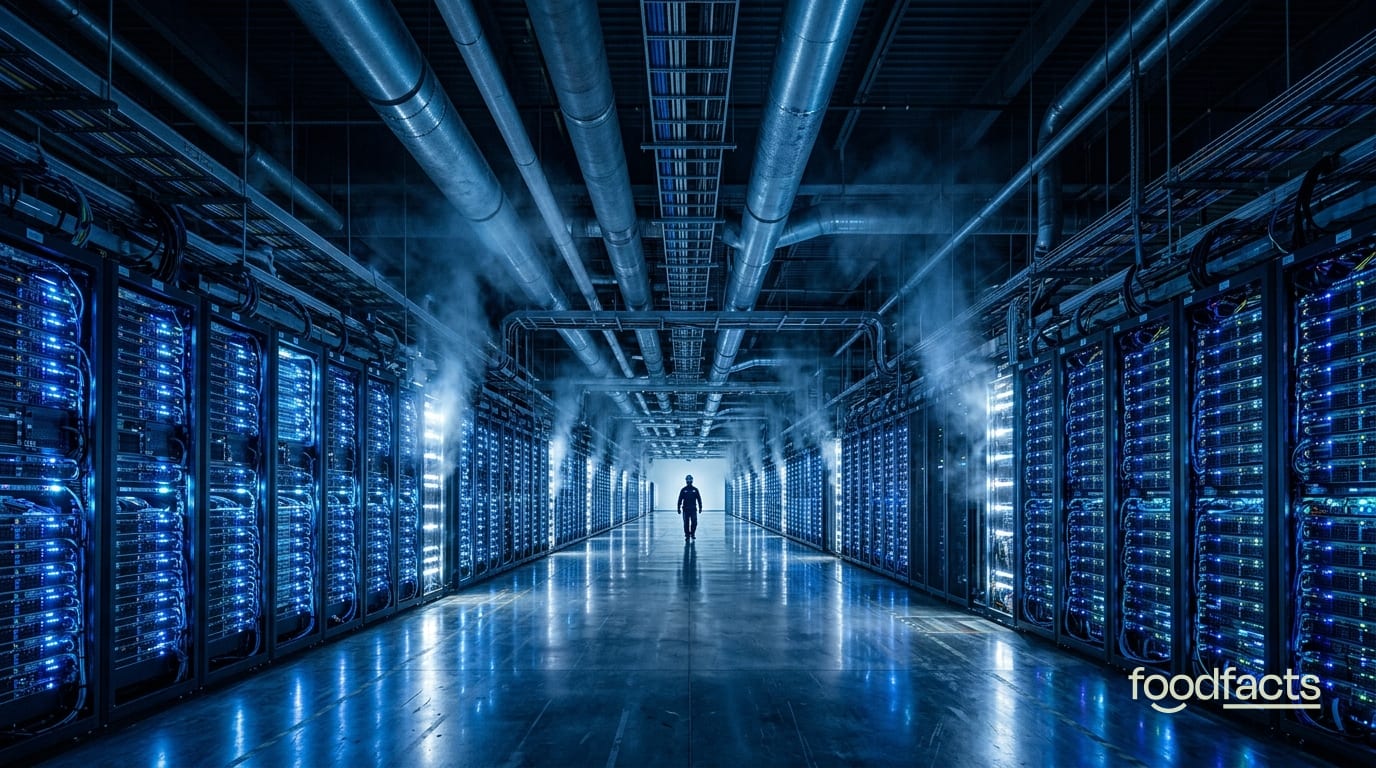
How much water does AI use?
Here is the headline figure people are reacting to. A September 2025 analysis by Morgan Stanley, reported by YourStory and other outlets, projected that water use linked to AI data centres could reach about 1,068 billion litres a year by 2028. That is roughly 1 km³, or about a trillion litres. The analysis describes it as an eleven-fold rise on today's levels.
A few things are worth being precise about, because the number gets thrown around loosely:
- It is a central estimate inside a projected range of roughly 637 to 1,485 billion litres, depending on how efficiently the technology develops.
- It counts more than just server cooling. The figure bundles together direct cooling, the water embedded in generating the electricity data centres consume, and the water used to manufacture their chips.
- It is a projection for 2028, not a measurement of today.
None of that makes AI's water use trivial. A trillion litres a year is a serious amount of water, and where data centres are built, and whose aquifers they draw down, absolutely deserves scrutiny. But it is the starting point for the comparison, not the end of it.
How much water does livestock use?
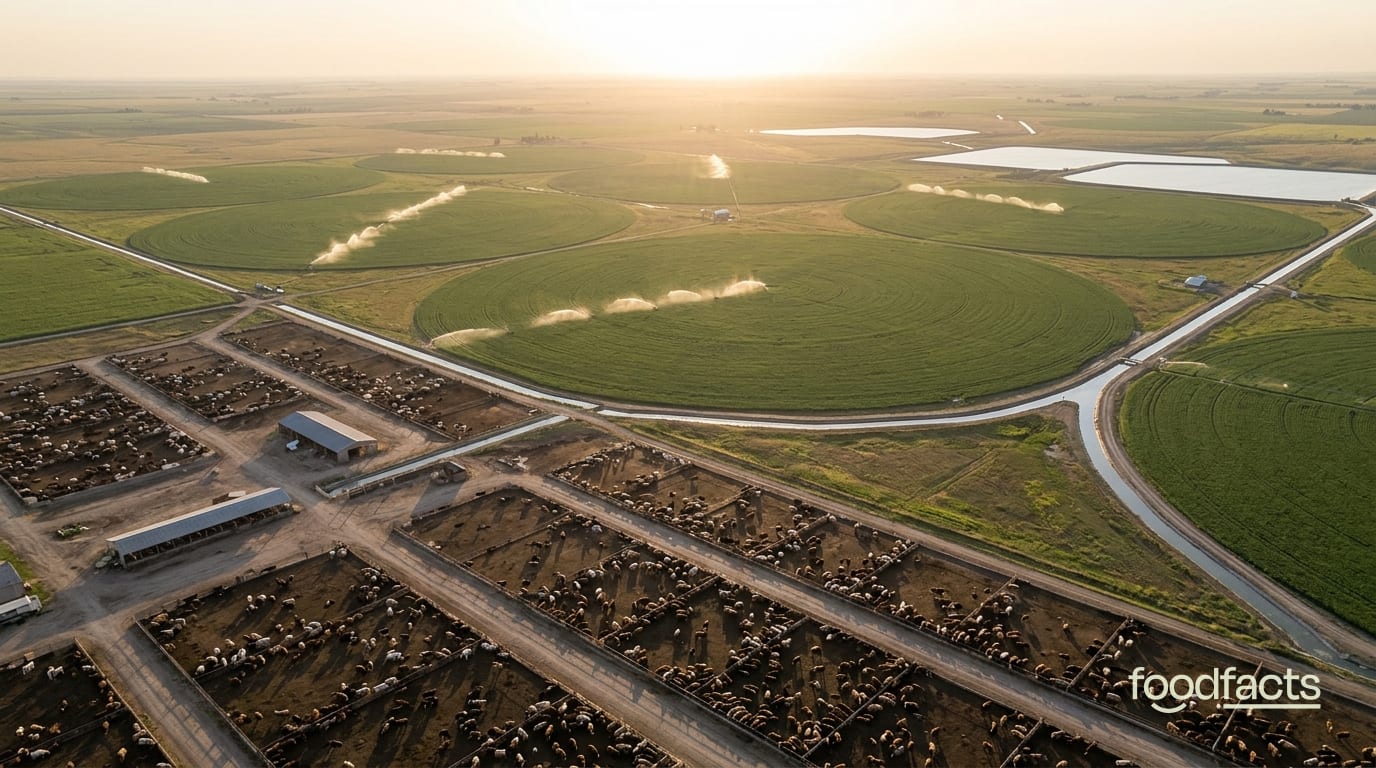
Now put the livestock number next to it. A 2024 study in the journal Water, by researchers at the UN Food and Agriculture Organization and the University of New Hampshire, modelled the global water use of livestock agri-food systems. It found that these systems consume roughly 228 km³ of freshwater (blue water) a year. The overwhelming majority of that water goes not to the animals' drinking troughs, but to irrigating the feed crops they eat.
That is the part of the story most people miss. When we hear "water use in farming", we tend to picture animals drinking. In reality the far bigger burden is the vast acreage of irrigated grain and soy grown to feed them. The same study found that feed production accounts for more than 90% of livestock's water withdrawals. Drinking and servicing the animals is a rounding error by comparison.
Once you see that, meat and dairy look less like a simple food choice and more like a resource-conversion system with enormous losses baked in. You pour fresh water into feed crops, lose most of the calories and protein passing them through an animal, and then call the result unavoidable.
AI vs livestock: the 200x comparison
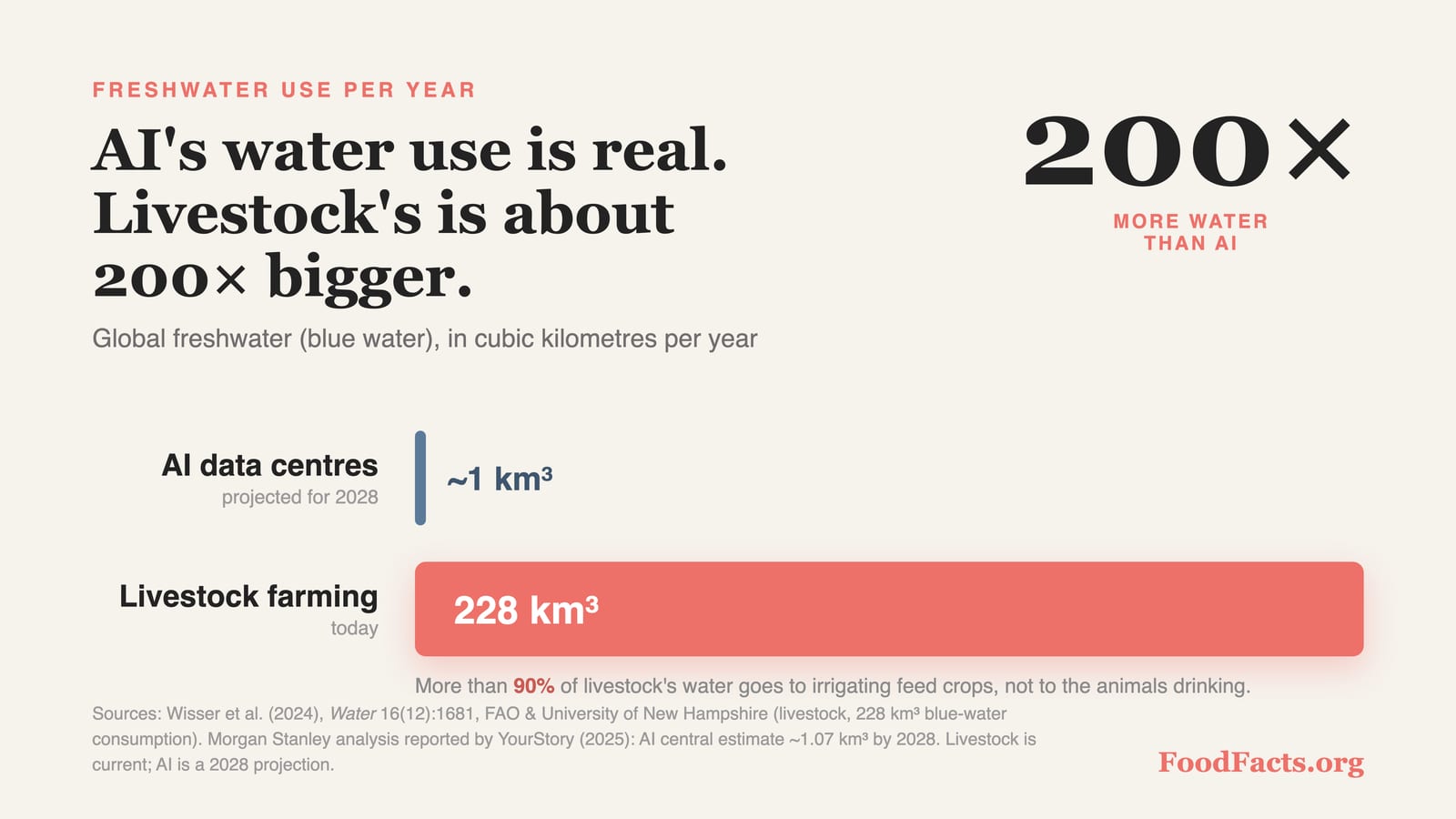
So how do the two stack up? Livestock's roughly 228 km³ of freshwater a year is about 200 times Morgan Stanley's central projection for AI in 2028 (around 1.07 km³). Carter put the gap at roughly 200-fold, and the arithmetic backs him up. 228 divided by 1.07 is about 213.
It is only fair to be clear about what this comparison is and is not:
- It sets livestock's current consumption against a 2028 projection for AI. Both industries are growing.
- It counts only livestock's blue water, meaning the irrigation, drinking and service water drawn from rivers, lakes and aquifers. It excludes the rainwater that also falls on feed and pasture, so it almost certainly understates agriculture's total water footprint rather than overstating it.
- AI's figure is broad. It covers cooling, power and chip manufacturing, and it comes from a bank's analysis reported in the media rather than a public dataset.
Even with every one of those caveats, the comparison is conservative. The most-quoted livestock number is hundreds of times larger than the most-quoted AI number. That does not mean AI companies are harmless. It means we are picking a very selective fight.
Why livestock keeps getting a pass
Part of the problem is cultural. Meat and dairy are treated as ordinary, default, politically protected products, while AI feels new, powerful and vaguely sinister. That makes AI easy to blame, even when an older industry is doing far more at far greater scale.
Part of it is how environmental stories get framed. Agriculture accounts for roughly 70% of global freshwater withdrawals, according to UNESCO's 2024 World Water Development Report. The World Bank makes the same broad point, noting that about 70% of freshwater goes to agriculture, rising to as much as 90% of withdrawals in many low-income countries. Yet public debate often slides straight past the obvious follow-up question. What kind of agriculture is driving that demand, and how much of it is really necessary?
That is where animal agriculture becomes hard to defend. The United Nations states that plant-based foods generally use less land, energy and water than animal-based foods, and that shifting towards more plant-rich diets can significantly cut environmental impact in high-income countries. Our World in Data reaches the same conclusion from another angle. What we eat is one of the biggest levers we have on water stress, emissions and land use alike.
So no, this is not a generic "agriculture uses water" story. It is a story about the inefficiency of feeding crops to animals and then calling the result a fixed cost of living.
The water crisis is not abstract
This matters because freshwater stress is already a lived reality for enormous numbers of people. UNESCO estimates that roughly half the world's population experiences severe water scarcity for at least part of the year, and the United Nations reports that around 10% of the world's population lives in countries with high or critical water stress.
Against that backdrop, the public selectivity is hard to take seriously. We are willing to panic over the future water demands of AI, but far less willing to confront the routine water demands of the foods many people eat every day. I do not think that is because the livestock evidence is weak. I think it is because the conclusion is inconvenient. And if you care about freshwater, you can no longer treat meat and dairy as environmentally neutral until proven guilty. The burden of proof has already shifted the other way.
What should happen next
The answer is not to pretend AI is fine. It is to widen the lens. Data centres should face hard questions about where they are built, how they are cooled and whose water they use. But meat and dairy should face exactly the same scrutiny, especially when the evidence shows that animal-based foods usually require far more water than beans, grains, vegetables and other plant foods.
That also means being honest with readers about where meaningful reductions actually come from. Better irrigation matters. Smarter regulation matters. Cutting food waste matters. But so does eating lower on the food chain. We have made this point before, in our fact-check on Elon Musk's claim that animal agriculture makes no difference to global warming, where we looked at another example of how the impact of animal farming gets routinely downplayed.
I think that is what this water debate really exposes. It is not just a problem of numbers. It is a problem of attention. We are very good at spotting the environmental cost of new technology. We are much worse at recognising the cost of old habits, especially when they are sitting on our plates.
Frequently asked questions
How much water does AI use?
According to a September 2025 Morgan Stanley analysis reported by YourStory, water use linked to AI data centres could reach a central estimate of about 1,068 billion litres (roughly 1 km³, or a trillion litres) a year by 2028, an eleven-fold rise, within a projected range of 637 to 1,485 billion litres. That figure covers cooling, the electricity data centres use, and chip manufacturing.
Does AI use more water than farming?
No, and not even close. AI data centres are projected to use roughly 1 km³ of water a year by 2028, while a 2024 study in the journal Water found that livestock systems alone already consume about 228 km³ of freshwater a year. That makes livestock's water use roughly 200 times larger than AI's projected use, and farming as a whole accounts for about 70% of all freshwater withdrawals worldwide.
Why does livestock use so much water?
Most of livestock's water footprint does not come from the animals drinking. It comes from irrigating the vast quantities of feed crops, mainly grain and soy, grown to feed them. The 2024 Water study found feed production accounts for more than 90% of livestock's freshwater withdrawals.
Does this mean AI's water use does not matter?
No. A trillion litres a year is a real concern, and data centres should be held accountable for where they are built and how they are cooled. The point is one of proportion. If we are alarmed by AI's water use, we should be far more alarmed by the much larger, well-documented water cost of meat and dairy.

Independent fact-checking, funded by readers like you.
Misinformation is a growing threat to our health and planet. At foodfacts.org, we're dedicated to exposing the truth behind misleading food narratives. But we can't do it without your support.
Wisser, D., Grogan, D.S., Lanzoni, L., Tempio, G., Cinardi, G., Prusevich, A., & Glidden, S. (2024). Water Use in Livestock Agri-Food Systems and Its Contribution to Local Water Scarcity: A Spatially Distributed Global Analysis. Water, 16(12), 1681.
YourStory (9 September 2025). Morgan Stanley flags 1 trillion litre water demand from AI growth.
UNESCO (2024). UN World Water Development Report 2024: Statistics.
World Bank Blogs (23 August 2023). The impact of food production on water consumption.
United Nations. Food and Climate Change: Healthy Diets for a Healthier Planet.
United Nations. Water (Global Issues).
Our World in Data. Environmental Impacts of Food Production.
FoodPrint (27 February 2024). The Water Footprint of Food.




foodfacts.org is an independent non-profit fact-checking platform dedicated to exposing misinformation in the food industry. We provide transparent, science-based insights on nutrition, health, and environmental impacts, empowering consumers to make informed choices for a healthier society and planet.






.svg)


.svg)

