




Fibre under fire: debunking Eddie Abbew's claim that humans don't need it


Influencer Eddie Abbew recently posted a video in which he shares his own dietary habits, explaining the reasons why he chooses not to eat fruits and vegetables. While these are personal choices, he also goes on to say that there is no scientific proof that humans need fibre, a type of carbohydrate found in plant-based foods.
In this fact-check, we break down the reasoning behind the claim that fibre isn’t essential, assessing its validity against the latest available evidence and recommendations.



While fibre isn’t classified as an essential nutrient, its role in supporting digestion, immunity, and long-term health is well established in scientific research. Claims that humans don’t need fibre overlook how it supports vital functions throughout the body.
Amid widespread public health recommendations to increase fibre intake, viral social media posts claiming to avoid fibre entirely, and feel better for it, can understandably cause confusion. That’s why it’s important to understand the scientific foundation behind these guidelines. Knowing how nutrition advice is built can help distinguish between evidence-based recommendations and personal opinions that may not apply to everyone.


Claim 1: “There is no scientific proof that humans need fibre.”
Fact-check: This claim ignores a large body of scientific research and consensus (source). While fibre isn't classified as an 'essential nutrient' in the strictest biological sense, its role in maintaining health and preventing chronic disease is strongly supported by high-quality evidence from large-scale studies and clinical trials.
What fibre does…
The claim that humans don’t need fibre is based on the classification of some nutrients as essential. In a more recent video, Eddie Abbew continued to argue that fibre isn’t ‘for humans’, on the basis that it doesn’t break down. Let’s unpack these claims to better understand the role played by fibre and more generally by food to support the body’s needs.
When you eat food, your body digests it, which means it breaks it down into smaller parts so it can absorb the nutrients and use them for energy, growth, and repair.
Essential nutrients are then classified based on their necessity for survival: these are compounds the body cannot synthesise (or cannot make in sufficient amounts), such as certain amino acids, fatty acids, vitamins, and minerals. Without them, deficiency diseases or death can occur.
Dietary fibres don’t fall into that category, because they aren’t absorbed or digested. But that doesn’t make them unimportant. It’s like saying a tool isn’t essential because it’s not part of the final product. The role of dietary fibres is to help digestion to work optimally, which has wide-ranging effects on the whole body (source).
Think of food like a Lego structure, where essential nutrients are the individual Lego bricks that your body uses, and digestion helps to take the Lego apart. Fibre isn’t one of the Lego bricks, but it’s a vital tool that helps ensure the entire process works smoothly.
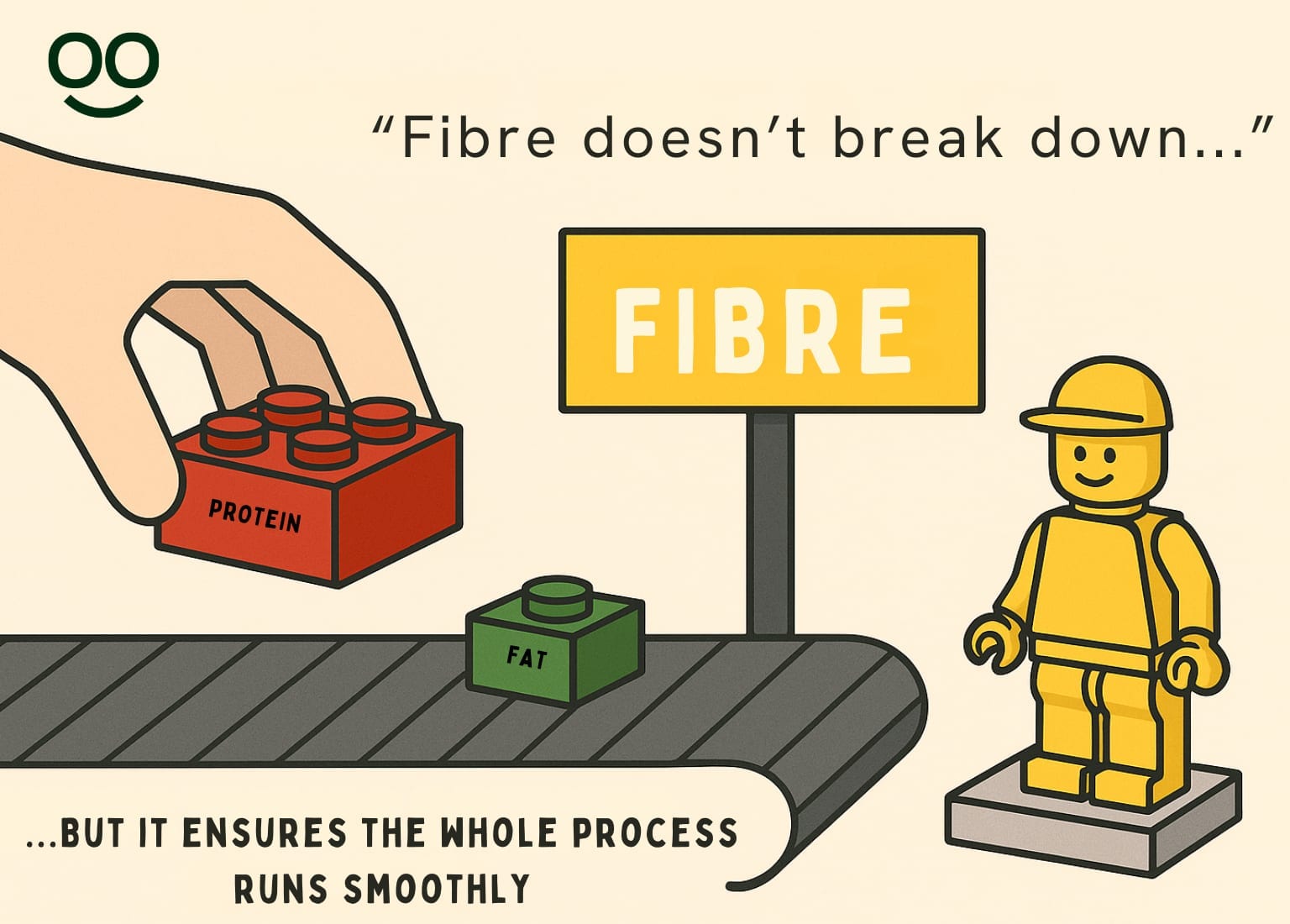
Let’s go through the main parts of food and what happens to each:

The British Dietetic Association summarises fibre’s role in in that way:
“Fibre is essential for your gut to work normally. It increases good bacteria which supports your immunity against inflammatory disorders and allergies. A high fibre diet seems to reduce the risk of chronic diseases such as cardiovascular disease, type 2 diabetes and bowel cancer.”
We can see that there are crucial interactions at the heart of this process, so looking at nutrients in isolation paints a misleading, incomplete picture. It’s also important to remember that fibre-rich foods contain other essential nutrients like vitamins, minerals, protein and antioxidants.
Adequate intake recommendations for fibre are therefore set for optimal health. In the US, the average recommendation is 28g/day, and in the UK, updated advice has increased these to 30g/day. There is also evidence showing that over 30g/day would offer more benefits (source).
… and why it matters
Fibre helps everything work smoothly in a few different ways, which we have outlined here based on different types of fibres:
- Insoluble fibre (like wheat bran):
Insoluble fibre doesn't dissolve or ferment much, but keeps your digestion moving. It acts like a sponge, soaking up water and bulking up your stool. This helps prevent constipation and reduces the time waste stays in your gut, which is important for gut health.
- Soluble fibre (like beta-glucans or psyllium husk):
Soluble fibre forms a gel in your gut that slows down how quickly things like sugar and cholesterol are absorbed. This can help stabilise blood sugar, reduce cholesterol, and support heart health. It also helps you feel full longer, which can reduce overeating.
- Fermentable fibre (like pectins or inulin):
Fermentable fibre gets broken down by your gut bacteria (fermentation). This produces short-chain fatty acids (SCFAs), tiny compounds that act like messengers in your body. SCFAs help regulate hunger by stimulating hormones that make you feel full, support your immune system and reduce inflammation and play a role in balancing energy use and fat storage.
Claim 2: “Most people doing the Carnivore Diet will tell you that they’ve reversed chronic metabolic conditions, they’ve felt the best they’ve ever felt, they’re full of energy, their skin glows better.”
Fact-check: This is what’s known as anecdotal evidence: individual stories that may reflect real experiences but aren’t reliable on their own for drawing conclusions.
Eddie Abbew claims that most people on the Carnivore Diet have positive experiences. One recent study did report similar findings. However, the participants were self-selected among a group of people having followed the diet for over six months. This means the results likely reflect a biased sample of people who already had good experiences and were motivated to share them. On the other hand, most people experiencing negative outcomes are likely to stop the diet before six months.
Relying on anecdotal evidence is like using one single review to judge an entire restaurant, without looking at any others. Social media makes this even worse, because algorithms keep feeding you more of what you already believe. There are plenty of people who’ve had negative experiences with the Carnivore Diet, they’re just not the ones going viral. But if you search for “why I quit the Carnivore Diet” on platforms like YouTube and scroll through the comments, you’ll start seeing some of them.
The main issue here is that anecdotal evidence is being used as the sole justification for a conclusion on the benefits of a diet, presented as the best way to eat for most people, and without engaging with the rest of the literature on fibre.
Let’s compare that to how science works and answers questions.
We often ask, “What does science say?” That question isn’t just about what results show: it’s about how those results were found. Following anecdotes that some people reported feeling better on the Carnivore Diet, science would ask whether any other factors might explain that feeling. For example: could the benefits come from cutting out ultra-processed foods, rather than eating only meat?
Science starts with a question. It forms a hypothesis. Then it tests that hypothesis. That’s very different from starting with a belief or idea, and then sharing points that support it. That’s just not how science works.
When it comes to the Carnivore Diet, there’s very little long-term data. That’s partly because it would be unethical to run a randomised controlled trial asking people to follow a diet that could lead to nutrition deficiencies (source). While some people might report feeling better after starting the Carnivore Diet, this doesn’t tell us anything about long-term consequences. And the thing is: you don’t feel heart disease developing. That’s why long-term studies are essential to understand the full picture of health impacts.
So, what does science say about fibre?
Eddie’s claim is focused on the suggested benefits of the Carnivore Diet to reverse chronic conditions. This is a broad statement, and various, tailored diets might be best suited depending on the condition. However, there is ample evidence pointing to the benefits of fibre (which is lacking in a strict Carnivore Diet) when it comes to managing or preventing a range of chronic conditions.
The latest research shows that the impact of dietary fibre extends beyond the gut (source). Fibre shapes the gut microbiome, fuelling beneficial bacteria to produce metabolites like short-chain fatty acids that strengthen immunity, regulate metabolism, and protect against chronic disease (source, source, source, source).
Therefore digestive health is vital not just for digestion, but for immunity, disease prevention, and overall well-being. Taking care of your gut means taking care of your whole body.
Claiming that fibre is “not essential for human health” is nutrition misinformation of the highest order.
Personal anecdotes can be interesting, but they are not a substitute for decades of high quality research.
We know from countless studies that a diet rich in fibre from fruits, vegetables, whole grains, beans, nuts, and seeds supports better digestion, a healthier weight, improved blood sugar control, and lower risk of heart disease, stroke, type 2 diabetes, and colon cancer. Fibre feeds the trillions of microbes that live in your gut and in turn those microbes help regulate your immune system, metabolism, and even your mood. Human health depends on a rich variety of plants and the fibre they contain.
If an individual experiences unusual symptoms when eating certain foods - including itchiness or any arbors suggestive of a true food allergy - it's important to seek professional advice rather than dismissing entire food groups. For the rest of us, putting plants at the centre of the plate remains one of the most powerful steps we can take for long term health.

Digestive health supports the immune system
About 70% of the immune system is housed in the gut (source). A well-balanced microbiome helps protect against pathogens and modulates immune responses, reducing inflammation and risk of infection.
Digestive health supports mental health (gut-brain axis)
The gut and brain communicate through the "gut-brain axis." While the gut-brain axis is not new, it has seen a surge in interest recently, with research consistently highlighting “how the gut and brain are deeply interconnected and influence each other in ways that affect our overall health, emotions, and behavior” (source). An unhealthy gut is linked to the development and progression of mental health issues like anxiety or depression, possibly due to inflammation and neurotransmitter imbalances (source, source).
Digestive health helps to prevent chronic diseases
Poor digestive health and gut imbalance (dysbiosis) are associated with conditions like irritable bowel syndrome (IBS), and inflammatory bowel disease (IBD). Beyond gut-related conditions, extensive research has shown associations between increased dietary fibre intake and a reduced risk of many conditions including type 2 diabetes, cardiovascular diseases and colon cancer.
Final take away
Eddie is right to say that the typical Western diet is causing health issues. But here’s the twist: research shows the opposite of what he suggests: that these health issues are partly due to a lack of fibre (source).
Let’s finish with Eddie’s claim that we (presumably, this refers to we in the West) are being “brainwashed” into thinking fibre is good for us. Brainwashing usually refers to the use of pressure to adopt beliefs or attitudes. If that was really the case, efforts to “brainwash” Westerners into increasing fibre intake would be clearly failing. Why? Because the data shows precisely the opposite. In the US, 95% of the population falls short of fibre consumption recommendations, with inadequate intakes prompting a public health concern (source).
This massive discrepancy seems to stem from a misconception of what a standard Western diet looks like. Eddie Abbew implies that it might be packed with fibre, and high in refined carbohydrates. Reality paints a different picture, that of a diet that is too high in refined carbohydrates, in sugar and saturated fat, mainly due to an over-reliance on ultra-processed products - foods which lack in… fibre.
Eddie Abbew's claim that people only need fibre because they're eating "high-carbohydrate grains that have been stripped of all nutrients" presents a fundamental misunderstanding of its role. This frames fibre as a mere antidote to an unhealthy diet, rather than the cornerstone of good health.
The core issue with processed grains isn't just a lack of "all nutrients"; the most significant loss during refining, which removes the bran and germ, is dietary fibre. This is critical because fibre's benefits are inherent and far-reaching, regardless of other dietary choices. Fibre, in its own right, is vital for gut and digestive health, disease prevention, blood sugar control, and even weight management.
.avif)
We have contacted Eddie Abbew and are awaiting a response.
Disclaimer
This fact-check is intended to provide information based on available scientific evidence. It should not be considered as medical advice. For personalised health guidance, consult with a qualified healthcare professional.
Danae Marshall is affiliated with ZOE, a commercial company focused on personalised nutrition.
Independent fact-checking, funded by readers like you.
Misinformation is a growing threat to our health and planet. At foodfacts.org, we're dedicated to exposing the truth behind misleading food narratives. But we can't do it without your support.
Sources
Reynolds, A. et al. (2019). “Carbohydrate quality and human health: a series of systematic reviews and meta-analyses.”
McKeown, N.M. et al. (BMJ, 2022). “Fibre intake for optimal health: how can healthcare professionals support people to reach dietary recommendations?”
Ioniță-Mîndrican, C-B. et al. (2022). “Therapeutic Benefits and Dietary Restrictions of Fiber Intake: A State of the Art Review”
BDA (2024). “Fibre” (Food Fact Sheet)
Lennerz, B. S. et al. (2021). “Behavioral Characteristics and Self-Reported Health Status among 2029 Adults Consuming a “Carnivore Diet””
Goedeke, S. et al. (2024). “Assessing the Nutrient Composition of a Carnivore Diet: A Case Study Model.”
Kieffer, D.A. et al. (2016). “Impact of Dietary Fibers on Nutrient Management and Detoxification Organs: Gut, Liver, and Kidneys.”
Makki, K. et al. (2018). “The Impact of Dietary Fiber on Gut Microbiota in Host Health and Disease.”
Dahl, W.J. et al. (2017). “Health Benefits of Fiber Fermentation.”
Delzenne, N.M. et al. (2024). “The gut microbiome and dietary fibres: implications in obesity, cardiometabolic diseases and cancer.”
Mosoni, P. (2014). “Dégradation des fibres alimentaires par le microbiote colique de l’Homme.”
Wiertsema, S.P. et al. (2021). “The Interplay between the Gut Microbiome and the Immune System in the Context of Infectious Diseases throughout Life and the Role of Nutrition in Optimizing Treatment Strategies.”
Petrut, S-M. et al. (2025). “Gut over Mind: Exploring the Powerful Gut–Brain Axis.”
Exon Publications (2025). “Gut Health: The Microbiome, Diet, Supplements, and a Healthy Lifestyle.
Weickert, M.O. et al. (2018). “Impact of Dietary Fiber Consumption on Insulin Resistance and the Prevention of Type 2 Diabetes.”
Fu, L. et al. (2022). “Associations between dietary fiber intake and cardiovascular risk factors: An umbrella review of meta-analyses of randomized controlled trials.”
World Cancer Research Fund Network (2018). “Diet, nutrition, physical activity and colorectal cancer.”
O’Keefe, S.J. (2019). “The association between dietary fibre deficiency and high-income lifestyle-associated diseases: Burkitt’s hypothesis revisited.”
Quagliani, D. & Felt-Gunderson, P. (2016). “Closing America’s Fiber Intake Gap.”


foodfacts.org is an independent non-profit fact-checking platform dedicated to exposing misinformation in the food industry. We provide transparent, science-based insights on nutrition, health, and environmental impacts, empowering consumers to make informed choices for a healthier society and planet.








.svg)


.svg)

