





Yoghurt, kefir and candida: what the evidence really says about sugar, strains and survival


A recent post by Eric Berg questions if yoghurt is a good source of healthy bacteria, claiming that most of the yoghurt bacteria never gets through the stomach, and mentions that ‘better’ solutions are kefir and sauerkraut. He adds that yoghurt ‘makes candida worse’ due to its added sugar content. What does the evidence say?



While it is true that standard yoghurt contains only two mandatory bacterial strains and that bacterial survival in the gut varies, the claim that yoghurt worsens candida or that kefir and sauerkraut are categorically better is not currently well supported by high-quality clinical evidence.
Content that tries to hook viewers by creating fear over foods that are staples in many people’s lives, and that have been generally associated with health benefits (like yoghurt), can lead people to unnecessarily avoid affordable, nutritious foods or spend more on products marketed as superior without clear evidence to back that up. Though kefir and fermented vegetables can be part of a balanced diet, yoghurt is one of the most accessible and well-researched fermented foods available.


Interest over fermented foods and beverages, including yoghurt, kefir, sauerkraut, tempeh and kimchi has been on the rise due to emerging evidence of the benefits of consuming these foods. These include a possible reduction of the risk of cardiovascular disease and type 2 diabetes, and possible influence on the gut-brain axis, impacting mood and brain activity (source; source).
Claim 1: “There’s only two or three strains of microbes in yoghurt” and “most of yoghurt (bacteria) never gets through the stomach”
Fact-check: This claim is misleading.
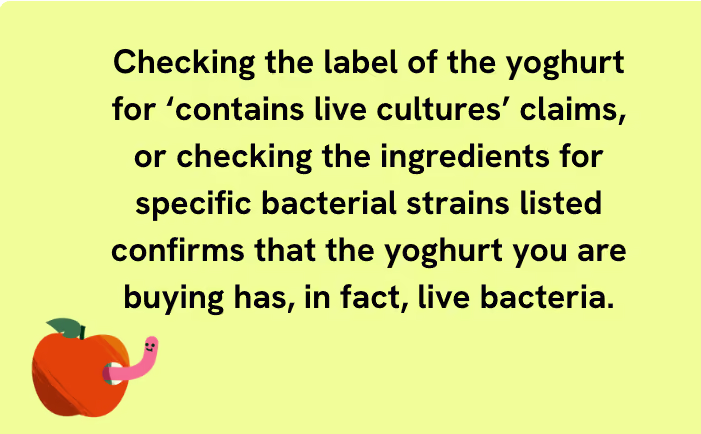
In order to call yoghurt a yoghurt, and align with international standards, it requires the milk to be fermented with two types of bacteria, Streptococcus thermophilus and Lactobacillus delbrueckii subsp bulgaricus, at a minimum count of 10 million CFU (Colony-Forming Unit) per gram, which is more than ‘a few million bacteria’, as stated in this post by Eric Berg. In that sense, the claim that yoghurt may have only ‘two or three’ strains accurately describes the regulatory minimum for standard yogurt. However, several commercial products intentionally include additional probiotic bacteria for added benefits, including Bifidobacterium and Lactobacillus (source; source).

As for whether these bacteria survive the journey to the gut, the evidence is more nuanced than the original claim suggests. The evidence does not currently support the blanket statement that most yoghurt bacteria never get through the stomach. Stomach acid is indeed highly acidic (fasting pH can be around 1–2), but this does not mean all ingested bacteria die. The key question is what proportion of yoghurt bacteria survive in the real conditions of digestion (with food buffering the acid) and reach the intestine alive.
In human studies, viable yoghurt-associated bacteria have been recovered from feces, showing that at least some cells survive gastrointestinal transit; however, survival is strain-specific, and depends on the product matrix and dose, as well as individual factors (source; source). For instance, yoghurt helps buffer the acidity of the stomach, which in turn may enhance probiotic survival (source).
Another factor is that, even though all yoghurts start out with live and active cultures, some yoghurts are heat-processed after fermentation is complete (to extend shelf life), which can kill a significant portion, or all of the bacteria (source) .
Claim 2: ‘Yoghurt makes candida worse’ and ‘most yogurt that you buy also has added sugar which actually ends up feeding yeast or candida or the bad bacteria’
Fact-check: This claim is misleading.
This post by Eric Berg starts with a woman (in voiceover) asking ‘wait, yoghurt makes candida worse?’ However, once Berg starts his explanation, he speaks about the number of strains in yoghurt and their survival as they are digested, and it is only later in the post that he makes a remark that yoghurt “makes candida worse” because the yoghurt bought by most of us has added sugar, and sugar “ends up feeding yeast or candida.” Though these statements contain grains of truth, the claims are overstated.
What is Candida? Candida is a type of yeast that is part of the normal human microbiome, living on the skin and mucosal surfaces. However, certain conditions that change the body’s environment, such as a weakened immune system, hormonal changes, microbiome changes or medication use, may cause candida to overgrow and cause an infection, called Candidiasis (source).

There is currently limited direct evidence to link dietary sugar consumption with ‘worsened’ candidiasis in non-diabetic individuals, nor is there consensus on a no/low sugar diet to prevent or treat candida. However, a high sugar consumption, on a regular basis, can negatively affect the body in different ways, and may encourage candida overgrowth. For instance, high sugar intake is a known risk factor for type 2 diabetes, and people with uncontrolled diabetes may be at significantly higher risk of candidiasis due to elevated blood glucose levels, which can promote yeast growth (source; source).
Take away: there is currently no evidence that links yoghurt consumption with candidiasis, and some evidence (from small clinical trials) suggests a possible benefit of eating plain yoghurt with live cultures to help reduce/inhibit candida colonisation, though more recent and larger studies are required (source; source). Yoghurt is also a great source of protein, calcium, vitamin B12, and choosing plain or low added sugar yoghurts (from plant or animal sources) remains a reasonable approach to keeping daily sugar intake within recommended limits, currently set at less than 25g of added sugar per day by major health bodies.
We know from human evidence that consuming yoghurt is good for health. There is no evidence to support the claim that eating yoghurt can worsen or cause candida. It's this kind of reductionist click bait that can make people scared of a food that may be a very good source of healthy nutrients in their diet.

Claim 3: Kefir and sauerkraut are “much better” solutions instead of consuming yoghurt
Fact-check: This claim is overstated.
Kefir milk is a fermented drink produced from kefir grains and milk, and contains a wide variety of bacterial and yeast strains. In recent years, kefir has gained attention by the scientific community and the public due to its possible benefits for cardio-metabolic and overall health (source; source).
Due to its production methods, kefir often has greater microbial diversity than standard yoghurt, given that it involves more complex community microorganisms than those required for yoghurt, but the specific health benefits of kefir are still a matter of research (source; source). Sauerkraut and other fermented vegetables may also be great sources of probiotics, provided that they contain sufficient live microorganisms.

In short: while kefir shows potential benefits, its superiority over yoghurt is not yet established, and there is no current evidence that ranks different fermented foods/drinks based on their conferred health benefits.
Are fermented and probiotic the same?
According to a consensus statement by the International Scientific Association for Probiotics and Prebiotics, fermented foods are defined as foods made through desired microbial growth and enzymatic conversions, but this does not automatically make them probiotic. For a food to be classified as probiotic, it must contain live microorganisms in sufficient quantities shown to confer a health benefit. Many commercially sold sauerkrauts are pasteurised after fermentation, which kills the bacteria, meaning they may offer nutritional benefits from the cabbage itself, but cannot be considered probiotic.
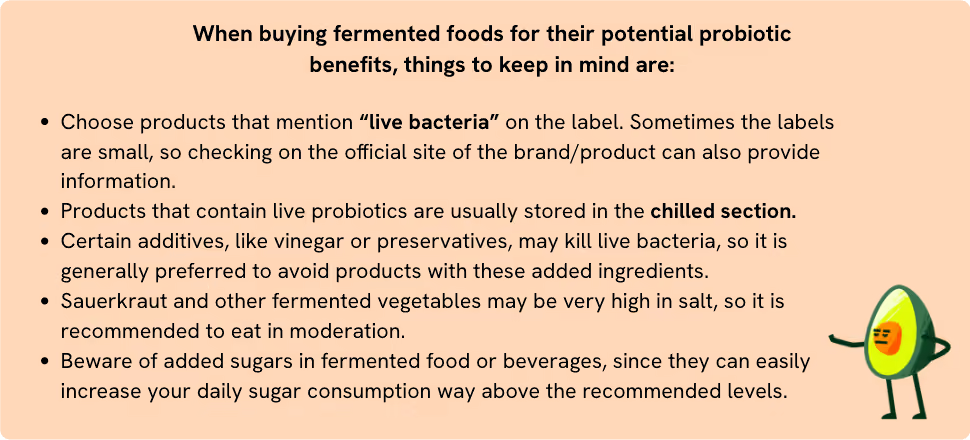
It's exciting to see the increasing science of how fermented foods support our health. They've been part of the human diet for centuries and it's great to include fermented foods in your diet if these help you and you enjoy them and you feel benefits.
Bottom Line
Yoghurt is a well-researched fermented food with a long safety record and documented nutritional benefits. The claim that it worsens candida is not supported by clinical evidence, and some evidence suggest that yoghurt containing live cultures may help inhibit candida colonisation (though more recent and larger studies are required). Moreover, while kefir does tend to have greater microbial diversity than standard yoghurt, there are currently no high-quality studies that support ranking it as categorically better for health outcomes. Both yoghurt and kefir can be part of a healthy eating pattern. As for sauerkraut, the evidence base is more limited, and many commercial versions are pasteurised, meaning they contain no live bacteria at all.
We have contacted Eric Berg and are awaiting a response.
Disclaimer
This fact-check is intended to provide information based on available scientific evidence. It should not be considered as medical advice. For personalised health guidance, consult with a qualified healthcare professional.
Independent fact-checking, funded by readers like you.
Misinformation is a growing threat to our health and planet. At foodfacts.org, we're dedicated to exposing the truth behind misleading food narratives. But we can't do it without your support.
Sources
- Marco, M, et.al (2016) Health benefits of fermented foods: microbiota and beyond
- Kok, C & Hutkins, R (2018) Yogurt and other fermented foods as sources of health-promoting bacteria
- NIH (2025) Probiotics
- FAO (2003) CODEX Standards for fermented milks
- Elli, M, et.al (2006) Survival of yogurt bacteria in the human gut
- Morelli, L (2014) Yogurt, living cultures, and gut health
- Flach, J, et.al (2017) The underexposed role of food matrices in probiotic products: Reviewing the relationship between carrier matrices and product parameters
- WHO (2025) Candidiases (yeast infection)
- Nature Index - Oral candidiasis in diabetic patients
- Hilton, E, et.al (1992) Ingestion of yogurt containing Lactobacillus acidophilus as prophylaxis for candidal vaginitis
- Hu, H, et.al (2013) Impact of eating probiotic yogurt on colonization by Candida species of the oral and vaginal mucosa in HIV-infected and HIV-uninfected women
- WHO (2015) WHO calls on countries to reduce sugars intake among adults and children
- Ibrahim, S, et.al (2023) A review and comparative perspective on health benefits of probiotic and fermented foods
- Rosa, D, et.al (2017) Milk kefir: nutritional, microbiological and health benefits
- Li Lim, J, et.al (2026) Review on kefir beverages from milk and water: health benefits, processing and applications
- Marco, M, et.al (2021) The International Scientific Association for Probiotics and Prebiotics (ISAPP) consensus statement on fermented foods
- ZOE (2026) 7 potential benefits of sauerkraut
- British Heart Foundation (2026) British Heart Foundation warns that many gut-friendly foods come with a heart health catch



foodfacts.org is an independent non-profit fact-checking platform dedicated to exposing misinformation in the food industry. We provide transparent, science-based insights on nutrition, health, and environmental impacts, empowering consumers to make informed choices for a healthier society and planet.








.svg)


.svg)

