
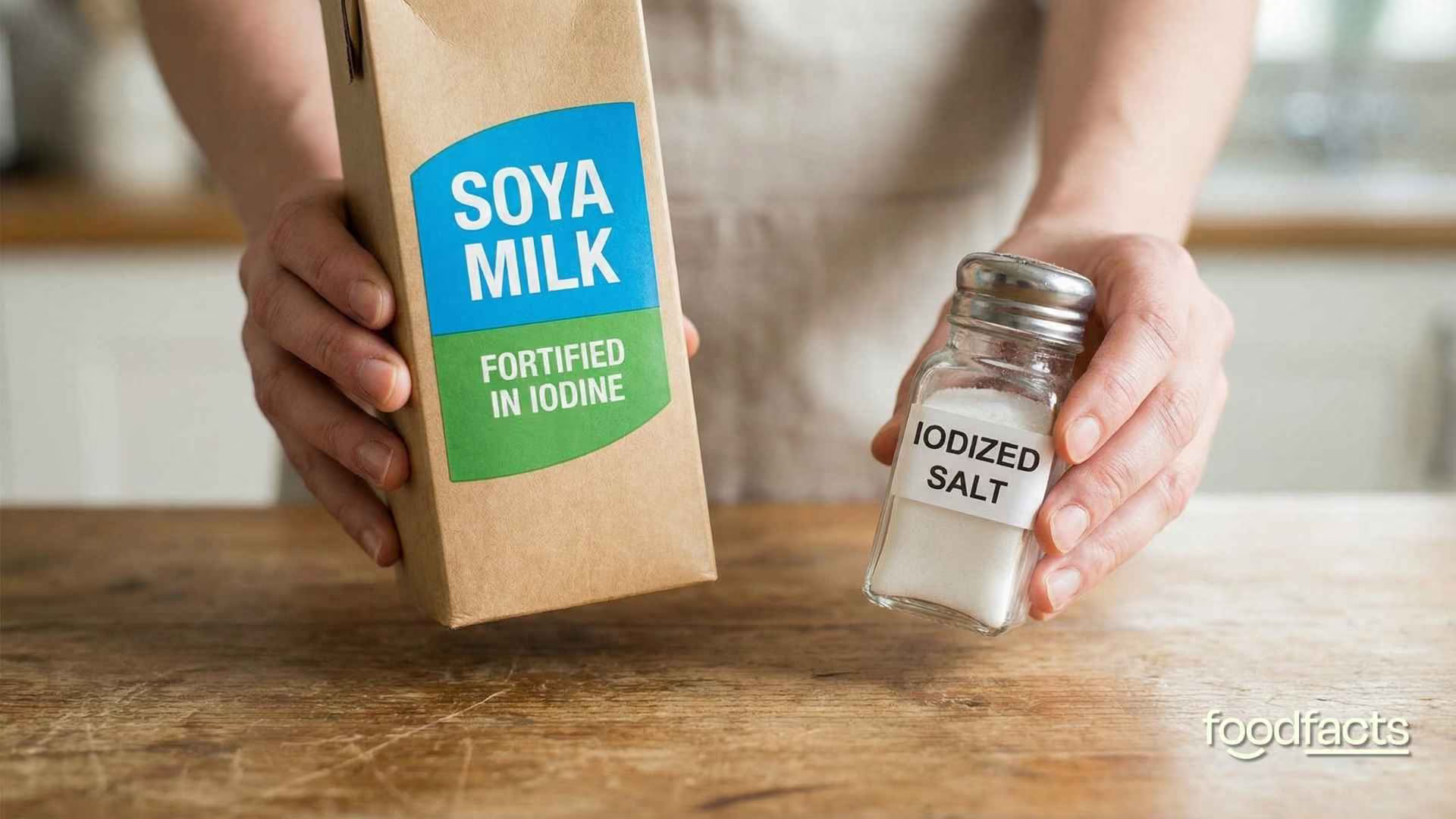




Do plant milks really harm our IQ? How a misleading Daily Mail headline distorted the iodine story


This fact-check examines the impact of the recent Daily Mail headline “Beware Veganuary: How plant milks could be secretly harming our IQ.” The implied claim in the headline, which is what most people will see, is that drinking plant-based milks might directly contribute to lowering IQ, perhaps due to nutrient deficiencies. In this fact-check, we assess whether this implied claim accurately reflects the contents of the article itself, and the evidence on plant-based milk consumption and brain health.



The issue described by the author is iodine deficiency in UK women of childbearing age and during pregnancy, driven by the UK’s reliance on dairy as a main iodine source. The expert calls for population‑level solutions such as iodised salt, regular surveillance of urinary iodine, and increased awareness among health professionals and the public.
Sensationalised headlines risk distracting from the real public-health urgency: in this case, ensuring sufficient iodine intake, particularly in women of childbearing age. Framing the issue as plant-based milks “harming IQ” reinforces an overly simplistic narrative that these alternatives are inherently unhealthy, which may discourage their use by people who choose them for allergy, ethical, or environmental reasons, without addressing the underlying nutritional gap.


Why context matters beyond the headline
Headlines often strip away nuance, and here the wording suggests a direct link between drinking plant-based milks and poorer brain health. Restoring context means we can better understand the issue, who is affected, and how to remedy it.
Claim (implied by the headline): Plant-based milk consumption could lower IQ.
Fact-check: The headline displaces the focus of the article, which highlights concerns of rising iodine deficiencies, which during pregnancy can lead to impaired fetal development. The UK’s context is unusual in that it has no mandatory salt iodisation and limited use of iodised table salt, so iodine intake relies heavily on milk and dairy products, compared with many other Western countries where iodised salt plays a larger role.
What’s the issue actually being discussed?
Discussions about nutrient deficiencies and vegan diets often revolve around vitamin B-12 concerns. However, this article discusses the issue of iodine deficiency on a population level, specifically looking at the UK context and implications for pregnant women. Before going any further, let’s take a closer look at iodine: what is it and what is its role?
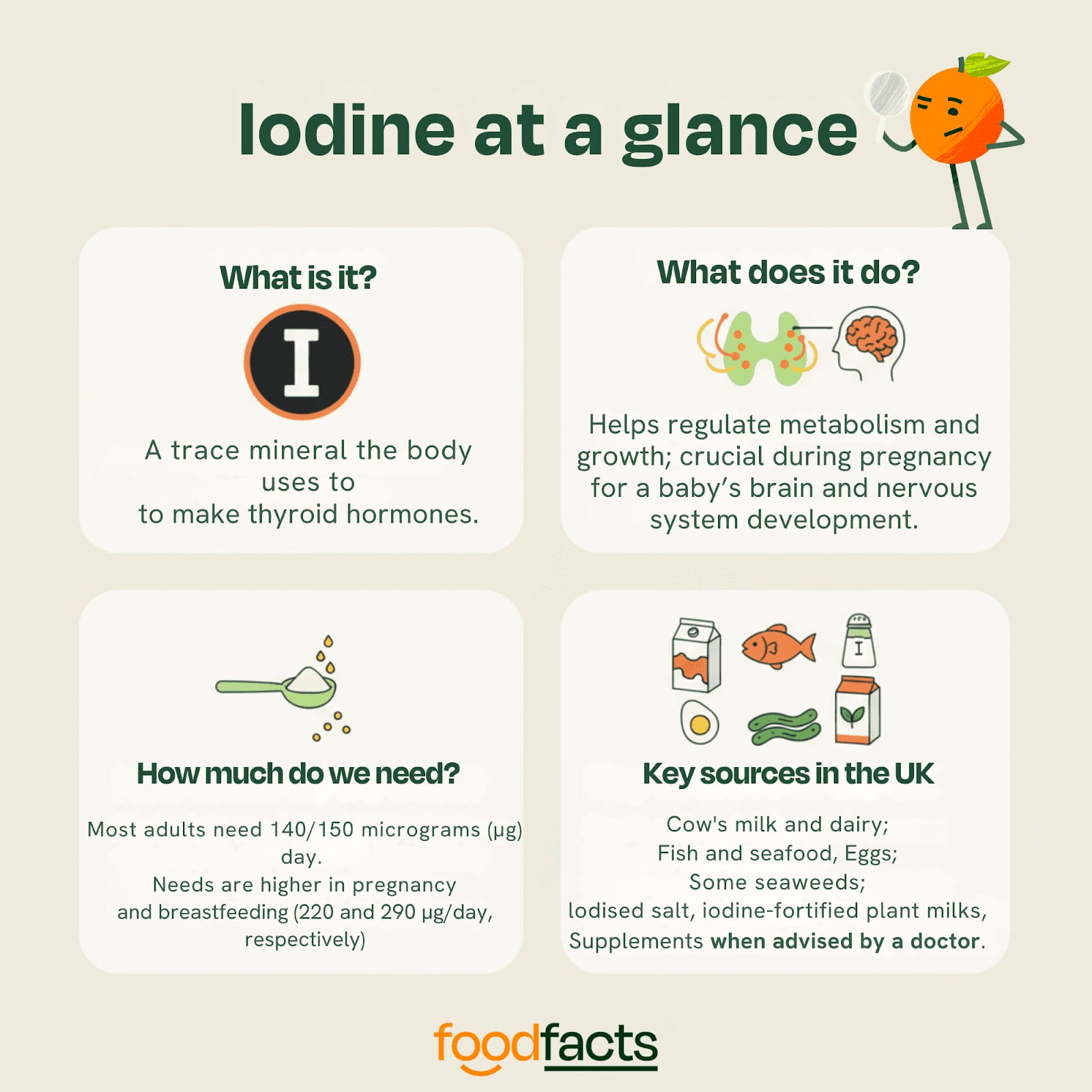
Iodine deficiency concerns are real. In the article, Professor Kristien Boelaert explains:
“Even a mild deficiency can affect the child’s cognitive abilities such as speech and reading – lowering IQ scores by eight to ten points, the World Health Organisation (WHO) says.”
Although high‑quality randomised trials with child learning outcomes are limited, the association is supported by observational research on iodine status and children’s cognition, including in settings with generally mild deficiency such as the UK (source). In this UK cohort study of just over 1000 mother–child pairs, iodine status was measured in early pregnancy and children’s IQ and reading performance were assessed in mid‑childhood. Mothers with lower iodine levels had children who were significantly more likely to score in the lowest range for verbal IQ and for reading accuracy and comprehension, even after accounting for many other factors that affect learning. The authors concluded that these findings show inadequate iodine in early pregnancy – at levels typical for the UK, not just in severely deficient countries – is an important public‑health concern because it is associated with worse cognitive outcomes in children.
Background context, and the role of plant-based milks
The article explains that “the iodine status of women of reproductive age in the UK is now among the lowest in the world,” highlighting the importance of taking prompt action. Recent data and research show that iodine intake and status in UK women of reproductive age and in pregnancy are indeed often insufficient (source, source), and that the UK lags behind many other Western countries that have implemented iodised salt or more robust iodine‑fortification policies. In most continental regions of the world, soil contains very little iodine, which in turn affects the iodine content of crops (source). That is why iodised salt has been chosen by many Western countries to combat iodine deficiency.
So what is the role of plant-based milk?
From the headline alone, it would be easy to conclude that cow’s milk is inherently rich in iodine and that swapping it for plant-based drinks is what puts people at risk. The article itself paints a more nuanced picture, explaining how UK farming practices turned dairy into its main iodine source, eradicating deficiency concerns which are now resurfacing (source).
As Professor Boelaert notes, cow’s milk is “not naturally rich in iodine”; it has become iodine-rich because iodine salts are added to cattle feed and iodine-based disinfectants are used in milking, which increases iodine content in the milk (source). Research suggests that milk and dairy products provide roughly 30% of iodine intake for UK adults (50% in children), so removing dairy without planned alternatives leads to reduced iodine intake (source, source).
This matters because dietary patterns are shifting: more people are moving towards plant-based eating, and scientific reports increasingly highlight the environmental and health benefits of plant-forward dietary patterns (source, source). That shift requires rethinking how key nutrients – including iodine – are supplied in the food system and discussed in nutrition education. Plant-based substitutes can support individuals to make the transition, by helping people to maintain food habits that they have come to love (such as adding a splash of milk to their coffee). However, plant-based substitutes are not always nutritionally equivalent, highlighting the need for clear guidance, especially at times when nutritional needs are different such as during pregnancy (source).

Iodine is a good case study. Unlike other countries, the UK never adopted universal salt iodisation, in part because the rise in milk iodine content was assumed to have solved deficiency, so dairy became the de facto iodine vehicle (source). Many plant-based drinks sold in the UK are still unfortified with iodine and contain very little of it, so if someone switches from iodine-rich cow’s milk to an unfortified plant milk and makes no other changes (such as consuming iodised salt), their iodine intake will be impacted (source). That is not the same as suggesting plant-based milks “cause” lower IQ; the mechanism is still iodine deficiency, and the main problem highlighted is that there are inadequate, population‑level measures in place to prevent it. Indeed Professor Boelaert stresses that this is a preventable issue, and awareness is the first step to tackle it.
From individual Veganuary choices to real solutions: iodised salt and population-level action
The solutions proposed in the article itself focus essentially on structural, public‑health fixes. It highlights that “there is an incredibly simple solution: add iodine to salt, something already done for up to 90 per cent of the world’s population.” These statements are in line with long-standing WHO and UNICEF recommendations: universal salt iodisation is the main, highly cost-effective strategy to eliminate iodine deficiency disorders and has been adopted in more than 120 countries (source, source).
The article also addresses concerns about salt intake, amid campaigns to limit the latter, adding that “you only need a quarter of a teaspoon of iodised salt to get around 78mcg of iodine, instantly providing 52 per cent of the daily recommended 150mcg for those aged over 12,” which shows how a small, well-designed change can deliver a large share of daily iodine needs (source).
Taken together, the evidence points to population-level actions as the central message:
- Mandatory iodisation of table salt;
- Clear iodine-fortification standards for both cow’s milk and plant-based alternatives;
- Surveillance and better guidance for women before and during pregnancy.
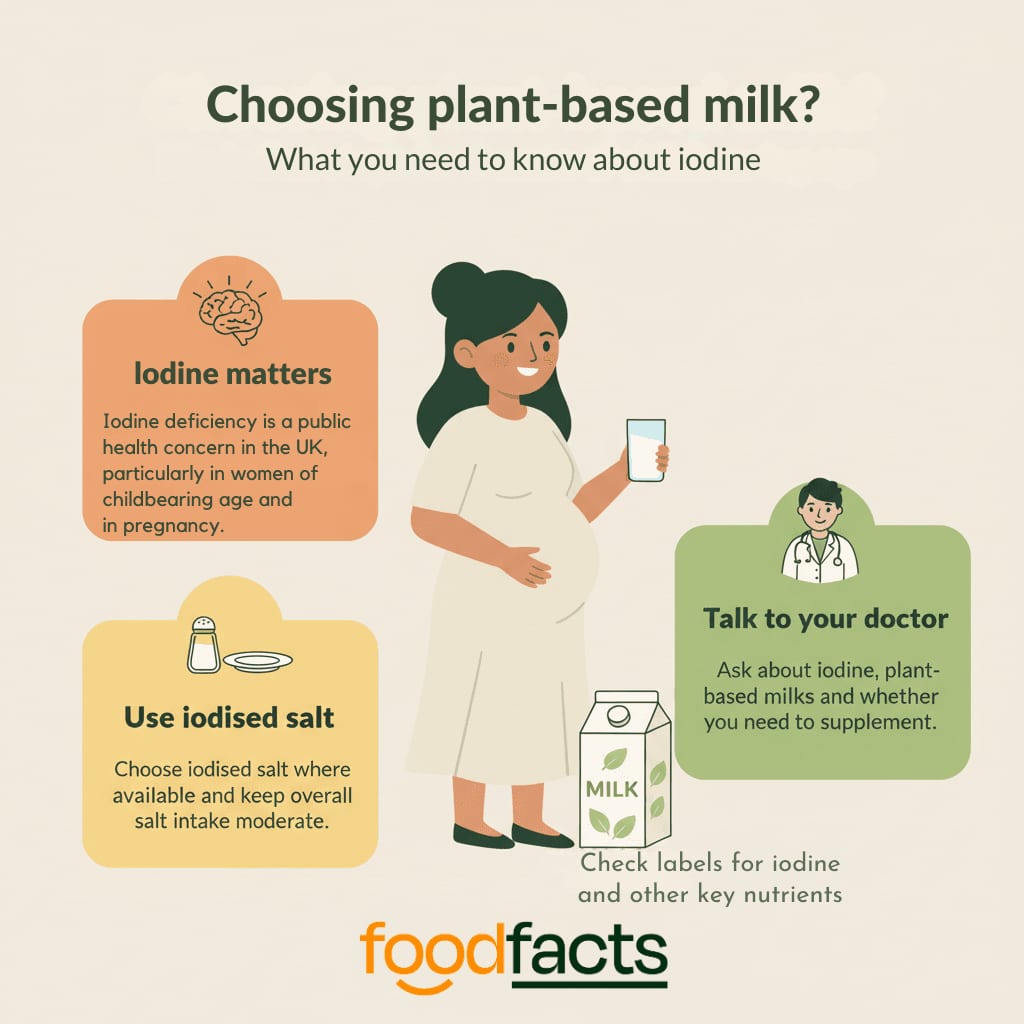
For more information, check out NHS recommendations on iodine. It is always best to check with your doctor before supplementing, as taking too much iodine over time could also be detrimental.
Final take away
The headline shifts attention onto individual choices and plant-based milks, creating an incomplete picture that can cause unnecessary worry. A clearer message is that the underlying problem is iodine deficiency in women of childbearing age and during pregnancy, which can be addressed through iodised salt, appropriate supplementation (under medical guidance and where necessary), and stronger fortification and iodisation policies. In a media environment where many people only see or share the headline, this kind of framing risks obscuring the real issue and fuelling the false belief that plant-based milks are inherently harmful, instead of focusing on how to safeguard iodine status in pregnancy across all dietary patterns.
We have contacted the Daily Mail and are awaiting a response.
Disclaimer
This fact-check is intended to provide information based on available scientific evidence. It should not be considered as medical advice. For personalised health guidance, consult with a qualified healthcare professional.
Independent fact-checking, funded by readers like you.
Misinformation is a growing threat to our health and planet. At foodfacts.org, we're dedicated to exposing the truth behind misleading food narratives. But we can't do it without your support.
Sources
- NIH (2024). “Iodine. Fact Sheet for Consumers.”
- Manousou S. et al. (2018). “Role of iodine-containing multivitamins during pregnancy for children’s brain function: protocol of an ongoing randomised controlled trial: the SWIDDICH study.”
- Bath, S.C. et al. (2013). “Effect of inadequate iodine status in UK pregnant women on cognitive outcomes in their children: results from the Avon Longitudinal Study of Parents and Children (ALSPAC).”
- Rayman M. et al. (2008). “Iodine deficiency in UK women of child-bearing age. Proceedings of the Nutrition Society.”
- Jiang, H., et al. (2019). “A systematic review of iodine deficiency among women in the UK. Public health nutrition.”
- Rohner, F., et. al. (2023). “Global Coverage of Mandatory Large-Scale Food Fortification Programs: A Systematic Review and Meta-Analysis.”
- Phillips, D. (1997). “Iodine, milk, and the elimination of endemic goitre in Britain: the story of an accidental public health triumph.”
- Nicol, K. et al. (2025). “Plant-based milk alternatives: can they replace the iodine from UK cow’s milk?”
- Witard, O. C., et al. (2022). “Dairy as a Source of Iodine and Protein in the UK: Implications for Human Health Across the Life Course, and Future Policy and Research.”
- Gibbs, J., & Cappuccio, F. P. (2022). “Plant-Based Dietary Patterns for Human and Planetary Health.”
- Rockström, J. et al. (2025). “The EAT–Lancet Commission on healthy, sustainable, and just food systems.”
- Dineva M. et al. (2021). “Iodine status of consumers of milk-alternative drinks v. cows’ milk: data from the UK National Diet and Nutrition Survey.”
- WHO (2023). “Iodization of salt for the prevention and control of iodine deficiency disorders.”
- WHO (2022). “UNIVERSAL SALT IODIZATION AND SODIUM INTAKE REDUCTION COMPATIBLE, COST–EFFECTIVE STRATEGIES OF GREAT PUBLIC HEALTH BENEFIT.”
- NHS (2020). “Iodine.”
- WennersHerron, A. (2024). “Social media users probably won’t read beyond this headline, researchers say.”


foodfacts.org is an independent non-profit fact-checking platform dedicated to exposing misinformation in the food industry. We provide transparent, science-based insights on nutrition, health, and environmental impacts, empowering consumers to make informed choices for a healthier society and planet.








.svg)


.svg)

