
Fact-Checking:
Barbara O'Neill
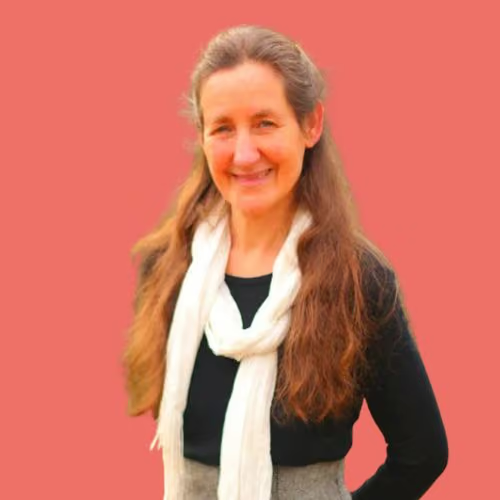
Barbara O’Neill is an Australian alternative health promoter who teaches that the body is designed to heal itself if supported with “natural” remedies, specific diets, and lifestyle changes. Her talks often weave health advice with Christian and biblical themes, presenting natural healing as part of following God’s “laws of health.”


Profession: Alternative health promoter, retreat co‑owner, online lecturer
Credentials: No recognised health-related qualifications; did not complete nursing training; prohibition order notes absence of credible health qualifications; naturopathy certificate from the College of Naturopathic Medicine recognising her contribution (not an accredited medical or dietetic qualification)
Tagline: “Self Heal by Design” / body designed to heal itself through natural methods, diet, and herbal remedies.
Barbara O’Neill is an Australian alternative health promoter who teaches that the body is designed to heal itself if supported with “natural” remedies, specific diets, and lifestyle changes. Her talks often weave health advice with Christian and biblical themes, presenting natural healing as part of following God’s “laws of health.” She has a large international audience via retreats, online courses, and widely shared talks, despite a permanent prohibition order from the New South Wales Health Care Complaints Commission (HCCC) banning her from providing health services due to “dubious and dangerous health claims.” Deepfake videos using her likeness have also been used by scammers to promote fraudulent health cures online, without her involvement.
F - Financial incentive
Are there visible revenue streams associated with the content?
Barbara O Neill’s natural‑healing narrative and lectures are used to present her as a global educator figure, with some event advertising describing her as a “worldwide natural health educator” or even “the world’s greatest health influencer in this decade.” This positioning underpins a speaking itinerary that includes numerous international retreats, conferences and lecture tours, where tickets range from relatively low‑cost day events to premium, week‑long residential packages and online access options.
She and her husband have been presented as the owners and founders of Misty Mountain Lifestyle Retreat, a residential health centre in NSW. Public pricing indicates that a standard one‑week residential programme typically costs several thousand Australian dollars per person (for example, listings show single-guest packages in the mid AUD 3,000s to 7,000 range, depending on room type and inclusions). These in‑person programmes sit alongside paid online courses, and her name front‑lines a product shop selling books, herbal preparations, foods, skin and hair products, and related items.
Take-away: The self‑healing message is integrated with a commercial ecosystem of retreats, online courses, and products, with Barbara’s name and protocols central to marketing.
A - Authority signalling
How do they get perceived as sources of nutritional information?
O’Neill presents herself as a trusted health guide primarily on the basis of life experience (mother, grandmother, great‑grandmother and long‑time speaker on health topics) rather than on recognised clinical qualifications. In interviews and podcasts, she and her hosts often contrast her decades of “helping people” with formal qualifications, suggesting that “a piece of paper” matters less than practical results and lived wisdom. What is not mentioned is that medical qualifications come with rigorous training, regulation and accountability.
She has been described as a naturopath, nutritionist and health educator, and more recently has publicised receiving a naturopathy certificate from a college of naturopathic medicine in recognition of her contributions, rather than as the result of following a regulated training pathway. Her account of why certain qualifications have been dismissed contrasts starkly with regulatory findings in Australia, which note that she has no accredited health‑professional qualifications and did not complete nursing training, warnings that were echoed by the UK-based General Council and Register of Naturopaths. Despite this lack of medical training or qualification, she was presented as the “health director” of her retreat and continues to deliver detailed lectures on hormones, cancer, infection and chronic disease that go far beyond general wellness tips and into specific explanatory models and suggested protocols.
In some talks her husband recounts refusing an ambulance after being shot, saying he preferred his wife’s care and would only use the “health system” in extreme situations, while the post added a note that this should not be seen as health advice. These anecdotes however contribute to portraying Barbara as a competent carer, trusted above ‘mainstream medicine’.
Take-away: Authority is signalled through life experience, faith‑inspired “laws of health,” honorary‑style naturopathy recognition and titles such as “health director,” while the absence of recognised medical or dietetic qualifications—and the accountability that comes with them —is downplayed, even as she offers detailed advice on serious medical conditions.
C-Claims
What is the core messaging, and what is left out?
The core idea - O’Neill’s central message is that the body can “self-heal by design” if given the right conditions: specific diets, natural remedies and lifestyle routines aimed at avoiding “toxins,” detoxifying and rebalancing the body, often presented as preferable to or safer than conventional treatment. Course titles on her official site promise freedom from sickness when these “laws of health” are followed, which is appealing but does not reflect the reality of many illnesses or how disease mechanisms and prognosis actually work.
From idea to certainty - This idea is frequently framed in absolute terms: the body is portrayed as capable of fighting off almost any illness if we remove modern “interferences,” and diseases are often described as consequences of our current environment, medical interventions, or lifestyle “breaking” God’s or nature’s design. Natural methods are depicted as the route to resolving the “cause” of illness, while modern medicine is characterised as symptom‑suppressing, sometimes toxic and profit‑driven. Serious conditions are framed as reversible through her protocols, with strong implications that medical treatments can be replaced or avoided, and that if people follow these steps properly they might be “free from sickness”; this framing risks placing guilt on those who do become or remain seriously ill despite doing “the right things.”
What is left out - O’Neill has downplayed the seriousness of her permanent ban in Australia, implying regulators “went after” her for giving common‑sense advice such as drinking more water, going to bed earlier, or putting apple in a cloth for a 10‑month‑old to chew, and suggesting it was triggered by her husband’s political activities rather than the substance of her teachings (source). This framing contrasts with the NSW Health Care Complaints Commission decision, which cites high‑risk clinical advice: describing cancer as a fungus treatable with bicarbonate of soda, discouraging antibiotics for pregnant women with Group B Streptococcus, promoting raw goat’s milk for infants, and making strong anti‑vaccination and anti‑screening claims, all without credible supporting evidence.
Her explanations often weave real physiological concepts into a neat, coherent story (everything from pesticides to plastics to underwear fabric becomes part of a single narrative about hormonal imbalance), but she generally does not cite peer‑reviewed research, and many of the mechanisms she describes are oversimplified or demonstrably false. Let’s go through a few of those:
Verifiably false mechanistic claims (wild yam cream)
O’Neill claims that wild yam cream (e.g. “Anna’s Wild Yam”) contains a plant compound that, when rubbed into the skin, prompts the body to make its own progesterone, correcting “hormone imbalance” and treating problems ranging from hot flushes and depression to osteoporosis and breast‑cancer risk. Wild yam does contain diosgenin, which can be used in a laboratory as a raw material to synthesise progesterone, but human bodies do not convert diosgenin from wild yam or cosmetic creams into progesterone. Clinical trials have found that wild yam creams do not raise progesterone levels and are not effective for menopausal symptoms. This means the central mechanism she describes, that the cream makes your body produce its own progesterone, is incorrect, and the broad therapeutic promises are unsupported.
Imbalances as a single root cause
In her hormone lectures, O’Neill presents early periods, breast and cervical cancer, fibroids, PCOS, endometriosis and depression as essentially all “symptoms of a hormonal imbalance,” often linked to contraceptive pills (including use by previous generations), HRT or environmental exposures such as pesticides, plastics and even underwear fabrics. Evidence shows these conditions are multifactorial: genes, infections (for example, high‑risk HPV for cervical cancer), metabolism, lifestyle and hormones all play roles; they are not simply downstream symptoms of one imbalance that can be corrected with creams and detox foods.
Meanwhile, she gives little attention to the actual quantified risks and benefits found in large studies, such as modest, time‑limited increases in breast‑cancer risk alongside reduced risks of ovarian and endometrial cancers and major improvements in symptoms and quality of life (source, source).
One example: Angelina Jolie and BRCA risk
O’Neill has cited Angelina Jolie as an example, suggesting Jolie did not have to remove her breasts and that what was needed was hormonal balancing. Jolie is a documented carrier of a BRCA1 mutation with a very high inherited risk of breast and ovarian cancer; she chose risk‑reducing bilateral mastectomy after specialist counselling to substantially lower that risk. There is no evidence that “balancing hormones” provides comparable risk reduction in BRCA carriers, and guidelines instead discuss enhanced surveillance, surgery and certain medications as evidence‑based strategies. Presenting a high‑risk genetic scenario as something that could have been managed by hormone balancing alone misrepresents both the evidence and the seriousness of the decisions women in similar situations face.
Cancer, fungus and bicarbonate; discouraging evidence‑based care
The HCCC found that O’Neill told clients cancer was caused by a fungus and could be treated with sodium bicarbonate, including via “cancer conquering” diets and bicarbonate body wraps. There is no credible clinical evidence that human cancers are systemic fungal infections curable with bicarbonate; such claims directly contradict oncology guidelines and risk encouraging patients to refuse or delay treatments that have demonstrably improved survival.
When asked about her claims about cancer and fungus, she referenced the widely discredited Tullio Simoncini, who “was found guilty of manslaughter for treating a patient with a brain tumour with sodium bicarbonate” (source). This context does not feature in O’Neill’s narrative.
What is indeed largely absent from her discourse is discussion of what happens to people with potentially curable cancers who decline or postpone standard treatments in favour of unproven alternatives. For example, a large study found that breast and colorectal cancer patients were 5 times more likely to die after opting for an alternative therapy as their initial treatment, as opposed to conventional treatment (source). When doctors recommend treatments, they typically emphasise uncertainty, side effects and the fact that therapies may not work, enabling informed choice; bycontrast, O’Neill’s narratives often present natural approaches with far greater certainty than the evidence supports.
Vital screening and infant feeding
O’Neill speaks against several forms of routine screening, including early pregnancy ultrasounds and Pap smears. Regarding the latter, she has downplayed the role of HPV, calling it “a scam,” which is well-documented to be responsible for most cases of cervical cancer, with 99.7% of cases linked to permanent infections. To support her position, she often repeats the idea that if something is wrong, your body will let you know. However, many conditions can be asymptomatic until they are advanced or much harder to treat, which is precisely why screening programmes were developed. In contrast to her messaging, cervical screening programmes are estimated to prevent or delay large numbers of deaths each year (source); UK data suggest that cervical screening saves around 5000 lives annually in England alone (source).
She has suggested raw goat’s milk is a suitable substitute for breast milk for infants who cannot breastfeed, despite public‑health warnings that raw milk can transmit serious infections and that unmodified goat’s milk does not meet the nutritional and safety standards of breast milk or infant formula. When she was questioned about this by the HCCC, she claimed that she advised mothers to favour goat’s milk formula rather than raw milk. As the commission pointed out that this contradicted some of her written statements, O’Neill admitted she should have been clearer. However, she was found years later to suggest that raw goat’s milk was a suitable alternative on a podcast hosted by Gary Brecka.
Evidence vs anecdotes
The HCCC reported that “Mrs O'Neill has displayed disinclination to reconsider her dubious health claims that are not evidence based or supported by mainstream medicine even when presented with peer reviewed and/or widely accepted literature.” Her public content leans heavily on stories and mechanistic narratives (“starving fungus,” “rebalancing hormones”) woven into a persuasive storyline about design and self‑healing, rather than on balanced discussion of clinical trials, guidelines or uncertainty.
Success stories (individuals whose scans or symptoms reportedly improved after following her protocols) are highlighted as supposed proof that the system works, while non‑responders, complications and those who ultimately needed or benefited from conventional treatment are rarely mentioned. This selective use of anecdotes makes it hard for audiences to see actual probabilities or risks and can encourage the belief that “if I just follow this programme, I too will recover,” without showing how often that does not happen.
Take-away: Appealing themes of nature, faith and self‑healing are extended into sweeping claims that conflict with established evidence on cancer, infection, vaccination, screening, hormones and infant feeding. Several core mechanisms (such as wild yam cream making the body produce progesterone) are demonstrably false, and there is little engagement with the wider scientific literature or with the risks of delaying or rejecting standard care in favour of her protocols.
T - Tone
How is the information packaged, and what makes it appealing?
O’Neill’s style is calm, measured and maternal, and she delivers much of her content in lecture format, walking audiences through what appears to be a “big picture” explanation of how the body works and why illness happens. She often speaks in detailed, science‑sounding language about hormones, detox pathways, cancer mechanisms and environmental chemicals, which can give a strong impression of competence and comprehensive understanding.
However, when those mechanisms are examined against established evidence, many are oversimplified, selectively framed or simply inaccurate. She weaves partial truths which can sound like common sense (real physiological processes, real concerns about over‑medicalisation and environmental exposures) into a coherent story about why people are sick now, why they aren’t getting better, and why returning to “basics” will restore health—rest, balance, whole foods, and avoiding “toxins.” Although some of these lifestyle themes align with mainstream advice, they are taken much further, suggesting that they can replace well‑tested treatments, and presented without the careful handling of uncertainty that characterises good scientific and clinical practice.
Her talks contrast this apparently holistic understanding with a strongly critical view of mainstream healthcare and pharmaceuticals, casting doctors as drug‑prescribers who focus on short‑term symptom management while missing the root causes—and sometimes using anecdotes (for example, about her husband refusing an ambulance, potentially delaying ultrasounds, or linking drugs to later cancer diagnoses through her theoretical explanations) to suggest that natural methods might be more appropriate. Some of these messages are stated directly (e.g. that vaccines are unsafe, that HPV and related screening are a “scam,” that cancer is a fungus), and others are implied through stories and framing, but together they can normalise relying on her protocols and worldview instead of standard care.
This narrative is particularly appealing to people who feel poorly served by mainstream medicine or are facing frightening diagnoses: it offers a simple, hopeful account in which the body is beautifully designed, problems come from human interference (chemicals, drugs, engineered foods), and following “laws of health” can make you free of sickness. Yet attaching that story to high‑certainty claims that natural methods may replace treatments—from depression to cancer—can reinforce distrust of interventions that have been shown to save lives, delay diagnosis or treatment until disease is more advanced, and undermine trust in clinicians who are trying to help. Her prohibition order has not diminished this influence; clips of her talks continue to circulate widely and are used to promote retreats, online courses and products, extending the reach of this persuasive style to new audiences.
Take-away: A calm, lecture‑based, science‑sounding storytelling style—framed around nature, “God’s laws” and common sense—can make complex, inaccurate or high‑risk claims feel coherent and trustworthy, encouraging high‑stakes departures from evidence‑based care while masking the uncertainty and nuance that genuine scientific practice requires.
Final take-away
O’Neill’s work has attracted significant controversy and public concern from health professionals. Fact‑checking organisations and clinicians have highlighted the gap between her claims and the underlying evidence, and some have issued explicit warnings about her advice: see for example this post by dietitian Danielle Shine and immunologist Andrea Love explaining why some of O’Neill’s recommendations are unsafe and not supported by data.
Some of O’Neill’s concerns tap into real issues, and because of this they might, especially in isolation, be regarded as “common sense.” But it is important to note that her collective message and ‘us vs them’ framing misrepresent experts’ positions on several topics. For example, major reviews and reports, such as the Lancet Commission on Pollution and Health and WHO assessments, recognise that pollution and certain chemicals (including air pollutants and some industrial compounds) are important environmental risk factors for disease and premature death. But where scientific bodies emphasise quantified risks and multiple contributing factors, her framing tends to be more black‑and‑white, casting almost all modern illness as the direct result of ‘toxins’ or medical interventions, and implying that avoiding these and following natural ‘laws of health’ is sufficient to prevent or reverse disease.
Disclaimer
FoodFACT profiles summarise public-facing claims and marketing alongside our analysis. Quotes, prices, and membership figures are taken from linked sources as viewed at the time and may change. This content is for information only and is not medical advice. See something wrong or outdated? Let us know and we’ll update.




.svg)
