




The world is running out of time: inside the looming global food crisis




A FoodFacts.org Special Investigation, April 2026
Summary: A convergence of conflict, fertilizer market collapse, climate stress, and a historic collapse in humanitarian funding has pushed the global food system to a breaking point. From famine in Gaza and Sudan to UK food inflation heading toward double digits, this investigation examines the interconnected crises shaping what we eat, and what hundreds of millions cannot.
What is the 2026 global food crisis?
The 2026 global food crisis is the convergence of conflict, fertilizer shortages, climate stress, and falling humanitarian funding that has pushed 318 million people into crisis-level hunger. Two countries, Gaza and Sudan, are in confirmed famine simultaneously, the first time this century. Fertilizer prices are up roughly 80% year-on-year following the Strait of Hormuz crisis, and UK food inflation is forecast to reach 9–10% by December 2026.
Quick facts
- 318 million people face crisis-level hunger globally, more than double the 2019 level.[36]
- 41 million are at IPC Phase 4 or worse, one disruption away from famine.[36]
- Gaza and Sudan are in confirmed famine simultaneously, the first time this century.[7][37]
- Urea fertilizer prices are up roughly 81% year-on-year following the Strait of Hormuz crisis.[31]
- The Food and Drink Federation has revised UK food inflation forecasts to at least 9–10% by December 2026.[15]
- The World Food Programme needs $13 billion in 2026, but is forecast to receive barely half.[36][38]
The world is already on fire
Professor Toni Farmer has spent fifteen years working inside the food system: as a farmer, a policy advocate, and in industrial-scale food manufacturing. She is now an adjunct professor at the University of Pennsylvania and Rowan University, where she teaches courses on regenerative agriculture, integrated pest management, and the future of food.[35]
She does not mince words.
"We are seeing global yields drop on our major commodity crops," she warned in a viral post this month, "and I need people to understand that is 70% of the global diet."[35] The timeline she lays out is stark: in roughly five years, food prices become a constant background concern for ordinary families; in ten years, real food shortages begin to bite. The commodity crops she names (corn, wheat, soy, sugar, rice) are the structural pillars of almost everything people eat globally.

This isn't the fringe view of a doomsday prepper. It is a view now reflected in key government reports, including the UK's Joint Intelligence Committee assessment and the Defra Food Security Report[32], and supported by agricultural economists and scientists worldwide. The global food crisis is not looming. For hundreds of millions of people, it is already here.
The numbers that should shock us all
According to the World Food Programme's 2026 Global Outlook[36], 318 million people currently face crisis levels of hunger or worse, more than double the figure recorded in 2019, before the pandemic. Within that number, 41 million are at Emergency levels (IPC Phase 4 or worse), meaning they are one disruption away from famine.
And then there is what the WFP calls the funding gap. To reach the most vulnerable, the agency needs $13 billion in 2026. Current forecasts suggest it may receive barely half of that. As a result, WFP will be able to assist only around 110 million people, leaving more than 200 million without a safety net.[36][41]
WFP Executive Director Cindy McCain was unsparing in her January 2026 address[38]:
"Barely two weeks into the new year the world is already confronting the risk of a dangerous and deepening global hunger crisis. WFP can't end hunger on its own. Today's crises require swift, strategic and decisive action. I call on world leaders to step in earlier during humanitarian crises, rid our world of man-made famines, and most importantly, end these devastating conflicts which drive hunger and desperation."
Conflict, the WFP notes, is responsible for driving 69 percent of global hunger.[36] Climate shocks like droughts, floods, and storms compound the rest.
Two famines. Simultaneously. For the first time this century.
For the first time in this century, famine conditions were confirmed simultaneously in two countries: Gaza and Sudan.
In Gaza, famine was declared man-made by the UN-backed Integrated Food Security Phase Classification (IPC) in August 2025[7][21], confirmed in Gaza City and its surroundings. UN Secretary-General António Guterres called it precisely that:
"It is a man-made disaster, a moral indictment — and a failure of humanity itself. Famine is not only about food; it is the deliberate collapse of the systems needed for human survival."
Sudan's crisis is even larger in scale. With more than 21 million people facing acute hunger, Sudan has become the world's hungriest country. Famine was confirmed by the IPC in two areas[13][37], El Fasher (North Darfur) and Kadugli (South Kordofan), with over 375,000 people at imminent risk of starvation. Two additional localities in North Darfur (Um Baru and Kernoi) recorded acutely elevated malnutrition rates[2][18][27][28] (exceeding IPC thresholds) in February 2026, though they had not been formally classified as famine by the IPC Famine Review Committee, with acutely malnourished children under five reaching 53% in Um Baru. The humanitarian response plan for Sudan requires $2.9 billion; at the time of writing it has received just 5.5% of that funding (as of February 2026).[1]
Across Sudan, acute malnutrition is expected to worsen throughout 2026, with projected cases rising from 3.7 million to nearly 4.2 million people, including children under five and pregnant and breastfeeding women.[1][28]
Action Against Hunger framed the moral stakes plainly[1]:
"Famine is not inevitable. It is a collective decision: either we act now, or we accept that thousands of people will die from something as basic as not having enough to eat."
The fertilizer time bomb
If the immediate crisis is driven by conflict and underfunding, the next shock is already unfolding in slow motion through global fertilizer markets, and its full consequences will not be felt until harvests fail later this year.
Approximately one third of all globally traded fertilizer passes through the Strait of Hormuz.[4][23] Since the US-Israeli military operation against Iran began on 28 February 2026, commercial shipping through that critical chokepoint collapsed[5][24]. Tanker traffic fell to near zero within days, with major shipping companies suspending transit after war-risk insurance coverage was withdrawn. The conflict, referred to in military briefings as Operation Epic Fury, triggered Iranian drone strikes on commercial shipping and an effective closure of the strait.

The breadth of the disruption is staggering when examined by commodity. Persian Gulf producers account for a significant share of global seaborne urea exports (estimates range from around a third to nearly half[42]), a large proportion of global seaborne sulfur trade, and more than a quarter of global ammonia exports.[23][42] Qatar halted liquefied natural gas output following strikes on its energy infrastructure; Iran's urea and ammonia production experienced severe disruptions. Sulfur, a key raw material for phosphate fertilizer production, has received almost no mainstream coverage, yet the Gulf region's role in its supply is decisive.
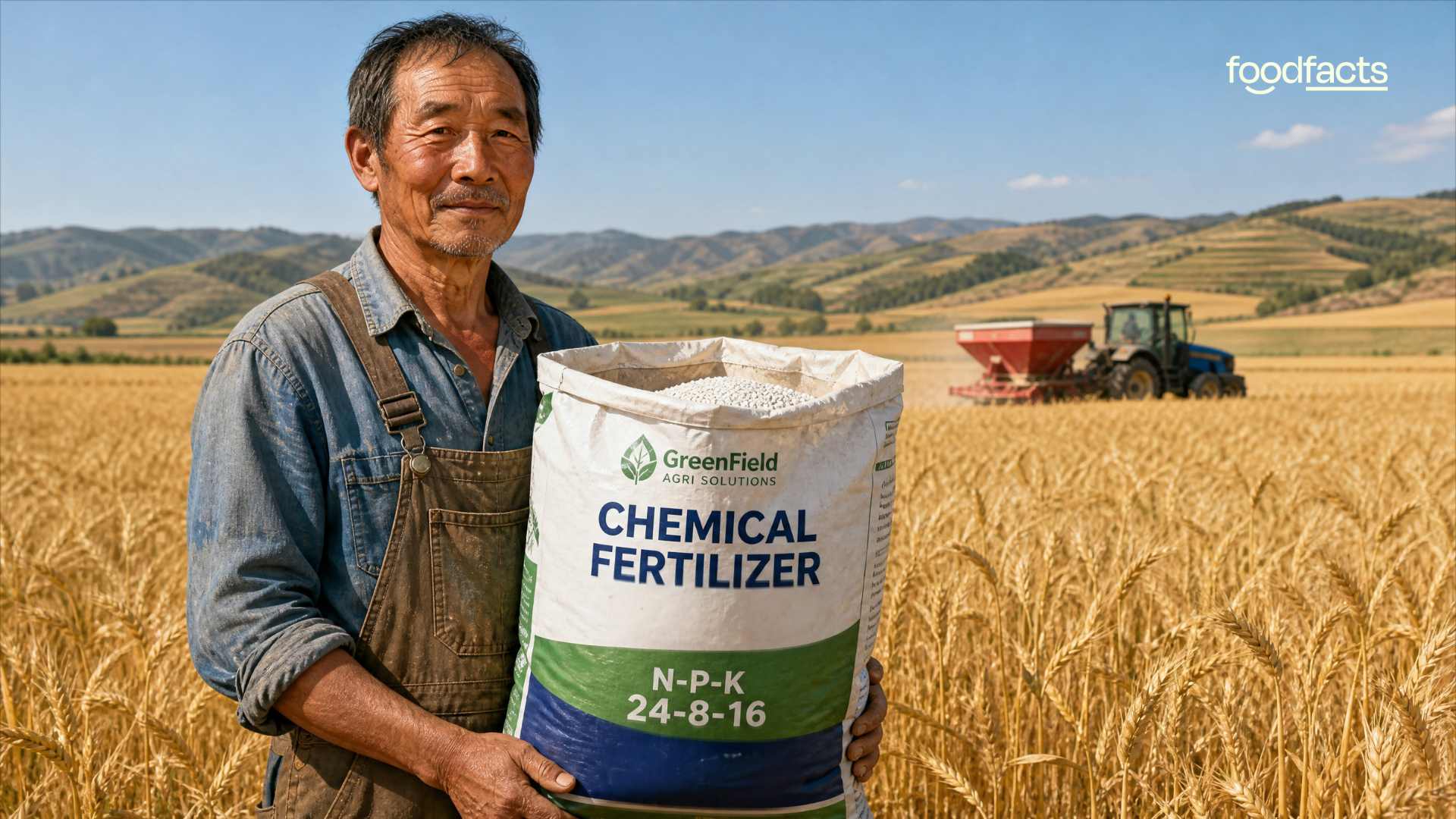
The price consequences have been immediate and severe. Urea prices at the port of New Orleans surged from $475/ton to over $600/ton within days of the conflict beginning.[8][9] Oxford Economics' Alpine Macro reported[6][25] that since the war's commencement, urea and ammonia prices have increased by roughly 46% and over 30% respectively (as of April 2026). Trading Economics data shows urea at $701 per tonne as of 6 April 2026[31], up nearly 81% year-on-year. The UK Agriculture and Horticulture Development Board had already flagged a £50/tonne increase in nitrogen fertiliser the previous year, and prices have continued to rally sharply since.
FAO chief economist Maximo Torero confirmed that fertilizer prices have surged sharply, describing farmers as being under a "double choke"[26] of higher fertiliser costs alongside rising fuel costs across the value chain. His warning was unambiguous: if the Middle East conflict continues, it could eventually hit the supply of essential staples and push global prices higher.
Francisco Martin-Rayo, co-founder of Helios AI, a food system risk analytics firm, put the agricultural timing problem plainly[6]:
"You can't put fertilizer in the ground in June that you missed putting in in March or April and expect the same result."
His firm is projecting global food prices could rise 12–18% by the end of 2026 if disruptions continue.[6]
The downstream consequences are already materialising. US corn planting intentions have fallen as farmers shift acres away from fertiliser-intensive crops toward soybeans, with Reuters reporting the lowest quantity of spring wheat planted since 1970[10]. Farm bankruptcies were already up 46% in 2025 compared to the previous year[3] (315 Chapter 12 filings versus 216 in 2024), the third consecutive annual increase, according to the American Farm Bureau Federation. Farmers entering the 2026 planting season are making fertilizer purchases in real time as prices skyrocket, with approximately 50% of nitrogen fertiliser applied to corn and 42% applied to spring wheat typically applied in spring.
Food prices are already rising, and it will get worse
The FAO Food Price Index[14], the global benchmark for food commodity prices, averaged 128.5 points in March 2026, up 2.4% from February, marking a second consecutive monthly increase, and standing 1% above its level a year ago.
The increases cut across all commodity groups. Vegetable oils rose 5.1% month-on-month and 13.2% year-on-year. Sugar prices surged 7.2%. Wheat jumped 4.3%, driven by drought-related deterioration of crop prospects in the United States and expectations of reduced planting in Australia due to higher fertilizer costs.[14][26]
For UK consumers, the pain is already real. Food and non-alcoholic drink prices are approximately 37% higher than their pre-Covid levels[33], a sustained erosion of purchasing power that has hit lower-income households hardest. UK food inflation stood at 3.3% year-on-year in February 2026. The Food and Drink Federation (FDF), having previously forecast UK food inflation would end 2026 at around 3%, revised that projection dramatically upward in April 2026[15], now forecasting food inflation of at least 9–10% by December, assuming the Strait of Hormuz reopens within two to three weeks. ITV News Economics Editor Joel Hills reported[20] that some analysts see UK food inflation potentially reaching double digits (up to 12%) if the Middle East energy crisis is prolonged.
Britain's fragile food system
The United Kingdom likes to think of itself as a stable, wealthy nation insulated from the food crises that affect the developing world. The evidence suggests that confidence is dangerously misplaced.
The UK produces only around 62% of the food it needs, according to the UK Food Security Report 2024[32], a figure that has barely changed in over a decade. That headline number masks acute vulnerabilities in specific sectors. Britain grows just 16% of its own fruit and only 53% of its own fresh vegetables, the latter the lowest level since records began in 1988.[32] One Green Party peer described the UK as "only 54% self-sufficient in food, in an increasingly unstable world," highlighting the structural dependency now being tested in real time.
A study published in the journal Sustainability in early 2026, led by researchers from the University of York and Anglia Ruskin University, mapped exactly how this fragility could cascade into crisis.[34] Drawing on insights from 39 food system experts from academia, government, and industry, the research modelled how seemingly unrelated shocks (a cyber-attack on a major retailer, a spell of extreme weather, or a geopolitical disruption) could escalate through brittle, just-in-time supply chains into food shortages, price spikes, public health crises, and ultimately social unrest.
Professor Sarah Bridle, Chair of Food, Climate and Society at the University of York, was clear about what is at stake[34]:
"The stability of the UK's food system is a critical aspect of national security. While we can't always prevent future shocks, we can build resilience to withstand them, and stop a bad situation from becoming a crisis. While there is a growing awareness of the potential risks, not enough coordinated work is being done to address the weak spots in the system."
Professor Aled Jones, Director of the Global Sustainability Institute at Anglia Ruskin University, warned that complacency among policymakers is itself a risk factor[34]:
"The potential for events to trigger a food crisis is frequently underestimated. The UK is not immune to disruptions that can lead to severe consequences. Policymakers must adopt a long-term perspective to policy planning, and work across departments and wider food system stakeholders to ensure a whole-systems approach to addressing the problems."
The Anglia Ruskin research builds on a £2 million initiative launched in early 2025, which found that more than 40% of food system experts believed widespread civil unrest (defined in the study as social disruption including protests, riots, or public disorder linked to food shortages) was possible or likely in the UK within the next ten years.[34] That finding carries added weight now.
At the NFU's annual conference in February 2026, Tom Bradshaw, president of the National Farmers' Union, gave arguably his most urgent speech on record.[12] Farmer confidence is at the lowest level ever recorded[22], with 64% of farmers and growers saying their profits are declining or that their business may not survive. He called out the UK's structural dependency with characteristic bluntness[12]:
"The events of the past few years have shown us we cannot keep relying on others to produce our food... the production of staples such as wheat, beef, poultry meat and vegetables are all down. The years of UK food production contracting must end now."
The government's response? Chancellor Rachel Reeves' Spring Statement 2026[11], delivered on 3 March, contained no mention of farming or food security, for the second consecutive year.
The funding crisis behind the crisis
Beneath the headline statistics about hunger and conflict lies a financial collapse in the global humanitarian system. The United States, for decades the world's largest donor to food aid, has significantly cut its foreign aid budget under President Trump, and shuttered USAID entirely, the agency that had an annual budget of nearly $5 billion for food aid and whose flagship Feed the Future initiative worked to address root causes of hunger in 20 countries.
The consequences are cascading. A study published in The Lancet in February 2026[30] projected that the dismantling of USAID and corresponding cuts by the UK, Germany, Canada, and others could lead to 9.4 million additional deaths by 2030, with approximately 2.5 million of those expected to be children under five. A separate Lancet analysis published in June 2025, focused specifically on USAID alone, put the projected death toll at over 14 million, including more than 4.5 million children under five.[30]
These cuts have had direct, traceable consequences. In the Democratic Republic of Congo, WFP had planned to assist all 2.3 million people at emergency hunger levels in 2025. Due to funding gaps, only 1 million were reached, and that number was cut again to 600,000 from October. A complete pipeline break in emergency food assistance for the eastern provinces was anticipated by early 2026.[39] In Afghanistan, WFP food assistance has reached less than 10% of food-insecure people despite soaring malnutrition rates.[39][41]
FAO Director-General Qu Dongyu laid out what the international community is effectively choosing to ignore[14]:
"Acute food insecurity is not just a crisis — it is a constant reality for millions of people, most of whom live in rural areas. Investment in emergency agriculture is critical, not just as a response, but as the most cost-effective solution to deliver significant long-lasting impact."
The climate shadow over every harvest
Woven through every dimension of this crisis is the long-term structural pressure of climate change on the world's capacity to grow food.
As Professor Paul Behrens warned at the National Emergency Briefing on Food Security in 2026:
"For generations, a stable climate has given us reliable harvests. But that era is gone. We are facing an increasingly chaotic system."
A landmark study published in Nature in June 2025, led by researchers at the Stanford Doerr School of Sustainability and the Climate Impact Lab[29], modelled crop yields across 12,000 regions in 55 countries, focusing on six key staples: corn, rice, wheat, soybeans, cassava, and sorghum. Its findings were sobering. Under a high-emissions scenario, global crop yields will fall by 24% by 2100. Even under net-zero pathways, yields are projected to fall by 11%. In the short term, by 2050, regardless of emissions trajectory, an 8% decline is already effectively locked in.[29]
Every additional degree Celsius of warming, the study found, reduces global food production by around 120 calories per day per person, approximately 4.4% of global food consumption. First author Andrew Hultgren and senior researcher Professor Solomon Hsiang of Stanford translated this into language anyone can understand[29]:
"When global production falls, consumers are hurt because prices go up and it gets harder to access food and feed our families. If the climate warms by 3 degrees, that's basically like everyone on the planet giving up breakfast."
The intersection of climate stress and today's geopolitical disruptions is not coincidence. Extreme weather events, intensified by climate change, continue to threaten yields worldwide. The UK experienced its driest spring in over a century in 2025, forcing cattle farmers to tap winter feed reserves months early. This isn't abstract risk modelling. It's already happening in fields across Britain and beyond.
The food system misinformation problem
There is one further dimension of the food crisis that rarely makes it into mainstream analysis but is directly relevant to the work of foodfacts.org: the role of misinformation in distorting public understanding and delaying action.
As food systems come under pressure, a parallel ecosystem of fear-based and ideologically driven narratives has flourished online. Nutrition has become one of the most heavily misinformed topics on social media, where personal beliefs are routinely presented as settled science and complex structural problems (subsidy regimes, corporate consolidation, the collapse of local food systems) are reduced to viral villains and single-ingredient scares. Our Traffic Lights System guide[16] offers a practical framework for identifying when online food content has crossed from simplification into outright misleading territory.
This matters for food security in direct ways. When the narrative shifts to blaming individual ingredients or attributing systemic failures to deliberate corporate malice, the public ends up demanding symbolic changes rather than structural ones. The real policy levers (agricultural investment, diversification of protein supply, soil health, supply chain resilience) are drowned out by culture-war noise. As we argued in our investigation into whether reducing livestock really causes food shortages[17], the evidence consistently points away from fear-driven narratives and toward the need for systemic dietary transition.
Meanwhile, ultra-processed foods now make up a significant share of the US and UK food supply, accounting for approximately 57% of calories in US diets and around 56% in the UK, not because of individual choices, but because of decades of commodity-crop subsidies, corporate consolidation, and an economic model that consistently prioritises volume over nutrition. The structural forces behind dietary harm are policy problems, not just personal ones.
The path forward: what the science recommends
The solutions exist. They are not secret. What they lack is political will, institutional courage, and adequate funding.
Diversifying protein supply is perhaps the most evidence-backed structural response to food system fragility. Three-quarters of the world's agricultural land is currently used for raising and feeding farmed animals, yet that system provides only 37% of global protein supply (Poore & Nemecek).[19] Alternative proteins, whether plant-based, cultivated, or fermentation-derived, require less land, less water, and critically, significantly less fertilizer per unit of protein. This matters enormously in a world where fertilizer supply chains are being disrupted by geopolitical shocks, as the events of March 2026 have made viscerally clear.
A coalition of 130+ organisations, including Greenpeace, Compassion in World Farming, and the European Consumer Organisation, called on the EU in 2025 to introduce an action plan for plant-based foods. The EU Plant-Based Coalition launched a €3 billion Innovation Investment Agenda for 2026–2035 in February 2026, structured around 75 projects and seven innovation pillars, with the goal of increasing plant-based proteins to 50% of total protein intake by 2035. That shift, the coalition notes, would strengthen Europe's food security and reduce import dependency simultaneously.
The Good Food Institute has argued persuasively that alternative proteins represent a genuine national security solution[19] (not just an environmental one) by reducing supply chain risks, diversifying the protein base, and increasing production efficiencies.
Building domestic food resilience is equally urgent in countries like the UK. The York–Anglia Ruskin research team recommends increasing UK energy security, diversifying food value chains, and co-designing resilience responses with communities most affected by food insecurity, rather than imposing top-down policies on them.[34]
Restoring humanitarian funding is the most immediate lever available to prevent famine deaths that are otherwise preventable. The WFP, FAO, UNHCR and UNICEF have consistent evidence that every dollar invested in anticipatory food security action saves up to seven dollars in averted losses, according to WFP's 2026 Global Outlook.[36] The current trajectory of cuts will kill people, and the Lancet data quantifies exactly how many.[30]
Ending the conflicts that drive hunger is the precondition for all other progress. The WFP estimates that conflict is responsible for 69% of global acute hunger.[36][38] There is no food security solution that bypasses peace.
The clock is ticking
Toni Farmer's five-to-ten year timeline captures something important: this crisis has momentum.[35] The seeds planted, or not planted, this spring will determine harvests in autumn 2026. The fertilizer missed in March cannot be applied retroactively in June. The aid programmes cut in 2025 cannot undo the malnutrition that calcified in children's bodies during that time.
The FAO Food Price Index has risen for two consecutive months to its highest level since December, standing 1% above where it was a year ago and climbing.[14][26] The world is watching the Strait of Hormuz with one eye and the spring planting forecasts with the other, hoping the two crises don't compound each other.
WFP's March 2026 analysis[40] warned that roughly 45 million more people could be pushed into acute hunger this year if the Middle East conflict persists, pushing global food insecurity to levels last seen at the start of the Ukraine war, when 349 million people were impacted.
They already are compounding. And for the 318 million people already living in crisis-level hunger (in Sudan, Gaza, the DRC, Haiti, Afghanistan, and dozens of other countries), the abstract language of geopolitics and commodity indices translates into a single, daily question: will there be enough to eat?
The honest answer, for too many people on this planet, is no.
FoodFacts.org is an independent fact-checking platform focused on food system misinformation and evidence-based food policy, run by The Freedom Food Alliance. For more on how we evaluate evidence and policy claims, see our fact-checking policies.

Independent fact-checking, funded by readers like you.
Misinformation is a growing threat to our health and planet. At foodfacts.org, we're dedicated to exposing the truth behind misleading food narratives. But we can't do it without your support.
Sources
- Action Against Hunger (9 February 2026). Sudan Famine Update: Deepening Starvation.
- Al Jazeera (5 February 2026). Famine conditions spread to more towns in Sudan's Darfur, experts warn.
- American Farm Bureau Federation (8 February 2026). Farm Bankruptcies Continued to Climb in 2025.
- Breakwave Advisors (10 March 2026). Hormuz Disruption and the Emerging Fertiliser Shock.
- Carnegie Endowment for International Peace (11 March 2026). Fertilizer isn't getting through the Strait of Hormuz, which could worsen global food prices.
- CNBC (25 March 2026). Fertilizer prices surge amid Iran war, sparking food security warnings.
- Concern Worldwide (21 August 2025). 'Entirely man-made' famine officially confirmed in Gaza.
- DTN Progressive Farmer (11 March 2026). Despite US and Israel-Iran Conflict, Retail Fertilizers Start March Mixed.
- Farm Policy News (3 March 2026). Fertilizer Prices Have 'Significant' Rise After Attack on Iran.
- Farm Policy News (26 March 2026). US Corn Acres to Fall in 2026, Surveys Show.
- Farmers Guardian (2 March 2026). Spring Statement 2026: Reeves fails to mention farming nor food security for second year in a row.
- Farmers Guardian (23 February 2026). NFU Conference 2026: 'We need a food strategy that sets clear ambitions.'
- FEWS NET (4 September 2025). Famine possibly ongoing in Al-Fasher of North Darfur.
- Food and Agriculture Organization (3 April 2026). FAO Food Price Index — March 2026 Update.
- Food and Drink Federation (1 April 2026). FDF revises food inflation forecast to at least 9% by the end of 2026.
- FoodFacts.org (1 October 2024). How to identify nutrition misinformation: the Traffic Lights System.
- FoodFacts.org (24 July 2025). Will reducing livestock really cause food shortages? Here's what the science says.
- Funds for NGOs (9 February 2026). Children at Risk: New Famine Zones Emerge in Sudan.
- Good Food Institute. Alternative proteins are a global food security solution.
- ITV News (31 March 2026). UK food inflation could hit 'double digits' due to war in Iran.
- Mondoweiss (21 August 2025). Famine has officially taken hold in Gaza, and it is 'entirely man-made,' experts say.
- National Farmers' Union (23 February 2026). NFU farmer confidence survey results show farmer confidence at all-time low.
- NDSU Agricultural Trade Monitor (March 2026). The Strait of Hormuz Closure and Global Fertilizer Trade Disruptions.
- NPR (20 March 2026). How the Iran war threatens global food supply.
- Oxford Economics / Alpine Macro (March 2026). Cited in CNBC (25 March 2026).
- Reuters (3 April 2026). World food price rise set to continue if Iran war lasts, FAO says.
- Reuters (5 February 2026). Malnutrition reaches famine levels in two more areas of Sudan's North Darfur.
- Save the Children (2026). Sudan famine alert — Um Baru and Kernoi.
- Stanford Doerr School of Sustainability / Climate Impact Lab (17 June 2025). Climate Change Cuts Global Crop Yields, Even When Farmers Adapt. Published in Nature.
- The Lancet (2 February 2026). Study on global aid cuts and projected deaths by 2030.
- Trading Economics (6 April 2026). Urea Price.
- UK Government — Defra (December 2024). United Kingdom Food Security Report 2024, Theme 2.
- UnHerd (2 April 2026). A food inflation crisis is coming.
- University of York / Anglia Ruskin University (February 2026). UK food system resilience study. Published in Sustainability.
- University of Pennsylvania — Penn LPS. Toni Farmer, Adjunct Professor.
- WFP (17 November 2025). WFP 2026 Global Outlook — 318 million face crisis-level hunger.
- WFP (3 November 2025). Famine conditions confirmed in Sudan's El Fasher and Kadugli.
- WFP (12 January 2026). WFP's Strategic Priorities Against Hunger — 2026.
- WFP (14 October 2025). WFP Warns Critical Operations Facing Food Aid Pipeline Breaks.
- WFP (16 March 2026). WFP projects food insecurity could reach record levels as a result of Middle East escalation.
- WFP USA (26 January 2026). In 2025, WFP Supported Millions Affected by Humanitarian Crises.
- World Economic Forum (31 March 2026). Beyond oil: 9 commodities impacted by the Strait of Hormuz crisis.



foodfacts.org is an independent non-profit fact-checking platform dedicated to exposing misinformation in the food industry. We provide transparent, science-based insights on nutrition, health, and environmental impacts, empowering consumers to make informed choices for a healthier society and planet.






.svg)


.svg)

