




Menopause influencers vs. the evidence




Until very recently, menopause was rarely discussed in public, but over the past decade, a surge of curiosity about the transition and how to handle its myriad of symptoms has fuelled not only new research and services, but also a flood of online information that ranges from evidence‑based to dangerously misleading or fully driven by commercial interests (source, source).
Over this same period, menopause has had “a moment” in media culture, with celebrities openly disclosing their experiences, media outlets publishing menopause-related content regularly, and documentaries focusing on the topic. Since the early 2000s, and even more since 2015, news coverage of menopause has risen as journalists, campaigners and women in midlife have pushed back against silence and stigma (source).
The shift has not only been about raising awareness, but also about markets. Several media outlets have reported a “gold rush” of menopause, where (pharmaceutical) companies, investors, health influencers, and others see menopause as a lucrative market. Social media is at the centre of this increasing and evolving ecosystem, where posts about menopause symptoms are accompanied by promotions for hormone tests, nutritional supplements, subscription programmes and 'miracle' foods or products promising to alleviate them.
#Menopause
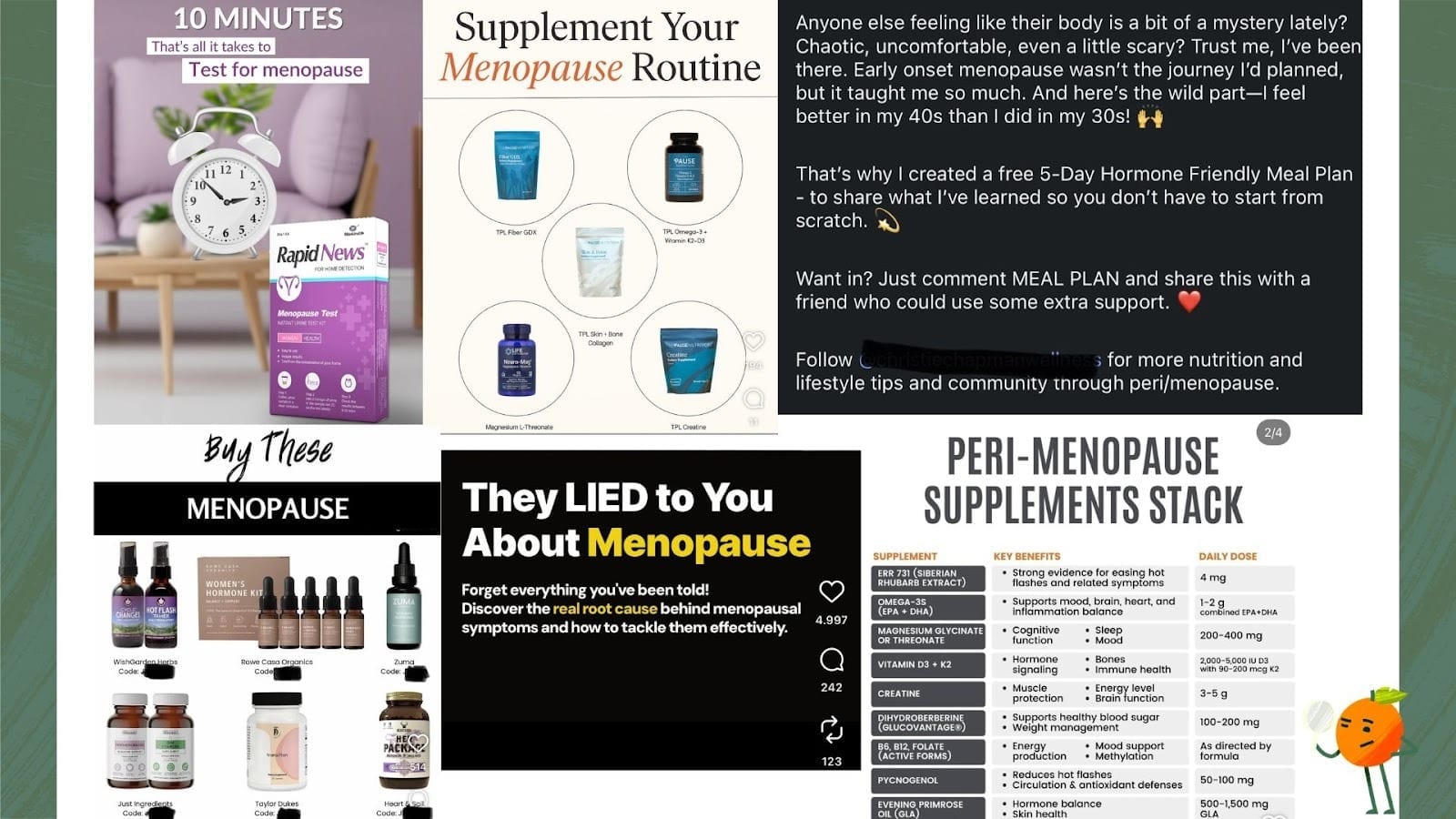
A quick scroll through Instagram shows how menopause is framed in everyday digital life. Posts tagged #menopause or #perimenopause often feature smiling or confident women sharing “exactly what to do if in perimenopause", “the food hacks for menopause” or “the supplement that changed my (their) life.” Short-form videos mix personal anecdotes with discount codes for meal plans, testing kits or online courses. The tone is frequently upbeat and solution-oriented, emphasising optimisation, empowerment and control. In some other cases, it is ‘doctors’ (not always with the clearest qualifications) lashing out against HRT or advocating for specific supplements.
Dietary advice is particularly prominent, from anti-inflammatory eating plans and supplement ‘regimes’ promising to ease hot flushes. In fact, an analysis of #menopause posts on Instagram found that the most common themes were weight loss/fitness and hormones, with complementary and integrative health and advertising (including supplements and diet advice) heavily represented (source). The picture that emerges seems to be less of a supportive community and more of a marketplace, where symptoms become selling opportunities.

This dynamic has begun to attract research attention. A recent study of Instagram posts and interviews with Brazilian “healthcare influencers” showed how social media feeds create over‑positive hype around menopause, actively filtering out fear, grief or anger in favour of upbeat, motivational content. Within these “affective atmospheres,” women are subtly invited to become “responsible menopause consumers” who research, buy and try different solutions. Though at first sight this can look supportive, it can also shift (full) responsibility onto individual women and signal that, if a woman is still struggling, it is because she has perhaps not tried enough solutions (source). The researchers also point to negative consequences of these digital health spaces, including consumers prescribing treatments to each other and a lack of checks on the reliability of the information shared.
“Also, even if unplanned, healthcare influencers maintain an over-positive hype around menopause as they block negative effects to protect themselves (...) The result is an over-positive atmosphere that, while comforting and helping some women, may exclude others (...) such as those who do not have the financial means to acquire promoted services and products (...) or those who do not identify themselves as belonging to the group of successful women dealing with menopause (...) This atmosphere introduces some negative consequences, such as a lack of control within followers’ exchanges and (...) from some healthcare influencers’ information, which may lead to internalisation of successful solutions that are not a one-size-fits-all.” Excerpt from Schneider, A. et.al. (2025)
Personal belief vs. clinical evidence: why the difference matters
Another recent analysis of YouTube videos comparing menopause influencers and medical professionals found that both groups sound very sure of themselves, but for different reasons. Influencers lean on phrases like “I think,” “I believe”, and “from my experience,” blending personal stories with advice to build emotional closeness and solidarity. Doctors, by contrast, anchor their claims in “studies show” or “guidelines recommend,” projecting authority through external evidence. The study warns that this belief‑based certainty from influencers, wrapped in intimate storytelling, can make health claims about menopause treatments feel trustworthy even when they are not grounded in scientific evidence (source).

This is especially true in the nutrition space, where supplements, functional foods and dietary programmes marketed at menopausal women proliferate with little scrutiny of the evidence behind their claims. Taken together, the hype that encourages women to consume their way through menopause and influencers’ highly persuasive, belief‑driven style of communication create fertile ground for misinformation, and for commercial actors who profit from it.
Where social media genuinely helps, and where it falls short
It would be unfair, however, to frame social media purely as a vehicle for misinformation and commerce. For many women, online communities have been the space where they have found a community navigating menopause. Forums, Facebook groups and Instagram accounts have helped break the silence around menopause, allowing women to share symptoms and experiences and arrive at medical appointments better informed and more confident. Peer support, even when imperfect, can fill a gap that healthcare systems have struggled to close. Social media has also allowed for activism and education strategies to disseminate information on menopause and to inform research on what topics concern those living with menopause (source). The challenge is not the conversation itself, but who is steering it and to what end.
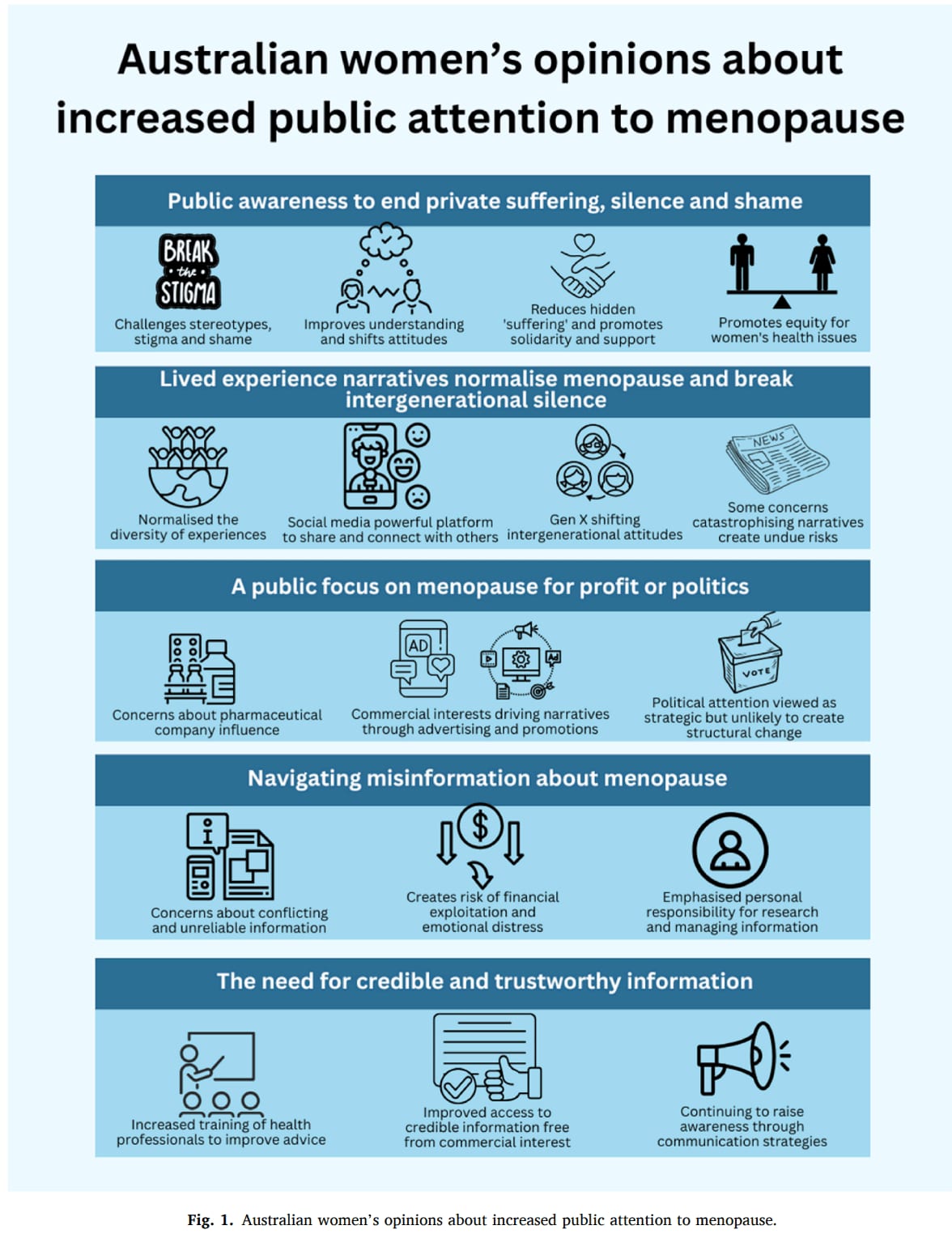
Researchers, the medical community and advocates have raised their voices to warn about the potential (economic, emotional) risk that aggressive menopause-marketing strategies in the quest for profit and the flood of (mis)information online can bring (source, source, source, source). Better information environments are urgently needed for all those experiencing or approaching menopause. Public education campaigns, better regulation of products and health claims, including the supplements and functional foods heavily marketed at menopausal women, and accessible evidence‑based guidelines are among the strategies that could help build more trustworthy and supportive environments for women in menopause. In any case, the burden of navigating a noisy, often profit-driven information landscape should not fall on women looking for answers; this is a matter that governments, international platforms and the medical community should steer, and not those whose main goal is to gain profit.

Independent fact-checking, funded by readers like you.
Misinformation is a growing threat to our health and planet. At foodfacts.org, we're dedicated to exposing the truth behind misleading food narratives. But we can't do it without your support.
Sources:
- Orgad, et.al., (2023) The menopause moment: The rising visibility of ‘the change’ in UK news coverage
- Hickey, M, et.al., (2024) An empowerment model for managing menopause
- Van Poucke, M. (2025) Negotiating the maze of menopause misinformation: A comparative analysis of stance in health influencer versus medical professional discourse
- BMJ Group. (2025) Menopause misinformation is harming care, warn experts
- Morgan, A. et.al., (2021) #Menopause on Instagram: a mixed-methods study
- Schneider, A. et.al., (2025) Bytes of affect: unveiling the emergence of the responsible menopause consumer on social media
- Thomas, S. et.al., (2025) “Menopause is not a dirty word.” Australian women's opinions about increased public attention to menopause
- Weiss, R. (2023) Menopause and social media: Pros and cons for the general public
- Thomas, S & Hickey, M. (2026) The ‘hot flush gold rush’: how women feel about being flooded with menopause marketing



foodfacts.org is an independent non-profit fact-checking platform dedicated to exposing misinformation in the food industry. We provide transparent, science-based insights on nutrition, health, and environmental impacts, empowering consumers to make informed choices for a healthier society and planet.






.svg)


.svg)

