
.avif)




Sensational headlines say plant-based meats harm your heart — but do they reflect what the study actually found?


On April 8, 2024, a new study was published in The American Journal of Clinical Nutrition, comparing the effects of plant-based and animal-based meat products on cardiometabolic health. Many news outlets have since published reports on these findings, with sensational headlines claiming that plant-based meats are bad for you.
Our analysis aims to review recurrent claims made in several news articles reporting on this study about the health effects of plant-based meats.



In summary, the study reported by the media outlets does not show that plant-based meats increase the risk of diabetes or heart disease. They also didn’t find that plant-based meats offer clear cardiovascular benefits. Awareness of the variety of plant-based alternative products is crucial for making informed choices.
Meat alternatives are becoming increasingly popular as people look for more environmentally friendly and ethical dietary choices. However, there’s a lot of conflicting information online about their impact on health. In this article, we clarify common claims to help you make informed choices about these products.


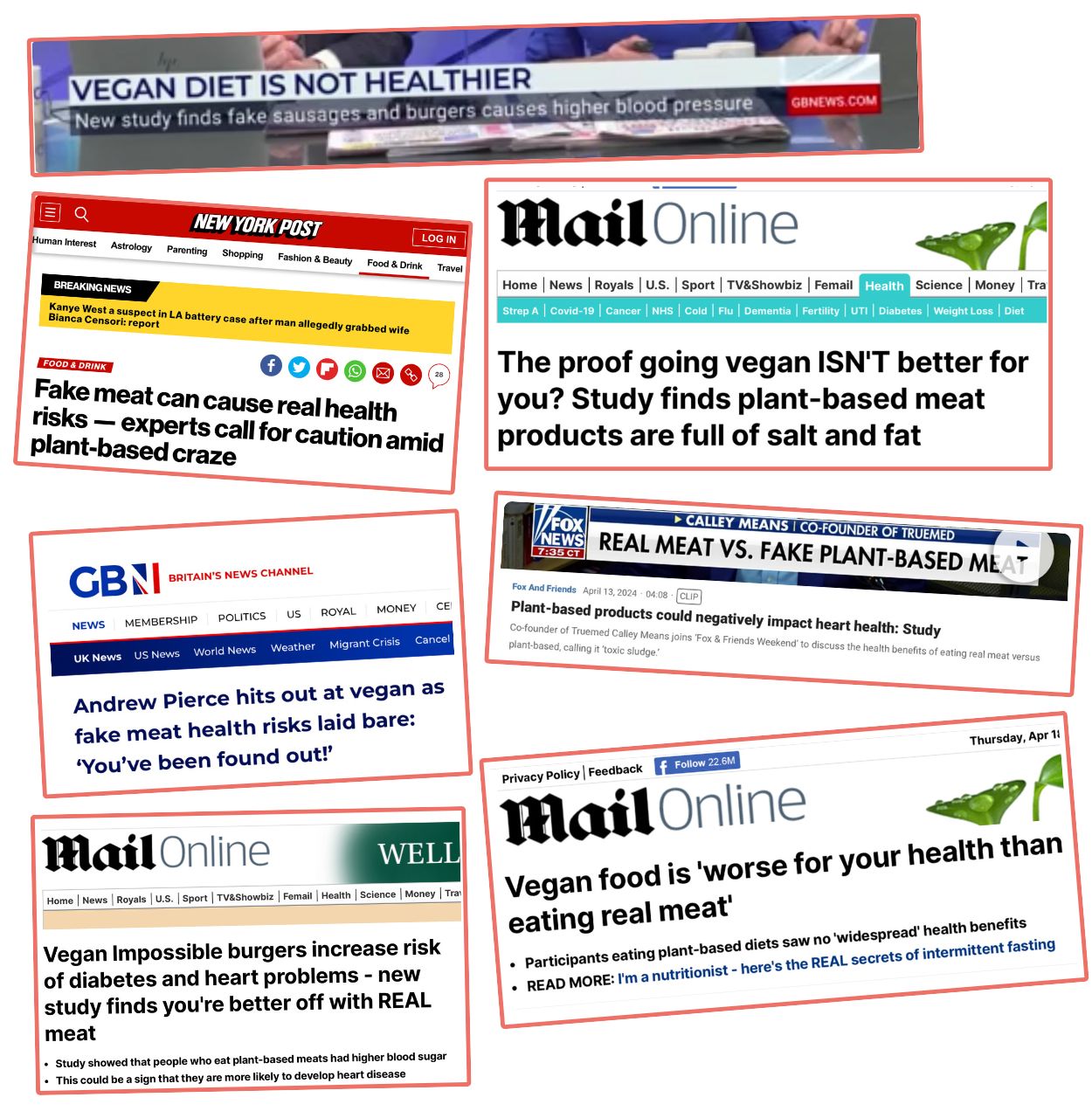
These articles categorise plant-based meats as unhealthy by making the following claims:
- 1 - Plant-based meats can increase your risk of diabetes…
- 2 - … they can raise your risk of heart problems, too.
- 3- Therefore, they aren’t healthier than animal-based meats.
- 4- Some then conclude that going vegan is not as healthy as consuming animal products.
Let's break down these claims. Firstly, what was the study which the above articles are reporting on, leading to those claims? The study was an 8-week Randomized-Controlled Trial (RCT) that included 89 people at high risk of type 2 diabetes. They were randomly assigned to consume either six types of Animal-Based (AB) meat or Plant-Based (PB) meat and provided with the test foods every 3 days.
Claim 1: “Plant-based meats increase the risk of developing diabetes."
Many of the media articles written based on this study claim meat alternatives raise the risk of diabetes. While no significant differences were found in fasting blood glucose, insulin, or HOMA-IR (insulin resistance) between the two groups, the blood sugar levels of participants who followed an animal-based meat diet (ABMD) had more time within the healthy range of glucose levels. In the ABMD group, the median time within this healthy range was 94.1%, while in the plant-based meat diet (PBMD) group, it was 86.5%.
It’s a stretch to claim that these results show meat alternatives increase the risk of diabetes:
A portion of participants volunteered to wear CGMs and those in the meat group had a little more time within a specific range of glucose levels. This is likely because those in the Plant-Based Meat Diet group had slightly larger rises in glucose after meals due to the higher carb content of the Plant-Based meats, but it came right back down afterwards, which is what should happen. It’s also not clear how informative this data even is for people without type 2 diabetes, and both groups were well above the target of >70% set for those with type 2 diabetes. Suggesting that the meat eaters had a lower risk of “full-blown diabetes” based on this is a stretch.

According to The Daily Mail, the concerns regarding an increased risk of diabetes are supported by previous research conducted in Poznań. Yet, they did not reference the study in the article. One study from Poznań University of Medical Sciences compared fast food meals from plant- and animal-based products. However, as it focuses on menus from fast-food restaurants, it doesn’t address the health effects of incorporating plant-based meats into one’s diet.
Additionally, a 2024 study published in the journal The Lancet Regional Health–Europe, found that plant-based alternatives (milk and meat combined) were associated with lower risk of developing type 2 diabetes.
Claim 2: "Plant-based products could negatively impact heart health.”
Specific plant-based meat alternatives can contain high salt levels and are heavily processed. The media often use this to suggest that eating these products could increase the risk of heart problems. For example, “spikes” in sodium intake among “fake meat eaters” are quoted by The Daily Mail, alongside a lack of improvement in blood pressure.
Several factors can increase the risk of developing heart disease, including diabetes, high LDL cholesterol, and high blood pressure. In this study, there were no significant effects on the lipid profile (including LDL cholesterol) between the animal-based and plant-based groups.
The claim that plant-based diets could negatively affect heart health partially stems from the interpretation of findings on blood pressure. For example, The Daily Mail wrote “‘modest improvements’ in blood pressure were noted in the meat-eaters but not those on a plant-based diet.” These modest improvements concerned nocturnal systolic and diastolic blood pressure dip. However, the American Heart Association and the American College of Cardiology do not count these nocturnal blood pressure changes as significant as health risks, as noted in the study. The study also found that those following a plant-based meat diet (PBMD) had lower diastolic blood pressure (DBP) than the animal-based meat group, which doesn’t appear in The Daily Mail’s coverage.
Overall, the results do not suggest that plant-based meats increase the risk of heart problems.
Additionally, a recent review of studies examining the impacts of plant-based meat alternatives (PBMAs) on heart health found that the evidence supports the idea that replacing meat with PBMAs is likely a more heart-healthy choice. However, more long-term studies assessing the risk of having a heart attack or stroke amongst people who regularly consume PBMAs would support more robust conclusions about these foods.
Claim 3: “Plant-based meats aren’t healthier than the products they aim to replace."
The available data comparing animal-based and plant-based alternatives does not suggest that plant-based meats are “worse for your health.” This is a broad claim that requires further evidence.
The SWAP-MEAT study compared the effects of plant and animal meat products. The results suggest that plant meats offer some heart health advantages, as they found LDL-cholesterol concentrations and body weight were lower when consuming plant-based meats. Despite this, the more recent study found few differences between the two diets; the 8-week plant diet didn’t show widespread cardiometabolic health benefits compared with a corresponding meat-based diet, which is what seems to have led to headlines stating that PBMDs are “worse for your health.” This does not mean that we should dismiss either study, or that plant meats are worse for you; it just means we have some mixed results so far.
We also have evidence to suggest a link between red and processed meat consumption and increased risks of diabetes and heart disease, suggesting healthier alternatives could exist. A recent review of 93 studies concluded that carefully selected, specific plant-based alternatives have the potential to be healthier and nutrient-rich alternatives to animal-based foods. There is a vast diversity in the available meat alternatives, so it’s therefore essential to know how to select plant-based options:
While PBMAs tend to provide healthier nutritional profiles than meat, on average, the different products that are available can still vary substantially in their profiles, so it’s important to read nutritional labels, paying particular attention to the saturated fat content, if you’re aiming for healthier options.
Claim 4: A “vegan diet is not healthier.”
Such headlines have the potential to be misleading because they conflate “vegan food” and “vegan diets” with a few “ultra-processed substitutes,” which constitute a small proportion of what vegan food is. Research highlights that a healthy plant-based diet is associated with better health outcomes, whereas an unhealthy plant-based diet is associated with worse health outcomes. The evidence is particularly compelling when it comes to cardiovascular health.
Some media outlets have misrepresented this and similar studies by overlooking that plant-based meat typically makes up only a small part of a plant-based diet. In a trial, it’s necessary for the food being studied to account for a significant portion of the participants' calorie intake; otherwise, the results could be inconclusive. However, this does not mean that plant-based meats are intended to replace meat in a one-to-one ratio based on the quantities people currently consume. Instead, these products can serve as a helpful transition tool toward plant-based diets, alongside a greater emphasis on whole plant protein sources.
The bottom line
Plant-based meats offer a practical way to transition to a more plant-centered diet. They can be incorporated as part of a balanced, healthy diet that favours whole foods. Sensational headlines tend to oversimplify issues, which can, in the long run, hinder the transition towards plant-centred diets.
Independent fact-checking, funded by readers like you.
Misinformation is a growing threat to our health and planet. At foodfacts.org, we're dedicated to exposing the truth behind misleading food narratives. But we can't do it without your support.
Sources
Crimarco, A., et al. (2020). A randomized crossover trial on the effect of plant-based compared with animal-based meat on trimethylamine-N-oxide and cardiovascular disease risk factors in generally healthy adults: Study With Appetizing Plantfood-Meat Eating Alternative Trial (SWAP-MEAT). https://doi.org/10.1093/ajcn/nqaa203
Dicken, S. (2024). Food consumption by degree of food processing and risk of type 2 diabetes mellitus: a prospective cohort analysis of the European Prospective Investigation into Cancer and Nutrition (EPIC). DOI: 10.1016/j.lanepe.2024.101043
Espinosa, S.N., (2024). Mapping the evidence of novel plant-based foods: a systematic review of nutritional, health, and environmental impacts in high-income countries. https://doi.org/10.1093/nutrit/nuae031
Gu, X.m et al. (2023). Red meat intake and risk of type 2 diabetes in a prospective cohort study of United States females and males.
Heidarzadeh-Esfahani, N., et al. (2024). Association of plant-based dietary patterns with the risk of type 2 diabetes mellitus using cross-sectional results from RaNCD cohort. https://doi.org/10.1038/s41598-024-52946-z
Kamiński, M., et al. (2024). Nutrient composition of plant-based fast-food meals and their omnivore counterparts: A cross-sectional analysis of e-menus. https://doi.org/10.1016/j.nut.2023.112323
Nagra, M., et al. (2024). Animal vs Plant-Based Meat: A Hearty Debate. https://doi.org/10.1016/j.cjca.2023.11.005
Satija, A., et al. (2018). Plant-based diets and cardiovascular health. https://doi.org/10.1016/j.tcm.2018.02.004
Toh, D.W.K., et al. **(2024). Plant-Based Meat Analogs and Their Effects on Cardiometabolic Health: An 8-Week Randomized Controlled Trial Comparing Plant-Based Meat Analogs With Their Corresponding Animal-Based Foods.
Fox News:
https://www.foxnews.com/video/6350868150112
GB News:
https://www.gbnews.com/news/andrew-pierce-hits-out-vegan-meat-health-risks-laid-bare
NY Post:
https://nypost.com/2024/04/12/lifestyle/plant-based-fake-meats-can-cause-real-health-risks-study/
The Daily Mail:
https://www.dailymail.co.uk/health/article-13313439/Vegan-food-worse-health-eating-real-meat.html



foodfacts.org is an independent non-profit fact-checking platform dedicated to exposing misinformation in the food industry. We provide transparent, science-based insights on nutrition, health, and environmental impacts, empowering consumers to make informed choices for a healthier society and planet.






.svg)


.svg)

