




How EU farming subsidies have long favoured meat and dairy — and what the evidence suggests needs to change before 2028




A new report from food systems charity Foodrise reveals, for the first time, the precise breakdown of EU Common Agricultural Policy (CAP) subsidies by food type. The findings make for uncomfortable reading. Beef and lamb received an estimated 580 times more public money than legumes in 2020. The question now is whether the EU will use the upcoming 2028–2034 CAP negotiations to change course.
What is the EU Common Agricultural Policy, and how does it shape what we eat?
The Common Agricultural Policy is the single largest allocation in the EU budget, worth tens of billions of euros each year. It funds farmers across all 27 member states and shapes what gets grown, what gets promoted, and ultimately, what ends up on European plates. The CAP for 2028–2034 is currently in its decision-making phase, making this a pivotal moment for EU food policy.
How EU subsidies break down by food type, and what the data reveals
The figures in CAP at the Crossroads, published by Foodrise in February 2026, are striking:
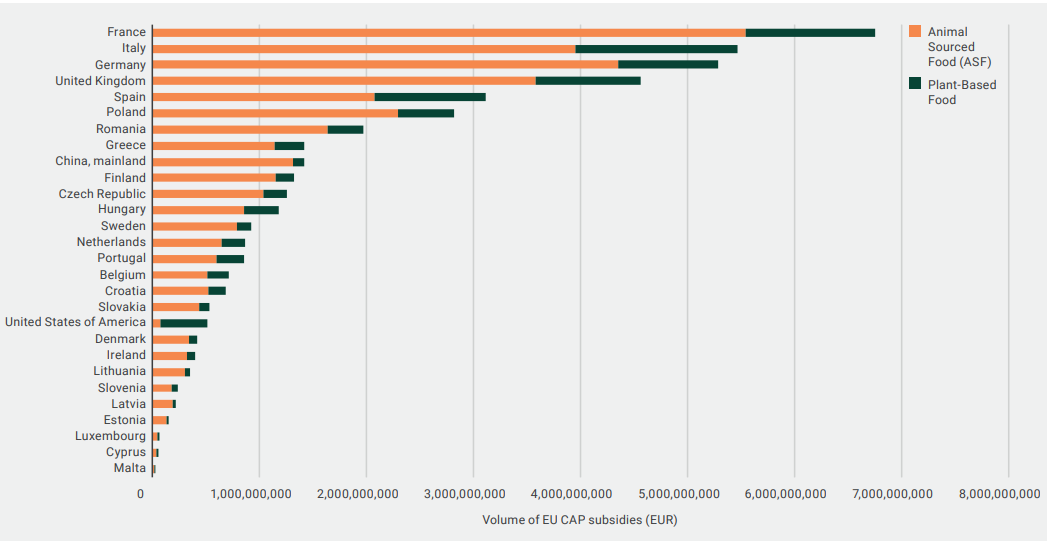
- In 2020, an estimated 77% of CAP subsidies (~€39 billion) went to animal-sourced foods — over three times more than the €11.6 billion directed to plant-based foods
- Beef and lamb received an estimated 580 times more in subsidies than legumes (€8 billion vs. €14 million)
- Dairy received an estimated 554 times more than nuts and seeds (€16 billion vs. €29 million)
- Meat and dairy as a whole received over 10 times more than fruit and vegetable production, and around 16 times more than cereal production
- The €39 billion directed to animal-sourced foods alone made up nearly a quarter (23%) of the EU's entire 2020 budget of €168.7 billion
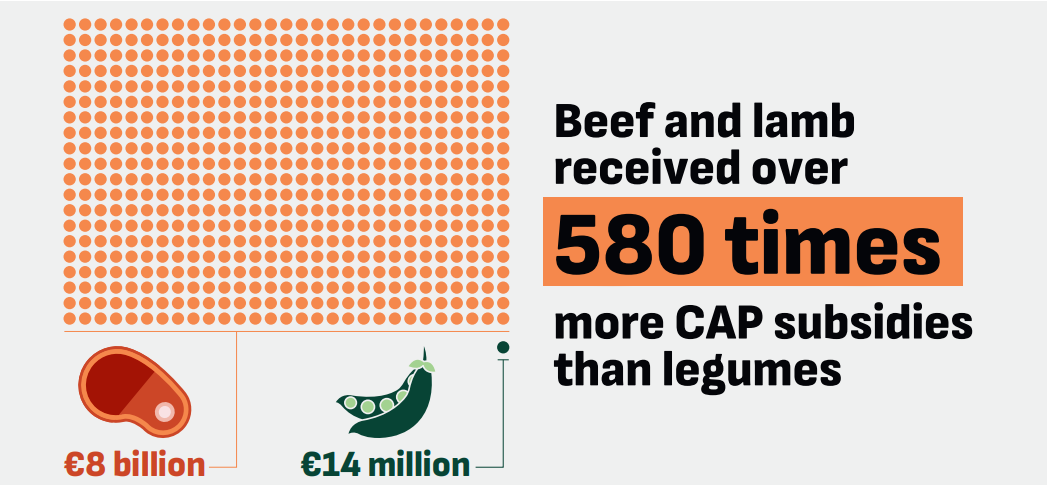
That imbalance doesn't exist in a vacuum. As the report notes, these disparities largely reflect the fact that CAP payments have historically been allocated on an area basis, and animal agriculture — including the cropland used to grow feed — occupies around 71% of EU agricultural land. An estimated 63% of Europe's cropland is used to grow animal feed rather than food for direct human consumption.
How current EU agricultural spending has been linked to environmental and public health costs
Animal-sourced foods are estimated to account for between 81–86% of the embodied greenhouse gas emissions from EU food production, while supplying only around 32% of the calories and 64% of the protein consumed across the bloc. By comparison, legumes — which are good for soil nitrogen, require far less land per gram of protein, and are featured in most European dietary guidelines — received just €14 million in subsidies.
The WHO classifies processed meat as a Group 1 carcinogen and red meat as Group 2A. Diet-related disease linked to animal-sourced food consumption cost EU health systems an estimated €452 billion in 2022. Agriculture was also responsible for 93.4% of the EU's ammonia air pollution in 2022, with livestock alone accounting for 66.1% — a leading driver of fine particulate matter (PM2.5) pollution, estimated to cause around 239,000 premature deaths in EU-27 countries that year.
How meat and dairy industry lobbying has been linked to stalled EU food policy reforms
The report also documents the role of industry lobbying in shaping — and stalling — EU policy. Meat and dairy industries spent an estimated USD $18 million lobbying the EU between 2014–2020. Language in a proposed reform of the CAP promotion programme, which had originally referenced alignment with the EU's Beating Cancer Plan and encouraged a shift to "a more plant-based diet, with less red and processed meat," was removed from subsequent drafts following industry lobbying. Specific emissions targets for agriculture were similarly scrapped or weakened. The pattern has similarities with how the fossil fuel sector has historically sought to slow energy transition policy.
How rebalancing the CAP could affect emissions, public health, and agricultural incomes
Shifting EU diets closer to the EAT-Lancet Planetary Health Diet — a plant-rich diet with moderate amounts of animal products — would, according to the studies cited in the report, have measurable downstream effects:
- Agricultural incomes in the EU could increase by an average of 5.4% by 2030 and 36.2% by 2050
- Adoption of the Planetary Health Diet in 54 high-income countries could reduce agricultural production emissions by an estimated 61%
- Up to 1,963 premature deaths and 1,039 cancers per 100 people in Europe could potentially be prevented in a 20-year risk period through dietary shifts aligned with the Planetary Health Diet
- A shift towards plant-based diets could reduce EU fertiliser use by nearly a quarter (23.4%) and reduce nitrogen emissions by an estimated 40% if meat and dairy consumption were halved
The European Plant-Based Food and Beverage Market is projected to grow by over 50% by 2030, and alternative proteins are estimated to have the potential to add €111 billion per year to the EU economy by 2040. Denmark's Plant-Based Action Plan, which includes grants, public procurement standards, and crop diversification incentives, is cited in the report as a working model for how member states can begin to shift the dial.

Six policy changes that could rebalance EU farming subsidies, and why reformers say now is the moment
The Foodrise report makes several policy recommendations to EU decision-makers ahead of CAP negotiations:
- Introduce a Plant-Based Action Plan covering the whole supply chain, from producer to consumer
- Create an Agri-food Just Transition Fund outside the CAP, to support livestock farmers through diversification, reskilling and voluntary buy-out schemes
- End EU funding for the promotion and marketing of meat and dairy immediately
- Rebalance CAP payments to primarily support plant-based food production for direct human consumption
- Reform CAP subsidies for livestock to be conditional on stocking density limits and commitments to reduce livestock numbers
The 2024 Strategic Dialogue on the Future of EU Agriculture, which was unanimously adopted by farming groups, civil society, businesses and academics, concluded that "a shift towards balanced diets that are healthier and more sustainable is essential". The EU's own Group of Chief Scientific Advisors has made similar calls, as have the World Bank and the European Court of Auditors. The momentum is there. Whether EU policymakers act on it in the 2028–2034 CAP cycle is the central question this report puts on the table.

Independent fact-checking, funded by readers like you.
Misinformation is a growing threat to our health and planet. At foodfacts.org, we're dedicated to exposing the truth behind misleading food narratives. But we can't do it without your support.



foodfacts.org is an independent non-profit fact-checking platform dedicated to exposing misinformation in the food industry. We provide transparent, science-based insights on nutrition, health, and environmental impacts, empowering consumers to make informed choices for a healthier society and planet.






.svg)


.svg)

