




Untangling microwave myths: what physics actually says about how they work


This fact-check is slightly different from others on Foodfacts.org. The claims we’re addressing come from a popular video by ‘Gubba Homestead,’ which presents microwaves as a hidden danger using arguments that resemble common conspiracy-style narratives. These claims can sound convincing because they use scientific terms in confusing ways.
We’ll go claim by claim, stepping back to break down the logic behind each claim, in a way that makes sense without pre-existing extensive knowledge of physics or chemistry. And if you wish to dig even deeper, look out for our Expert Weigh-In sections, which include direct insights from a physicist who analysed these claims.



The rumour of a Soviet ban has been disproved by historical records and expert testimony. Physics shows that microwave photons don’t have nearly enough energy to break chemical bonds or ionise atoms. Cooking in a microwave works the same way as other methods: it raises molecular motion, denatures proteins normally, and often preserves more nutrients thanks to shorter cooking times.
These claims spread because they sound scientific while playing on distrust of technology. Left unchallenged, they fuel conspiracy-style thinking and create confusion about everyday kitchen tools. Breaking them down shows how science and evidence give us safer, clearer answers than instinct or rumour.


Claim 1: Microwaves were banned in the Soviet Union because they were dangerous.
The video says Soviet scientists discovered microwaves were so harmful that the USSR banned them outright in the 1970s.
Step 1. What would banning them imply?
To evaluate the claim that the USSR banned microwaves because they were dangerous, we need to consider what such a ban would imply: either confirmed evidence of harm, or precautionary measures based on perceived risks.
This hasn’t happened, and it’s important to note that the studies which Gubba claims led to a microwaves ban are not listed. On the other hand, this review of studies on microwaves safety concludes that “the best available evidence supports that the use of microwave cooking resulted in foods with safety and nutrient quality similar to those cooked by conventional methods, provided that the consumers followed the given instructions.”
No credible source confirms any formal government policy banning microwaves in the USSR.
Step 2. What actually happened?
There’s no evidence that such a ban ever happened. Conspiracy theories often rely on the idea that powerful groups hide important truths from the public, so simply pointing out the lack of records may not feel convincing on its own.
But in this case, first-hand historical testimonies and lived experience contradict the claim: from renowned engineers providing primary evidence that microwave ovens were not only available, but researched, developed and sold in the USSR during the 1970s and 1980s (including ads for Russian-developed microwave ovens), to Reddit threads from Russian users recalling usage of microwave ovens at the time they were supposedly banned.
The ban story survives online because it sounds dramatic, not because it reflects reality.
Claim 2: Microwaves violently agitate water molecules in a way that scrambles their structure, leaving you with something “energetically incoherent”
In other words, the video suggests microwaves don’t just warm food, they shake water molecules so violently that the molecules themselves become “scrambled” and lose their chemistry.
Step 1. What is water made of?
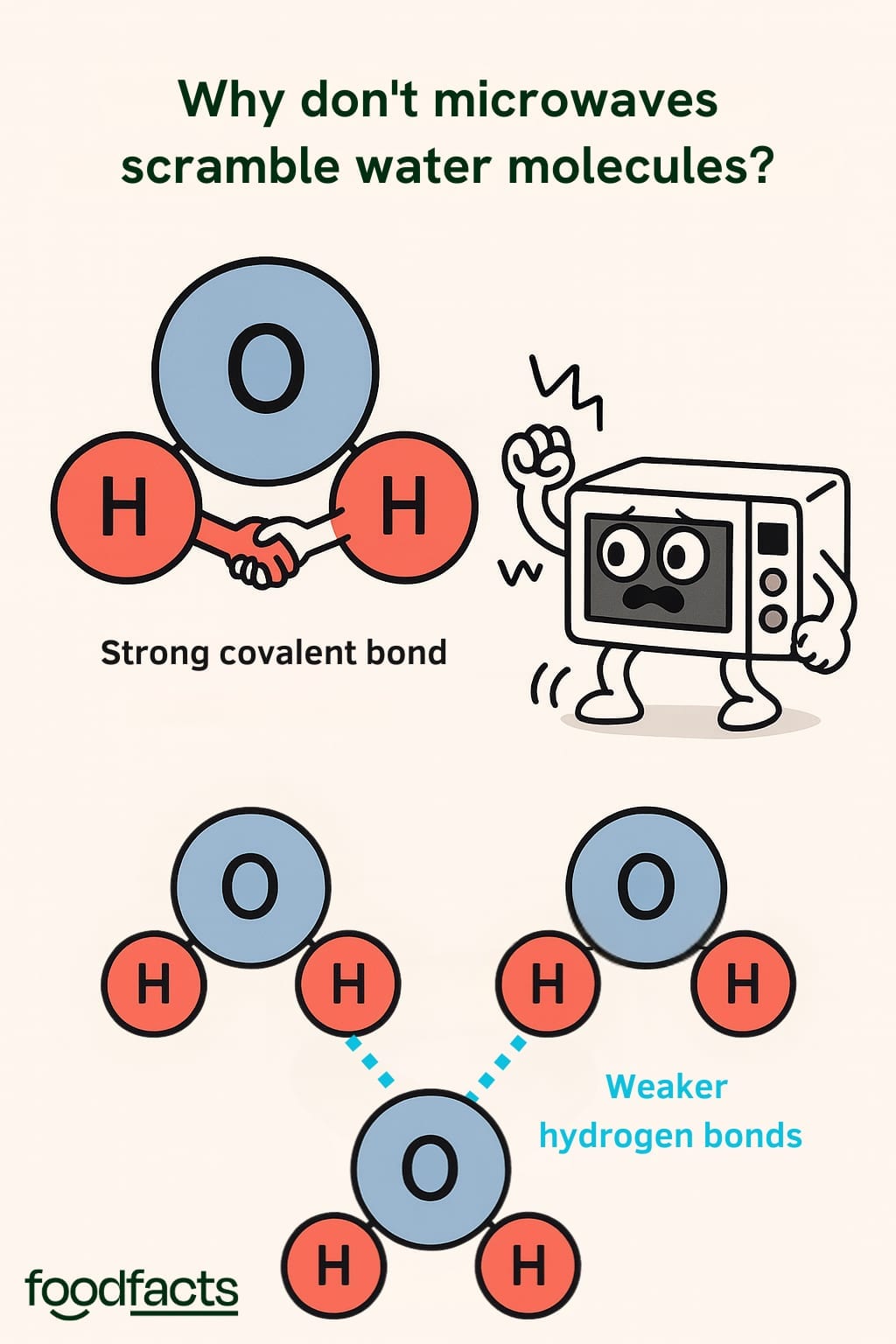
To fully understand this claim, we need to step back and look at what water is made of. Water is H₂O: one oxygen atom strongly bonded to two hydrogen atoms. Each individual molecule’s oxygen and hydrogens are bonded by covalent bonds.
Changing the structure of water as is claimed would involve either breaking the water molecule’s covalent bonds apart, creating hydrogen and oxygen; or ionising the molecule, which means adding or removing an electron(s).
Why the claim doesn’t add up
Microwave photons don’t carry enough energy, required by the principles of quantum mechanics, to break covalent bonds or to strip electrons. Our following Expert Weigh-Ins provide detailed information to explain this:
For a residential microwave oven, the microwaves used are of a nominal frequency of 2.45 Gigahertz, which translates to about a 12.2 cm wavelength.
Energy would then come out to be E = 1.62 x 10^-27 Joules. Converted to an easier unit of measurement, this value is about 1.0 electronvolt.
The minimum amount of energy needed to break a water molecule into hydrogen and oxygen is 7.7 electronvolt of energy.
We also know from quantum mechanics that energy is quantized and can only be absorbed in discrete packets. In other words, if a "photon" does not have energy equal to the energy it takes to break the bond between hydrogen and oxygen, it will not be absorbed.
So we can obviously see that the amount of energy in microwave radiation is much lower than than the energy required to break the covalent bond between hydrogen and oxygen. So the chemistry of water will not change.

So what do microwaves actually do?
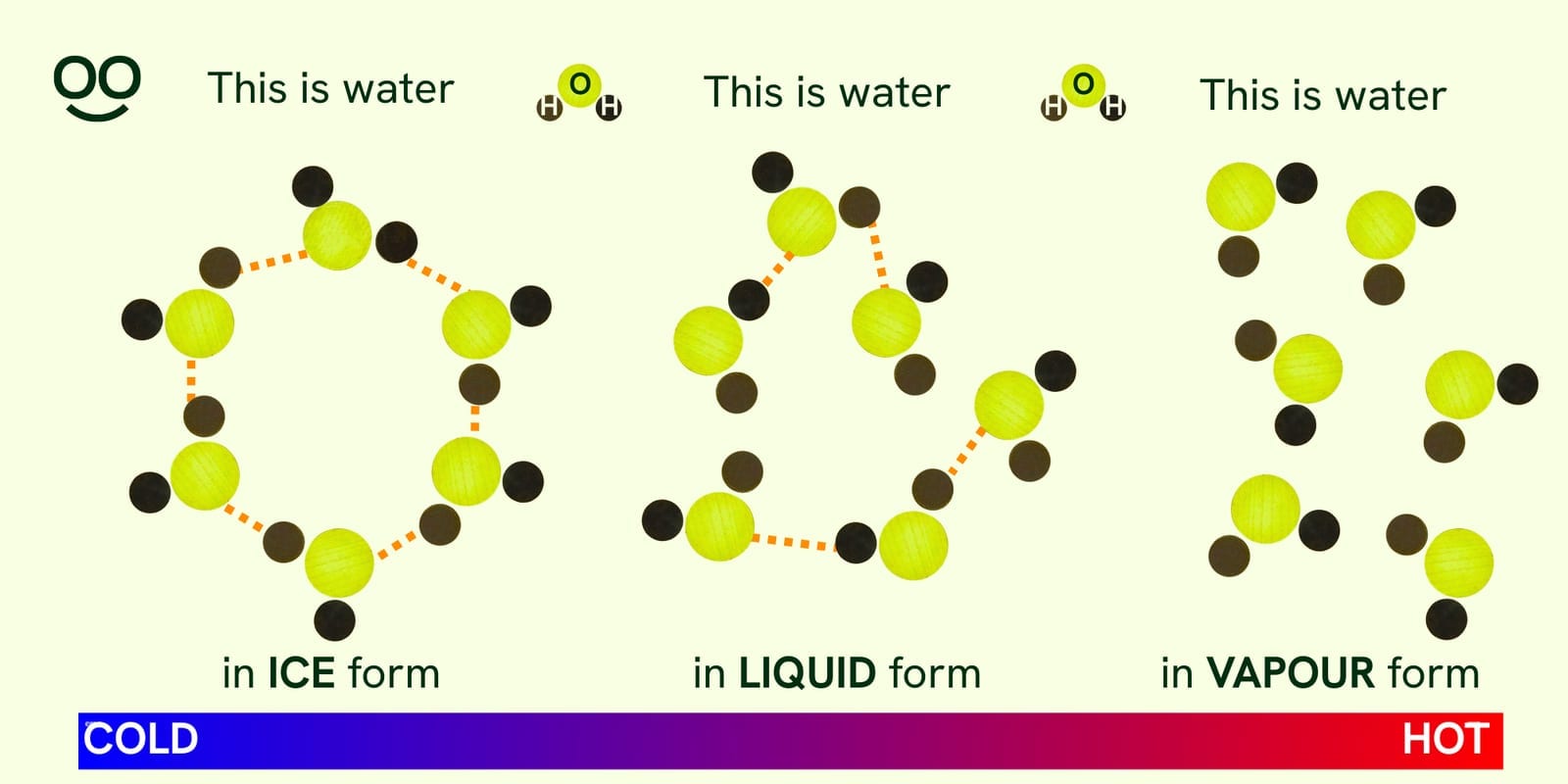
We have seen that microwaves don’t have enough energy to break the covalent bonds that link the oxygen atom to each of the two hydrogen atoms within single water molecules. Instead, what microwave heating does is to loosen the weaker hydrogen bonds between separate water molecules.
But this does not affect the structure of water. Those hydrogen bonds loosen and strengthen naturally as water changes state: solid ice (strong hydrogen bonds), liquid (weaker bonds), and steam (almost no bonding). When water turns to steam, hydrogen bonds weaken and break. That’s just heating, no matter the method, and it’s reversible when it cools.
Secondly, microwaves are a form of non-ionising radiation. Essentially, microwaves do not have enough energy to remove an electron from an atom and cause ions.
For example, the ionising energy of one hydrogen atom is 13.6 electronvolt, and the one for oxygen is 12.03 eV. This means that microwaves leave no lasting effect on the food.
Even though the method of heating the food is different in microwave ovens vs heating the food on a fire or heat source, the principle is the same: heating something requires increasing the energy of vibration of the molecules. Unless you provide a large enough amount of energy in one photon, it will not lead to the breaking of atomic bonds which require a high amount of energy to break.
However, the energy is usually large enough to break or change the intermolecular bonds, such as hydrogen bonds, hence causing a change of state from liquid to vapour for example.
Step 2. What does heating do, and how do microwaves work?
Heating means adding energy so molecules vibrate faster, which we feel as higher temperature.
While a stove transfers heat from the outside in by conduction, a microwave directly targets water molecules within the food, spreading heat from inside out. Microwaves heat water by making the molecules wiggle faster, which raises the temperature.
So how does this work?
Microwaves are a form of electromagnetic energy made up of oscillating electric and magnetic fields. When these fields interact with polar molecules, molecules that have a positive side and a negative side, they cause them to rotate back and forth in step with the field. Water is a polar molecule, so when exposed to microwaves, its molecules oscillate rapidly. This motion increases their energy, which we experience as heat. All food contains water, and so this method of directly targeting water molecules is an effective way to heat up food.
Think of a water molecule as shaking a maraca. Shaking makes the beads rattle, just like microwaves make a water molecule jiggle. But shaking doesn’t smash the maracas apart. Similarly, microwaves heat food by jiggling a water molecule, they don’t break apart the bonds that make water, water.
Claim 3: Microwave heating changes food so much that your body doesn’t recognise it.
Gubba claims that “it's not just about nutrients being lost. It's about eating something your mitochondria don't even recognise.” Let’s step back to assess whether microwave heating affects food differently compared to other methods of cooking.
What does cooking normally do to food?
Cooking always affects food molecules. Proteins “denature”: this means they unfold and take new shapes. That’s why a raw egg turns from clear to white when heated (source). This denaturation process involves the same mechanisms as mentioned above, that is it affects the weaker hydrogen bonds between molecules, rather than the covalent bonds that make up primary structure.
Any form of cooking (steaming, boiling, roasting) changes the shape of proteins and the arrangement of molecules. That’s what cooking is. Proteins denature, starches soften, fats melt, water evaporates. These changes are not the same as creating a harmful or “foreign” substance for your body; they’re part of normal food preparation. In fact, denaturing proteins through cooking makes them easier for our digestive enzymes to break down (source).
What about nutrient loss?
Research shows that due to its heating efficiency and shorter cooking time, nutrient loss is less prevalent when food is heated up in microwave ovens, compared to other methods of cooking.
Again, the loss of vitamins is a natural effect of cooking. But on the plus side, cooking also helps to destroy harmful pathogens.
Bottom line
From a physics perspective, microwaves don’t do anything mystical to your food. Cooking in a microwave and cooking on a stove both “boil down” to the same thing: increasing the vibrational energy of molecules. Microwaves just use a different route to get there, targeting water molecules directly. They heat it by exciting water molecules, just as other cooking methods raise temperature in different ways.
Why these conspiracy-style claims spread
Conspiracy theories often appeal to a general sense of distrust, particularly distrust of modern technology. They can be convincing because they work with topics that are inherently complex, then modify the science to sound plausible. In the case of microwaves, the idea taps into a natural instinct: trusting “older” ways of cooking over modern inventions.
But science moves us forward by helping us understand more, not less. With that understanding comes safety. The principles behind microwaves aren’t hidden away in some lab; physics and chemistry are taught in every school, giving us the tools to question extraordinary claims.
We have contacted Gubba Homestead and are awaiting a response.
Disclaimer
This fact-check is intended to provide information based on available scientific evidence. It should not be considered as medical advice. For personalised health guidance, consult with a qualified healthcare professional.
Independent fact-checking, funded by readers like you.
Misinformation is a growing threat to our health and planet. At foodfacts.org, we're dedicated to exposing the truth behind misleading food narratives. But we can't do it without your support.
Further reading
This article by FoodUnfolded is a great evidence-based resource to explore further myths surrounding microwaves (use of plastic, radiation concerns, etc.)
Sources
Okeke, C. et al. (2014). “Microwave Heating Applications in Food Processing.”
Osepchuk, J.M. “First-Hand:There Was No Ban on Microwave Ovens in the USSR.”
Blanco, A. et al. (2022). “Chapter 3 - Proteins.”
Britannica. “Denaturation”
Pelley, J.W. (2007). “Protein Structure and Function.”
BBC Science Focus. “Does microwaving food destroy its nutritional content?”
Klein, B.P. (1989). “Retention of nutrients in microwave-cooked foods.”


foodfacts.org is an independent non-profit fact-checking platform dedicated to exposing misinformation in the food industry. We provide transparent, science-based insights on nutrition, health, and environmental impacts, empowering consumers to make informed choices for a healthier society and planet.








.svg)


.svg)

