
Fact-Checking:
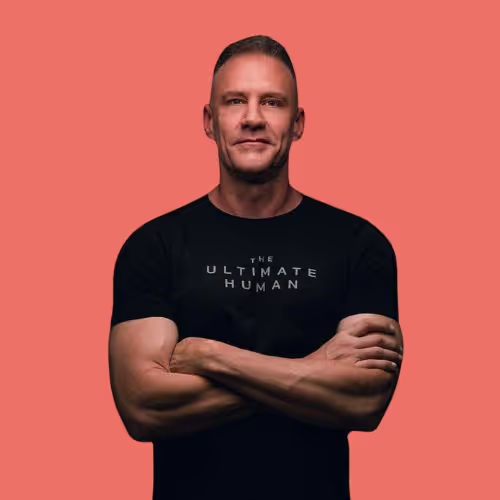
Gary Brecka
Gary Brecka is a US-based wellness influencer who describes himself as a "human biologist" and longevity expert, often grouped under the umbrella of biohacking.


Profession: Online wellness/longevity creator. Founder of the Ultimate Human brand (supplements, devices, VIP membership and podcast)
Credentials: BS in Biology (Frostburg State University); BS in Human Biology (National College of Chiropractic, now National University of Health Sciences). Former mortality analyst in the life insurance industry. No medical degree or clinical licence; he openly states he is not a physician or clinician.
Tagline: "Reveal what's really destroying your health"; self-described "human biologist" and biohacking/longevity expert
Gary Brecka is a US-based wellness influencer who describes himself as a "human biologist" and longevity expert, often grouped under the umbrella of biohacking.
Several medical professionals and science communicators have expressed concern that some of his advice, particularly around depression, folic acid, cardiovascular risk and pregnancy-related supplementation, is presented with a level of certainty that does not reflect the underlying evidence and could be risky if applied broadly without clinical supervision. While some of his high-level themes—such as the importance of sleep, movement, limiting highly processed foods —overlap with standard health guidance, the use of marketing language and absolutist framing is problematic. When health-related recommendations are broadly given by influencers without the required qualifications, it also means that there is no accountability should negative consequences occur.

F – Financial incentive
Is the message associated with revenue streams?
Brecka has built a commercial ecosystem around his Ultimate Human brand, combining a large social-media audience with a portfolio of tests, supplements and memberships marketed as tools to "reveal what's really destroying your health" and correct underlying deficiencies. Here are some examples:
- Branded Ultimate Human cold plunge systems, promoted and powered with Cold Life, priced in the mid-thousands of dollars for a home unit.
- HYDRO+ hydrogen-rich water systems, marketed as upgrading drinking water for health benefits.
- Gary-branded amino-acid and Ultimate Human supplements, typically around 30–70 USD per bottle depending on product and retailer.
Alongside these, a paid "VIP" membership is advertised at 97 USD per month (or 970 USD per year), offering access to Brecka's protocols, challenges and live sessions.
External providers also sell "Ultimate" methylation genetic tests and packages explicitly marketed as ideal for people who follow his approach, with tiered options ranging from about 279 GBP for lab-only results up to around 475 GBP for results plus a video consultation and personalised supplement list.
In many videos and interviews, Brecka begins with broadly accessible, free steps: better sleep, movement, sunlight, and reducing ultra-processed foods. But through his narrative he also describes methylation and deficiency testing as "one of the most overlooked things in all of modern medicine," and has said he thinks everybody should do a methylation gene test. Within that framing, the natural progression for followers who buy into the narrative is to move from free basics to paid genetic and biomarker testing, and from there to ongoing purchases of targeted supplements, water systems, cold-exposure equipment and membership access positioned as the route to "data-driven" longevity.
Take-away: A broad longevity and "biohacking" narrative is closely integrated with a commercial ecosystem of Ultimate Human tests, supplements, devices and memberships, where simple lifestyle advice often functions as a gateway into higher-priced, data-driven products pitched as instrumental for achieving true "optimal" health.
A – Authority signalling
How do they get perceived as sources of nutritional information?
What does "longevity expert" mean? Public profiles and conference biographies describe Brecka as a "human biologist," "biohacking and longevity expert," and a former mortality analyst for the life insurance industry who modelled risk and estimated time-to-death using medical and lifestyle data. Available information indicates he has two undergraduate degrees (biology and human biology) and no medical degree or recognised clinical qualification; a lot of his content however makes confident claims about the real cause of various diseases ("what's really destroying your health").
Use of scientific language and high-profile testimonies: Authority in his content is signalled less through formal research or clinical roles and more through a combination of scientific-sounding language, references to analysing large numbers of DNA profiles, and high-profile client anecdotes, including widely publicised work with UFC President Dana White and various athletes or public figures. Though he self-describes as a "researcher" in social media profiles, this does not appear to mean in the context of conducting peer-reviewed research or running clinical trials himself. This is important because it affects the way in which viewers might interpret marketing phrases like "Gary's proven protocols," which might mean that they have received positive feedback rather than scientifically proven to improve health and well-being independently of other factors.
Concern has also arisen when Brecka cited scientific papers to support his positions, however when checked, some of those references had nothing to do with the topics discussed. This makes it difficult for people without a scientific background to assess the reliability of claims on the basis that they appear to be supported by scientific sources.
Take-away: Brecka presents himself as a scientific and longevity expert based on undergraduate degrees, industry experience and high-profile client stories, while critics emphasise that while he is not a physician, some of his posts come across as confident public advice on complex medical topics.
C – Claims
What is the core messaging, and what is left out?
Core idea – methylation and root causes
Brecka's core message is that many common complaints (poor morning energy, weight gain, brain fog, low mood, chronic pain and more) "come down to" a "common hub," with methylation repeatedly presented as central. In one example, he states that methylation is "essentially nutrient deficiencies" and "one of the most overlooked things in all modern medicine," implying that a wide range of symptoms can largely be explained and fixed by identifying and correcting specific deficiencies via genetic and blood testing - which he promotes.
From idea to certainty – oversimplifying complex processes
Critics argue that this narrative blends plausible mechanisms, emerging science and personal anecdotes into a single explanatory story, while skipping over the variability of individual responses, the limits of current studies and the fact that many conditions he mentions are multifactorial. Because of the confidence in his delivery on complex medical topics, the solutions he promotes may sound more promising and more certain than the underlying evidence actually supports.
Anecdotes as evidence – the Dana White example
A key part of Brecka's appeal is the way high-profile stories are highlighted. One of the most widely shared examples is UFC president Dana White, whose dramatic weight loss, improved lab numbers and symptom changes are often presented as the result of following Brecka's programme. The transformation is certainly worth acknowledging, and the progress made credited to the individual.
What is not acknowledged is the basic uncertainty: someone who radically changes their lifestyle —improving diet quality, sleep, movement, alcohol intake and medical follow-up—could reasonably expect to feel and function better. The way the story is told invites viewers to attribute the transformation uniquely to Brecka's specific framework, rather than to the broader, well-supported lifestyle shifts that many clinicians are likely to recommend. That makes the anecdote compelling but not very informative about what, precisely, caused the improvement, or whether the same results would be likely for others with different circumstances.
Specific claim patterns highlighted by reviewers and health professionals
- Depression and serotonin. Science Feedback, an independent fact-checking organisation, has flagged several of Brecka's claims as misleading or false. In one review they examined a video in which he defines depression as an "inadequate supply of serotonin" and promotes gut focused supplements as a way to reverse it, in a way that might downplay some established treatments. Reviewers noted that current evidence describes depression as a complex, heterogeneous disorder influenced by multiple neurotransmitters, psychosocial factors and life events, and does not support explaining it solely through serotonin or a single gut-based mechanism. Other professionals, such as Doctor Mike (Mikhail Varshavski), have expressed concern over his seemingly outdated and overly narrow definition of depression.
- Folic acid, MTHFR and mental health. In other content, folic acid fortification or intake is linked to a wide range of mental health and neurodevelopmental problems, framed through MTHFR genetics. Genetic and nutrition commentators agree that MTHFR variants and folate status can matter for some people, but emphasise that evidence does not support blaming folic acid alone for conditions such as ADHD, OCD or anxiety, and that folic acid supplementation before and during early pregnancy consistently reduces neural tube defects —an intervention major public-health bodies still recommend. Experts in this area have warned that advising large audiences to avoid folic acid on the basis of such claims could carry serious, unacknowledged risks, particularly for people who might become or are pregnant.
- Cardiovascular risk and LDL cholesterol. In some appearances, Brecka has suggested that elevated LDL cholesterol on its own is not causally linked to heart disease, and that there is no evidence to support those links. Cardiovascular researchers counter, arguing that these statements ignore a large body of epidemiological, mechanistic and genetic evidence—including Mendelian randomisation studies—which consistently supports LDL as an independent causal risk factor, even though real-world risk also depends on other variables and lifelong exposure.
- "Biohacking" claims about water, salt, minerals and seed oils. Analyses by physicians describe him promoting hydrogen water, specific mineral-rich sea salts or, organic products or anti– seed-oil rules as levers for resolving a myriad of symptoms. While some of these preferences are unlikely to harm people who can afford them (such as drinking hydrogen water), they are often marketed without acknowledging limitations, or that many symptoms have multiple possible causes. In the case of sodium, for example, while he recommends adding a specific brand of salt to water, what does not get mentioned is that most people in Western countries already consume more sodium than recommended. Following this advice (given onlinewithout prior knowledge of individuals' diets or circumstances), some people could easily exceed recommended sodium intake, which could lead to negative consequences.
Take-away: Across topics, fact-checkers and clinicians see a recurring pattern: real physiological concepts and legitimate concerns about diet, pollution or ultra processed foods are woven into a simple, confident story in which complex conditions are traced back to a narrow set of "overlooked" mechanisms like methylation, and personalised protocols and anecdotes are presented with much more certainty than the current evidence base allows. The profile thus reflects a mix of broadly sensible lifestyle themes and more contentious claims, some of which could lead to dangerous consequences.
T – Tone
How is the information packaged, and what makes it persuasive?
Vague language with a scientific gloss
Phrases such as "sluggish mitochondria," "mineralising the body," or "feeling inflamed" help to make his discourse sound grounded in biology, even when the terms are not clearly defined or tied to measurable outcomes for the viewer. It is often unclear what, in practical terms, counts as a "sluggish" mitochondrion or a "mineralised" body. For example, many people already obtain sufficient minerals through their diet; the leap from that reality to a perceived need to "mineralise the body" further is not fully explained, but it is used within discussions about special branded salt or other products.
Why this tone is problematic
This confident tone, combined with suggestions of simple, direct cause-and-effect pathways, makes it harder to see where the limits of products or protocols might be. When multiple changes happen at once—diet, sleep, movement, supplements, tests—it becomes very difficult to tell what is actually driving any improvement in how someone feels. In that context, consumers may start to feel dependent on particular products or routines that may not be necessary, or may give more weight to an influencer's protocol than to advice from qualified health professionals, especially about potential long-term risks that are not immediately visible.
Another recurring pattern is the suggestion that Brecka has access to insights that mainstream experts have missed, often introduced with phrases such as "I want to show you something about stress that no one else will" or "we've been lied to about sodium." This is reinforced by selective correlations and false contrasts—such as implying that either red meat or sugar and seed oils must be the single culprit of the rise in chronic diseases—which can sound like common sense but do not accurately reflect how multiple factors interact.
Over time, those patterns can undermine trust in experts' conclusions, which can eventually lead people to distrust evidence-based guidelines. In turn, this reinforces the perception of influencers like Gary Brecka as the real 'experts', those who know what is "really destroying your health," and which products can fix it.
Take-away: Because many of the branded solutions are high-priced, this packaging can make "optimal" health seem like something that requires ongoing investment in specialised tests and premium tools. That perception risks overshadowing the fact that many of the most strongly evidence-based actions for improving health— better sleep, diet quality, physical activity, smoking cessation, moderating alcohol, and engaging with standard preventive care—are comparatively low-cost and widely accessible.
Disclaimer
FoodFACT profiles summarise public-facing claims and marketing alongside our analysis. Quotes, prices, and membership figures are taken from linked sources as viewed at the time and may change. This content is for information only and is not medical advice. See something wrong or outdated? Let us know and we'll update.








.svg)
